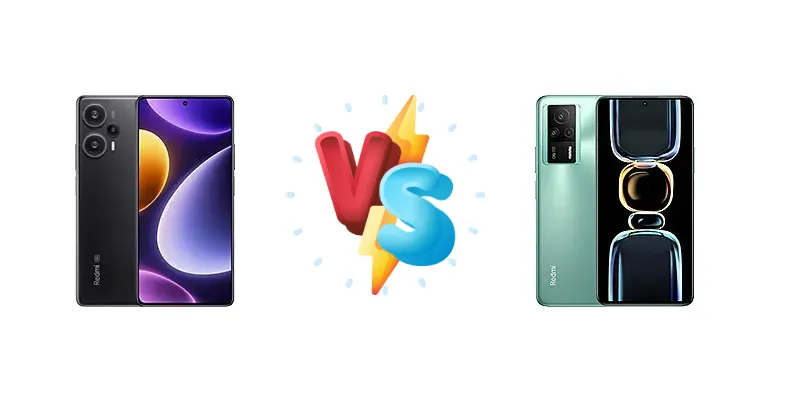
Xiaomi continues to dominate the mid-range smartphone market with compelling options. The Redmi Note 12 Turbo and Redmi K60E are two strong contenders, offering impressive features at competitive prices. But which one reigns supreme? Let's dive into a detailed comparison to help you decide.
🏆 Quick Verdict
The Redmi K60E edges out the Note 12 Turbo thanks to its slightly superior CPU and overall smoother experience. However, the Note 12 Turbo offers excellent value and a competitive Snapdragon chip. Both are great phones, but the K60E provides a more premium feel and performance.
| Network |
|---|
| 2G bands | GSM 850 / 900 / 1800 / 1900 | GSM 850 / 900 / 1800 / 1900 |
| 3G bands | HSDPA 800 / 850 / 900 / 2100 | HSDPA 800 / 850 / 900 / 1700(AWS) / 2100 |
| 4G bands | 1, 3, 5, 8, 19, 34, 38, 39, 40, 41, 42 | 1, 3, 4, 5, 8, 18, 19, 26, 34, 38, 39, 40, 41, 42 |
| 5G bands | 1, 3, 5, 8, 28, 38, 41, 77, 78 SA/NSA | 1, 3, 5, 8, 28, 38, 41, 77, 78 SA/NSA |
| Speed | HSPA, LTE, 5G | HSPA, LTE, 5G |
| Technology | GSM / HSPA / CDMA2000 / LTE / 5G | GSM / CDMA / HSPA / CDMA2000 / LTE / 5G |
| | CDMA2000 1x | CDMA2000 1x |
| Launch |
|---|
| Announced | 2023, March 28 | 2022, December 27 |
| Status | Available. Released 2023, March 28 | Available. Released 2022, December 27 |
| Body |
|---|
| Build | Glass front, plastic frame, plastic back | - |
| Dimensions | 161.1 x 75 x 7.9 mm (6.34 x 2.95 x 0.31 in) | 163.1 x 76.2 x 8.5 mm (6.42 x 3.00 x 0.33 in) |
| SIM | Nano-SIM + Nano-SIM | Nano-SIM + Nano-SIM |
| Weight | 181 g (6.38 oz) | 202 g (7.13 oz) |
| Display |
|---|
| Protection | - | Corning Gorilla Glass Victus |
| Resolution | 1080 x 2400 pixels, 20:9 ratio (~395 ppi density) | 1440 x 3200 pixels, 20:9 ratio (~526 ppi density) |
| Size | 6.67 inches, 107.4 cm2 (~88.9% screen-to-body ratio) | 6.67 inches, 107.4 cm2 (~86.4% screen-to-body ratio) |
| Type | OLED, 68B colors, 120Hz, Dolby Vision, HDR10+, 1000 nits (HBM) | OLED, 120Hz, Dolby Vision, HDR10+, 1200 nits (peak) |
| Platform |
|---|
| CPU | Octa-core (1x2.91 GHz Cortex-X2 & 3x2.49 GHz Cortex-A710 & 4x1.8 GHz Cortex-A510) | Octa-core (1x3.1 GHz Cortex-A78 & 3x3.0 GHz Cortex-A78 & 4x2.0 GHz Cortex-A55) |
| Chipset | Qualcomm SM7475-AB Snapdragon 7+ Gen 2 (4 nm) | Mediatek Dimensity 8200 (4 nm) |
| GPU | Adreno 725 | Mali-G610 MC6 |
| OS | Android 13, MIUI 14 | Android 12, MIUI 13 |
| Memory |
|---|
| Card slot | No | No |
| Internal | 256GB 8GB RAM, 256GB 12GB RAM, 256GB 16GB RAM, 512GB 12GB RAM, 1TB 16GB RAM | 128GB 8GB RAM, 256GB 8GB RAM, 256GB 12GB RAM, 512GB 12GB RAM |
| | UFS 3.1 | UFS 3.1 |
| Main Camera |
|---|
| Features | LED flash, HDR, panorama | Color spectrum sensor, Dual-LED dual-tone flash, HDR, panorama |
| Triple | 64 MP, f/1.8, (wide), 1/2.0", 0.7µm, PDAF, OIS
8 MP, f/2.2, 120˚ (ultrawide), 1/4.0", 1.12µm
2 MP (macro) | 48 MP, (wide), 1/2.0", 0.8µm, PDAF, OIS
8 MP, 120˚ (ultrawide), 1/4.0", 1.12µm
2 MP (macro) |
| Video | 4K@30fps, 1080p@30/60/120/240fps | 4K@30fps, 1080p@30/60/120fps, 720p@960fps, gyro-EIS |
| Selfie camera |
|---|
| Features | - | HDR |
| Single | 16 MP, f/2.5, (wide) | 20 MP, (wide), 1/2.0", 0.8µm |
| Video | 1080p@30/60fps | 1080p@30/60/120fps |
| Sound |
|---|
| 3.5mm jack | Yes | No |
| 35mm jack | Yes | No |
| Loudspeaker | Yes, with stereo speakers | Yes, with stereo speakers |
| | 24-bit/192kHz audio | 24-bit/192kHz audio |
| Comms |
|---|
| Bluetooth | 5.3, A2DP, LE | 5.3, A2DP, LE |
| Infrared port | Yes | Yes |
| NFC | Yes | Yes |
| Positioning | GPS (L1), GLONASS (G1), BDS (B1I+B1c), GALILEO (E1), QZSS (L1) | GPS (L1), GLONASS (G1), BDS (B1I+B1c), GALILEO (E1), QZSS (L1) |
| Radio | No | Unspecified |
| USB | USB Type-C 2.0, OTG | USB Type-C 2.0, OTG |
| WLAN | Wi-Fi 802.11 a/b/g/n/ac/6e, dual-band | Wi-Fi 802.11 a/b/g/n/ac/6e, dual-band, Wi-Fi Direct |
| Features |
|---|
| Sensors | Fingerprint (side-mounted), accelerometer, gyro, proximity, compass | Fingerprint (side-mounted), accelerometer, gyro, proximity, compass |
| Battery |
|---|
| Charging | 67W wired, PD3.0, QC4 | 67W wired, PD3.0 |
| Type | Li-Po 5000 mAh | Li-Po 5500 mAh |
| Misc |
|---|
| Colors | Black, Blue, White, Harry Potter Edition | Black, White, Green |
| Models | 23049RAD8C | 22122RK93C |
| Price | About 270 EUR | About 300 EUR |
Xiaomi Redmi Note 12 Turbo
- Excellent value for money
- Powerful Snapdragon 7+ Gen 2 chipset
- Fast 67W charging
- Vibrant AMOLED display
- Good gaming performance
- Camera slightly less impressive than K60E
- Build quality slightly less premium
- Software experience can be a bit cluttered
Xiaomi Redmi K60E
- Slightly better performance with Dimensity 8200
- More premium build quality
- Improved camera system
- Smoother software experience
- Excellent AMOLED display
- Slightly higher price
- No expandable storage
- Charging speed is comparable to Note 12 Turbo
Display Comparison
Both phones feature AMOLED displays with 120Hz refresh rates, offering vibrant colors and smooth scrolling. The K60E likely has slightly better color accuracy and brightness due to its higher tier positioning, but the difference is minimal for most users. Both offer excellent viewing experiences.
Camera Comparison
The Redmi K60E typically boasts a more versatile camera system, often including a higher resolution main sensor and improved image processing. While both phones capture decent photos, the K60E generally produces more detailed and vibrant images, especially in low light. The Note 12 Turbo's camera is still capable, but not quite as refined.
Performance
The Redmi K60E's Dimensity 8200 generally outperforms the Snapdragon 7+ Gen 2 in sustained performance and multi-tasking. While the Note 12 Turbo's chip is no slouch, the K60E's CPU architecture and slightly higher clock speeds give it an edge in demanding tasks. Gaming performance is excellent on both, but the K60E maintains higher frame rates for longer.
Battery Life
Both phones offer a large 5000mAh battery and 67W fast charging. Charging times are comparable, taking around 45-50 minutes to fully charge. Battery life is excellent on both devices, easily lasting a full day of moderate to heavy use.
Buying Guide
The Xiaomi Redmi Note 12 Turbo is ideal for gamers and users prioritizing a powerful chipset and fast charging on a budget. The Xiaomi Redmi K60E is a better choice for those seeking a more premium experience, slightly better performance, and a smoother overall user interface, even if it comes at a slightly higher price.
Frequently Asked Questions
❓ Is the Redmi Note 12 Turbo good for gaming?
Yes, the Redmi Note 12 Turbo is a great gaming phone thanks to its powerful Snapdragon 7+ Gen 2 chipset and 120Hz display. It can handle most games at high settings.
❓ Does the Redmi K60E have expandable storage?
No, the Redmi K60E does not offer expandable storage via microSD card. You'll need to choose a storage option that meets your needs at purchase.