
Xiaomi 13 Lite vs Redmi Note 12 Pro+: A Detailed Comparison
| Phones Images | |||||
|---|---|---|---|---|---|
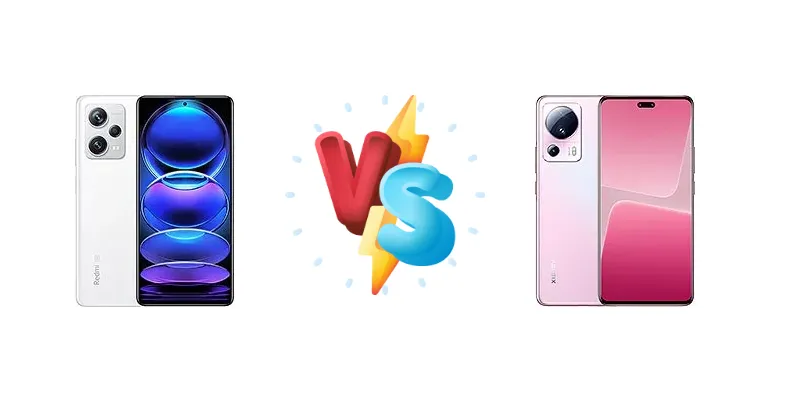
|
🏆 Quick Verdict
For the average user prioritizing all-day battery life and incredibly fast charging, the Xiaomi Redmi Note 12 Pro+ is the better choice. Its 120W charging significantly outperforms the 13 Lite’s 67W, and the active use battery score of 10:38h is impressive. However, the 13 Lite’s Snapdragon 7 Gen 1 offers a more refined experience for everyday tasks.
| PHONES | ||
|---|---|---|
| Phone Names | Xiaomi Redmi Note 12 Pro+ | Xiaomi 13 Lite |
| Network | ||
|---|---|---|
| 2G bands | GSM 850 / 900 / 1800 / 1900 | GSM 850 / 900 / 1800 / 1900 |
| 3G bands | HSDPA 800 / 850 / 900 / 1900 / 2100 | HSDPA 800 / 850 / 900 / 1700(AWS) / 1900 / 2100 |
| 4G bands | 1, 3, 5, 8, 19, 34, 38, 39, 40, 41 - International, China | 1, 2, 3, 4, 5, 7, 8, 12, 13, 17, 18, 19, 20, 26, 28, 32, 38, 40, 41, 42, 66 |
| 5G bands | 1, 3, 5, 8, 28, 38, 40, 41, 77, 78 SA/NSA - International | 1, 3, 5, 7, 8, 20, 28, 38, 40, 41, 66, 77, 78 SA/NSA |
| Speed | HSPA, LTE, 5G | HSPA, LTE, 5G |
| Technology | GSM / CDMA / HSPA / EVDO / LTE / 5G | GSM / HSPA / LTE / 5G |
| Launch | ||
|---|---|---|
| Announced | 2022, October 27 | 2023, February 26 |
| Status | Available. Released 2022, November 01 | Available. Released 2023, March 08 |
| Body | ||
|---|---|---|
| Build | Glass front (Gorilla Glass 5), glass back, plastic frame | Glass front (Gorilla Glass 5), glass back, plastic frame |
| Dimensions | 162.9 x 76 x 8.9 mm (6.41 x 2.99 x 0.35 in) | 159.2 x 72.7 x 7.2 mm (6.27 x 2.86 x 0.28 in) |
| SIM | Nano-SIM + Nano-SIM | · Nano-SIM + eSIM· Nano-SIM + Nano-SIM |
| Weight | 208.4 g (7.34 oz) | 171 g (6.03 oz) |
| - | IP53, dust and splash resistant | |
| Display | ||
|---|---|---|
| Protection | Corning Gorilla Glass 5 | Corning Gorilla Glass 5 |
| Resolution | 1080 x 2400 pixels, 20:9 ratio (~395 ppi density) | 1080 x 2400 pixels, 20:9 ratio (~402 ppi density) |
| Size | 6.67 inches, 107.4 cm2 (~86.8% screen-to-body ratio) | 6.55 inches, 103.6 cm2 (~89.5% screen-to-body ratio) |
| Type | OLED, 1B colors, 120Hz, Dolby Vision, HDR10+, 500 nits (typ), 900 nits (HBM) | AMOLED, 68B colors, Dolby Vision, HDR10+, 120Hz, 500 nits (typ), 1000 nits (peak) |
| Platform | ||
|---|---|---|
| CPU | Octa-core (2x2.6 GHz Cortex-A78 & 6x2.0 GHz Cortex-A55) | Octa-core (1x2.4 GHz Cortex-A710 & 3x2.36 GHz Cortex-A710 & 4x1.8 GHz Cortex-A510) |
| Chipset | Mediatek Dimensity 1080 (6 nm) | Qualcomm SM7450-AB Snapdragon 7 Gen 1 (4 nm) |
| GPU | Mali-G68 MC4 | Adreno 644 |
| OS | Android 12, upgradable to Android 14, HyperOS | Android 12, MIUI 14 |
| Memory | ||
|---|---|---|
| Card slot | No | No |
| Internal | 256GB 8GB RAM, 256GB 12GB RAM | 64GB 8GB RAM, 128GB 8GB RAM, 256GB 8GB RAM |
| - | UFS 2.2 | |
| Main Camera | ||
|---|---|---|
| Features | Dual-LED dual-tone flash, HDR, panorama | Dual-LED dual-tone flash, HDR, panorama |
| Triple | 200 MP, f/1.7, 24mm (wide), 1/1.4", 0.56µm, PDAF, OIS 8 MP, f/2.2, 120˚ (ultrawide), 1/4.0", 1.12µm 2 MP (macro) | 50 MP, f/1.8, 23mm (wide), 1/1.56", 1.0µm, PDAF 8 MP, f/2.2, 119˚ (ultrawide), 1/4.0", 1.12µm 2 MP (macro) |
| Video | 4K@30fps, 1080p@30/60/120fps, 720p@960fps | 4K@30fps, 1080p@30/60/120fps, 720p@960fps |
| Selfie camera | ||
|---|---|---|
| Dual | - | 32 MP, f/2.4, 100˚ (ultrawide), 1/2.74", 0.8µm 8 MP, f/2.3, (depth) |
| Features | HDR | Dual-LED flash, HDR |
| Single | 16 MP, f/2.5, (wide), 1/3.06", 1.0µm | - |
| Video | 1080p@30/60fps | 1080p@30/60fps |
| Sound | ||
|---|---|---|
| 3.5mm jack | - | No |
| 35mm jack | Yes | No |
| Loudspeaker | Yes, with stereo speakers | Yes |
| - | 24-bit/192kHz audio | |
| Comms | ||
|---|---|---|
| Bluetooth | 5.2, A2DP, LE | 5.2, A2DP, LE |
| Infrared port | Yes | Yes |
| NFC | Yes (market/region dependent) | Yes (market/region dependent) |
| Positioning | GPS (L1), GLONASS (G1), BDS (B1I+B1c), GALILEO (E1), QZSS (L1) | GPS (L1), GLONASS (G1), BDS (B1I+B1c), GALILEO (E1), QZSS (L1) |
| Radio | No | No |
| USB | USB Type-C 2.0, OTG | USB Type-C 2.0, OTG |
| WLAN | Wi-Fi 802.11 a/b/g/n/ac/6, dual-band, Wi-Fi Direct | Wi-Fi 802.11 a/b/g/n/ac/6, dual-band |
| Features | ||
|---|---|---|
| Sensors | Fingerprint (side-mounted), accelerometer, proximity, gyro, compass | Fingerprint (under display, optical), accelerometer, gyro, proximity, compass |
| Battery | ||
|---|---|---|
| Charging | 120W wired, PD3.0, 100% in 19 min | 67W wired, 100% in 40 min |
| Type | Li-Po 5000 mAh | Li-Po 4500 mAh |
| Misc | ||
|---|---|---|
| Colors | Arctic White, Iceberg Blue, Obsidian Black, Trend edition | Black, Lite Blue, Lite Pink |
| Models | 22101316UCP, 22101316UG | - |
| Price | € 349.99 / ₹ 23,899 | About 180 EUR |
| SAR | 1.09 W/kg (head) 1.00 W/kg (body) | - |
| SAR EU | 1.00 W/kg (head) 1.00 W/kg (body) | - |
| Tests | ||
|---|---|---|
| Battery life | - | Endurance rating 93h |
| Camera | - | Photo / Video |
| Display | - | Contrast ratio: Infinite (nominal) |
| Loudspeaker | - | -28.5 LUFS (Average) |
| Performance | - | AnTuTu: 534143 (v9) GeekBench: 2936 (v5.1), 2434 (v6) GFXBench: 33fps (ES 3.1 onscreen) |
Xiaomi Redmi Note 12 Pro+
- Incredibly fast 120W charging
- Strong active use battery life (10:38h)
- Higher peak display brightness (990 nits)
- Potentially larger main camera sensor
- Less efficient chipset (6nm)
- Potentially more thermal throttling under sustained load
Xiaomi 13 Lite
- More efficient Snapdragon 7 Gen 1 (4nm)
- Sleeker, lighter design
- Potentially better sustained performance
- Slightly better endurance rating (93h)
- Slower 67W charging (40 minutes)
- Lower peak display brightness (938 nits)
Display Comparison
Both the Redmi Note 12 Pro+ and Xiaomi 13 Lite feature excellent displays, with peak brightness figures of 990 nits and 938 nits respectively. While the difference is minimal, the Note 12 Pro+ edges out the 13 Lite in raw brightness, potentially offering better visibility in direct sunlight. Both displays boast an 'Infinite' contrast ratio (nominal), suggesting deep blacks and vibrant colors. The 13 Lite’s display, however, benefits from a potentially higher quality panel, given its focus on aesthetic appeal, though this isn't directly quantifiable from the provided data.
Camera Comparison
Both devices are marketed with capable photo and video capabilities, but the provided data doesn’t offer specifics beyond that. Without sensor size or aperture information, a direct comparison is difficult. However, given Xiaomi’s history, it’s likely the Note 12 Pro+ features a larger primary sensor, potentially offering better low-light performance. The image processing style will likely differ, with the 13 Lite potentially leaning towards more vibrant, social media-friendly images, while the Note 12 Pro+ might prioritize accuracy. The inclusion of OIS (Optical Image Stabilization) on either device would be a significant advantage, but this isn’t specified.
Performance
The chipset is where these phones diverge significantly. The Redmi Note 12 Pro+ utilizes the Mediatek Dimensity 1080 (6nm), featuring an octa-core CPU with two high-performance Cortex-A78 cores clocked at 2.6 GHz. The Xiaomi 13 Lite, on the other hand, employs the Qualcomm Snapdragon 7 Gen 1 (4nm). The 4nm process node of the Snapdragon 7 Gen 1 provides a clear efficiency advantage, translating to better thermal management and potentially longer sustained performance. While the Dimensity 1080 offers strong performance, the Snapdragon 7 Gen 1’s architecture (1x Cortex-A710, 3x Cortex-A710, 4x Cortex-A510) is optimized for a smoother, more responsive experience, particularly in demanding applications.
Battery Life
The Redmi Note 12 Pro+ boasts a significant advantage in charging speed with its 120W wired charging, achieving a full charge in just 19 minutes. The Xiaomi 13 Lite’s 67W charging takes considerably longer at 40 minutes. While the 13 Lite has a slightly better endurance rating of 93h versus the Note 12 Pro+'s 88h (old rating), the 10:38h active use score of the Note 12 Pro+ demonstrates strong real-world battery performance. The faster charging of the Note 12 Pro+ effectively mitigates any potential concerns about its slightly lower endurance rating.
Buying Guide
Buy the Xiaomi Redmi Note 12 Pro+ if you need a phone that can withstand heavy daily use and recharge in under 20 minutes. It’s ideal for power users, travelers, and anyone who dislikes battery anxiety. Buy the Xiaomi 13 Lite if you prefer a lighter, more stylish device with a focus on efficient performance for social media, streaming, and casual gaming. It’s a great fit for users who value aesthetics and a smooth user experience over raw power and extreme charging speeds.