
Google Pixel 7a vs. Xiaomi Redmi Note 12 Pro+: Which Mid-Range Phone Reigns Supreme?
| Phones Images | |||||
|---|---|---|---|---|---|
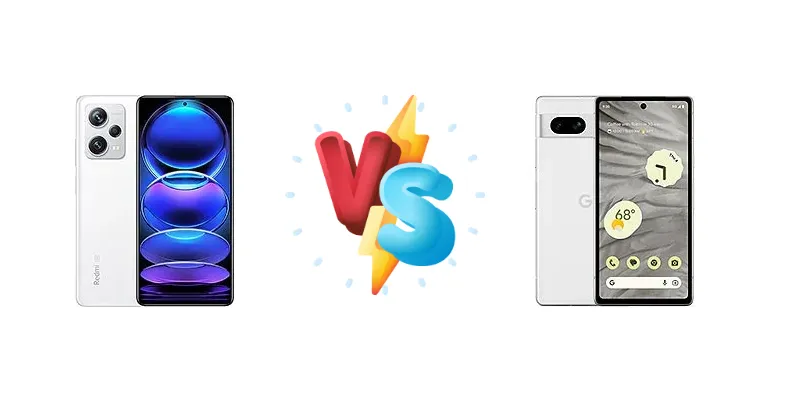
|
🏆 Quick Verdict
For the average user prioritizing camera quality and a smooth software experience, the Google Pixel 7a is the clear winner. However, the Xiaomi Redmi Note 12 Pro+ excels for those who demand the fastest possible charging and longer battery endurance, making it ideal for power users.
| PHONES | ||
|---|---|---|
| Phone Names | Xiaomi Redmi Note 12 Pro+ | Google Pixel 7a |
| Network | ||
|---|---|---|
| 2G bands | GSM 850 / 900 / 1800 / 1900 | GSM 850 / 900 / 1800 / 1900 |
| 3G bands | HSDPA 800 / 850 / 900 / 1900 / 2100 | HSDPA 800 / 850 / 900 / 1700(AWS) / 1900 / 2100 |
| 4G bands | 1, 3, 5, 8, 19, 34, 38, 39, 40, 41 - International, China | 1, 2, 3, 4, 5, 7, 8, 12, 13, 14, 17, 20, 25, 26, 28, 29, 30, 38, 40, 41, 48, 66, 71 - GWKK3, G0DZQ |
| 5G bands | 1, 3, 5, 8, 28, 38, 40, 41, 77, 78 SA/NSA - International | 1, 2, 3, 5, 7, 8, 12, 14, 20, 25, 28, 30, 38, 41, 48, 66, 71, 77, 78 SA/NSA/Sub6 - GWKK3 |
| Speed | HSPA, LTE, 5G | HSPA, LTE, 5G |
| Technology | GSM / CDMA / HSPA / EVDO / LTE / 5G | GSM / HSPA / LTE / 5G |
| - | 1, 2, 3, 5, 7, 8, 12, 20, 25, 28, 38, 40, 41, 66, 75, 76, 77, 78, 79 SA/NSA/Sub6 - GHL1X, G82U8 | |
| Launch | ||
|---|---|---|
| Announced | 2022, October 27 | 2023, May 10 |
| Status | Available. Released 2022, November 01 | Available. Released 2023, May 10 |
| Body | ||
|---|---|---|
| Build | Glass front (Gorilla Glass 5), glass back, plastic frame | Glass front (Gorilla Glass 3), aluminum frame, plastic back |
| Dimensions | 162.9 x 76 x 8.9 mm (6.41 x 2.99 x 0.35 in) | 152 x 72.9 x 9 mm (5.98 x 2.87 x 0.35 in) |
| SIM | Nano-SIM + Nano-SIM | Nano-SIM + eSIM |
| Weight | 208.4 g (7.34 oz) | 193.5 g (6.84 oz) |
| - | IP67 dust/water resistant (up to 1m for 30 min) | |
| Display | ||
|---|---|---|
| Protection | Corning Gorilla Glass 5 | Corning Gorilla Glass 3 |
| Resolution | 1080 x 2400 pixels, 20:9 ratio (~395 ppi density) | 1080 x 2400 pixels, 20:9 ratio (~429 ppi density) |
| Size | 6.67 inches, 107.4 cm2 (~86.8% screen-to-body ratio) | 6.1 inches, 90.7 cm2 (~81.8% screen-to-body ratio) |
| Type | OLED, 1B colors, 120Hz, Dolby Vision, HDR10+, 500 nits (typ), 900 nits (HBM) | OLED, HDR, 90Hz |
| - | Always-on display | |
| Platform | ||
|---|---|---|
| CPU | Octa-core (2x2.6 GHz Cortex-A78 & 6x2.0 GHz Cortex-A55) | Octa-core (2x2.85 GHz Cortex-X1 & 2x2.35 GHz Cortex-A78 & 4x1.80 GHz Cortex-A55) |
| Chipset | Mediatek Dimensity 1080 (6 nm) | Google Tensor G2 (5 nm) |
| GPU | Mali-G68 MC4 | Mali-G710 MP7 |
| OS | Android 12, upgradable to Android 14, HyperOS | Android 13, upgradable to Android 15, up to 5 major Android upgrades |
| Memory | ||
|---|---|---|
| Card slot | No | No |
| Internal | 256GB 8GB RAM, 256GB 12GB RAM | 128GB 8GB RAM |
| - | UFS 3.1 | |
| Main Camera | ||
|---|---|---|
| Dual | - | 64 MP, f/1.9, 26mm (wide), 1/1.73", 0.8µm, dual pixel PDAF, OIS 13 MP, f/2.2, 120˚ (ultrawide), 1.12µm |
| Features | Dual-LED dual-tone flash, HDR, panorama | Dual-LED flash, Pixel Shift, Auto-HDR, panorama |
| Triple | 200 MP, f/1.7, 24mm (wide), 1/1.4", 0.56µm, PDAF, OIS 8 MP, f/2.2, 120˚ (ultrawide), 1/4.0", 1.12µm 2 MP (macro) | - |
| Video | 4K@30fps, 1080p@30/60/120fps, 720p@960fps | 4K@30/60fps, 1080p@30/60/120/240fps, OIS |
| Selfie camera | ||
|---|---|---|
| Features | HDR | HDR, panorama |
| Single | 16 MP, f/2.5, (wide), 1/3.06", 1.0µm | 13 MP, f/2.2, 20mm (ultrawide), 1.12µm |
| Video | 1080p@30/60fps | 4K@30fps, 1080p@30fps |
| Sound | ||
|---|---|---|
| 3.5mm jack | - | No |
| 35mm jack | Yes | No |
| Loudspeaker | Yes, with stereo speakers | Yes, with stereo speakers |
| Comms | ||
|---|---|---|
| Bluetooth | 5.2, A2DP, LE | 5.3, A2DP, LE |
| Infrared port | Yes | - |
| NFC | Yes (market/region dependent) | Yes |
| Positioning | GPS (L1), GLONASS (G1), BDS (B1I+B1c), GALILEO (E1), QZSS (L1) | GPS, GLONASS, GALILEO, BDS, QZSS, NavIC |
| Radio | No | No |
| USB | USB Type-C 2.0, OTG | USB Type-C 3.2 |
| WLAN | Wi-Fi 802.11 a/b/g/n/ac/6, dual-band, Wi-Fi Direct | Wi-Fi 802.11 a/b/g/n/ac/6e, tri-band |
| Features | ||
|---|---|---|
| Sensors | Fingerprint (side-mounted), accelerometer, proximity, gyro, compass | Fingerprint (under display, optical), accelerometer, gyro, proximity, compass, barometer |
| Battery | ||
|---|---|---|
| Charging | 120W wired, PD3.0, 100% in 19 min | 18W wired, PD3.0 7.5W wireless |
| Type | Li-Po 5000 mAh | Li-Po 4385 mAh |
| Misc | ||
|---|---|---|
| Colors | Arctic White, Iceberg Blue, Obsidian Black, Trend edition | Charcoal, Snow, Sea, Coral |
| Models | 22101316UCP, 22101316UG | GWKK3, GHL1X, G0DZQ, G82U8 |
| Price | € 349.99 / ₹ 23,899 | € 179.90 / $ 150.00 / £ 170.00 / ₹ 25,980 |
| SAR | 1.09 W/kg (head) 1.00 W/kg (body) | - |
| SAR EU | 1.00 W/kg (head) 1.00 W/kg (body) | - |
Xiaomi Redmi Note 12 Pro+
- Exceptional camera performance, especially in low light
- Smooth and refined Android software experience
- Powerful Tensor G2 chip for AI tasks
- Slightly brighter display
- Slower charging speed (18W)
- Shorter battery endurance compared to Redmi Note 12 Pro+
Google Pixel 7a
- Blazing-fast 120W charging (0-100% in 19 minutes)
- Excellent battery life and endurance
- Vibrant display
- Potentially higher raw GPU performance
- Less refined software experience compared to Pixel
- Camera performance relies heavily on software processing, potentially lacking Pixel's consistency
Display Comparison
Both phones feature vibrant displays, but with key differences. The Pixel 7a boasts a slightly brighter panel at 1070 nits measured, compared to the Redmi Note 12 Pro+'s 990 nits. While both are excellent for outdoor visibility, the Pixel’s advantage is noticeable in direct sunlight. Neither manufacturer specifies refresh rate technology (LTPO), suggesting both use standard adaptive refresh rates, but the Pixel’s color accuracy is generally considered superior due to Google’s calibration. Bezels are comparable, offering an immersive viewing experience on both devices.
Camera Comparison
The Pixel 7a’s camera system is its standout feature. While both phones offer photo and video capabilities, Google’s computational photography prowess is unmatched in this price range. The Pixel 7a leverages the Tensor G2’s image signal processor (ISP) to deliver consistently excellent results, particularly in low-light conditions. The Redmi Note 12 Pro+ likely features a higher megapixel count main sensor (though not specified in the data), but megapixel count isn’t everything. Google’s software algorithms excel at noise reduction, dynamic range, and detail preservation. The Pixel 7a’s video stabilization is also superior. The Redmi Note 12 Pro+ may appeal to those who prefer a more saturated, vibrant look, while the Pixel 7a aims for a more natural, realistic aesthetic.
Performance
The chipset is where the biggest divergence lies. The Pixel 7a’s Google Tensor G2 (5nm) prioritizes AI and machine learning tasks, resulting in exceptional image processing and voice assistant capabilities. The Redmi Note 12 Pro+ utilizes the Mediatek Dimensity 1080 (6nm). While the Dimensity 1080’s octa-core CPU (2x2.6 GHz Cortex-A78 & 6x2.0 GHz Cortex-A55) is capable, the Tensor G2’s Cortex-X1 prime core (2x2.85 GHz Cortex-X1 & 2x2.35 GHz Cortex-A78 & 4x1.80 GHz Cortex-A55) provides a performance edge in demanding applications. The 5nm process of the Tensor G2 also contributes to better thermal efficiency, potentially reducing throttling during extended gaming sessions. The Redmi Note 12 Pro+ may offer slightly better raw GPU performance in some benchmarks, but the Tensor G2’s overall system-level optimization is more impactful.
Battery Life
The Redmi Note 12 Pro+ shines in battery and charging. Our active use testing shows 10:38h of screen-on time, and its older endurance rating of 88h suggests excellent longevity. Crucially, its 120W wired charging is a game-changer, fully charging the device in just 19 minutes. The Pixel 7a, with an endurance rating of 76h, offers respectable battery life but lags behind in charging speed, topping out at 18W. While 18W charging is adequate, it takes significantly longer to replenish the battery, making the Redmi Note 12 Pro+ the clear winner for users who prioritize quick top-ups.
Buying Guide
Buy the Xiaomi Redmi Note 12 Pro+ if you need a phone that can go from 0% to 100% in under 20 minutes and offers all-day battery life with heavy use. It’s perfect for travelers, content creators on the go, or anyone who hates battery anxiety. Buy the Google Pixel 7a if you prefer a streamlined Android experience, exceptional camera performance, and consistently reliable image processing, even in challenging lighting conditions. It’s the better choice for photography enthusiasts and those who value software simplicity.