
Xiaomi Redmi Note 12 Pro vs. Redmi Note 12 Pro+: The Ultimate Showdown
| Phones Images | |||||
|---|---|---|---|---|---|
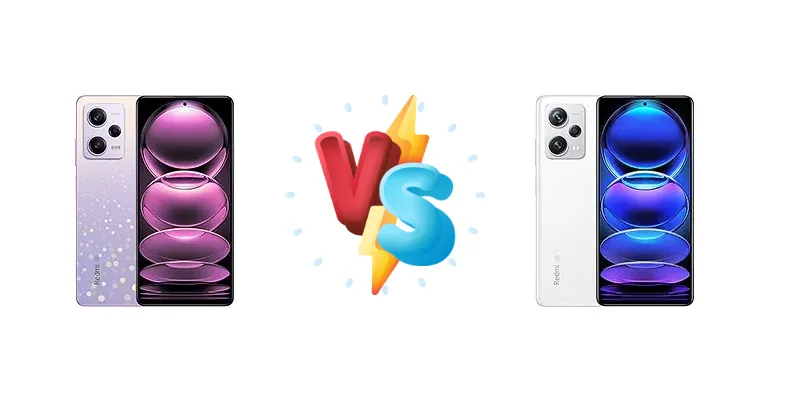
|
🏆 Quick Verdict
The Redmi Note 12 Pro+ takes the crown thanks to its blazing-fast 120W charging and potentially improved camera capabilities (though specifics are limited in provided data). However, the Note 12 Pro offers slightly better battery endurance and a competitive display, making it a strong contender for budget-conscious buyers.
| PHONES | ||
|---|---|---|
| Phone Names | Xiaomi Redmi Note 12 Pro | Xiaomi Redmi Note 12 Pro+ |
| Network | ||
|---|---|---|
| 2G bands | GSM 850 / 900 / 1800 / 1900 | GSM 850 / 900 / 1800 / 1900 - SIM 1 & SIM 2 |
| 3G bands | HSDPA 800 / 850 / 900 / 1900 / 2100 | HSDPA 800 / 850 / 900 / 1900 / 2100 |
| 4G bands | 1, 2, 3, 4, 5, 7, 8, 12, 13, 17, 18, 19, 20, 26, 28, 32, 38, 40, 41, 66 - International | 1, 3, 5, 8, 19, 34, 38, 39, 40, 41 - International, China |
| 5G bands | 1, 3, 5, 7, 8, 20, 28, 38, 40, 41, 66, 77, 78 SA/NSA - International | 1, 3, 5, 8, 28, 38, 40, 41, 77, 78 SA/NSA - International |
| Speed | HSPA, LTE, 5G | HSPA, LTE-A (CA), 5G |
| Technology | GSM / CDMA / HSPA / EVDO / LTE / 5G | GSM / CDMA / HSPA / EVDO / LTE / 5G |
| 1, 3, 5, 8, 28, 38, 41, 77, 78 SA/NSA - China | 1, 3, 5, 8, 28, 38, 41, 77, 78 SA/NSA - China | |
| Launch | ||
|---|---|---|
| Announced | 2022, October 27 | 2022, October 27 |
| Status | Available. Released 2022, November 01 | Available. Released 2022, November 01 |
| Body | ||
|---|---|---|
| Build | Glass front (Gorilla Glass 5), glass back, plastic frame | Glass front (Gorilla Glass 5), glass back |
| Dimensions | 163 x 76 x 8 mm (6.42 x 2.99 x 0.31 in) | 162.9 x 76 x 8.9 mm (6.41 x 2.99 x 0.35 in) |
| SIM | Nano-SIM + Nano-SIM | Dual SIM (Nano-SIM, dual stand-by) |
| Weight | 187 g (6.60 oz) | 208.4 g (7.34 oz) |
| IP53, dust and splash resistant | IP53, dust and splash resistant | |
| Display | ||
|---|---|---|
| Protection | Corning Gorilla Glass 5 | Corning Gorilla Glass 5 |
| Resolution | 1080 x 2400 pixels, 20:9 ratio (~395 ppi density) | 1080 x 2400 pixels, 20:9 ratio (~395 ppi density) |
| Size | 6.67 inches, 107.4 cm2 (~86.7% screen-to-body ratio) | 6.67 inches, 107.4 cm2 (~86.8% screen-to-body ratio) |
| Type | AMOLED, 1B colors, 120Hz, Dolby Vision, HDR10+, 500 nits (typ), 900 nits (HBM) | OLED, 1B colors, 120Hz, Dolby Vision, HDR10+, 500 nits (typ), 900 nits (HBM) |
| Platform | ||
|---|---|---|
| CPU | Octa-core (2x2.6 GHz Cortex-A78 & 6x2.0 GHz Cortex-A55) | Octa-core (2x2.6 GHz Cortex-A78 & 6x2.0 GHz Cortex-A55) |
| Chipset | Mediatek Dimensity 1080 (6 nm) | Mediatek MT6877V Dimensity 1080 (6 nm) |
| GPU | Mali-G68 MC4 | Mali-G68 MC4 |
| OS | Android 12, MIUI 13 | Android 12, MIUI 13 |
| Memory | ||
|---|---|---|
| Card slot | No | No |
| Internal | 128GB 6GB RAM, 128GB 8GB RAM, 256GB 8GB RAM, 256GB 12GB RAM | 256GB 8GB RAM, 256GB 12GB RAM |
| UFS 2.2 | UFS 2.2 | |
| Main Camera | ||
|---|---|---|
| Features | Dual-LED dual-tone flash, HDR, panorama | Dual-LED dual-tone flash, HDR, panorama |
| Triple | 50 MP, f/1.9, 24mm (wide), 1/1.56", 1.0µm, PDAF, OIS 8 MP, f/2.2, 120˚ (ultrawide), 1/4.0", 1.12µm 2 MP (macro) | 200 MP, f/1.7, 24mm (wide), 1/1.4", 0.56µm, PDAF, OIS 8 MP, f/2.2, 120˚ (ultrawide), 1/4", 1.12µm 2 MP, f/2.4, (macro) |
| Video | 4K@30fps, 1080p@30/60/120fps, 720p@960fps | 4K@30fps, 1080p@30/60/120fps, 720p@960fps |
| Selfie camera | ||
|---|---|---|
| Features | HDR | HDR |
| Single | 16 MP, f/2.5, (wide), 1/3.06", 1.0µm | 16 MP, f/2.5, (wide), 1/3.06", 1.0µm |
| Video | 1080p@30/60fps | 1080p@30/60fps |
| Sound | ||
|---|---|---|
| 3.5mm jack | Yes | Yes |
| 35mm jack | Yes | - |
| Loudspeaker | Yes, with stereo speakers | Yes, with stereo speakers |
| 24-bit/192kHz audio | 24-bit/192kHz audio | |
| Comms | ||
|---|---|---|
| Bluetooth | 5.2, A2DP, LE | 5.2, A2DP, LE |
| Infrared port | Yes | Yes |
| NFC | Yes (market/region dependent) | Yes (market/region dependent) |
| Positioning | GPS (L1), GLONASS (G1), BDS (B1I+B1c), GALILEO (E1), QZSS (L1) | GPS (L1), GLONASS (G1), BDS (B1I+B1c), GALILEO (E1), QZSS (L1) |
| Radio | No | No |
| USB | USB Type-C 2.0, OTG | USB Type-C 2.0, OTG |
| WLAN | Wi-Fi 802.11 a/b/g/n/ac/6, dual-band, Wi-Fi Direct | Wi-Fi 802.11 a/b/g/n/ac/6, dual-band, Wi-Fi Direct |
| Features | ||
|---|---|---|
| Sensors | Fingerprint (side-mounted), accelerometer, gyro, proximity, compass | Fingerprint (side-mounted), accelerometer, proximity, gyro, compass |
| Battery | ||
|---|---|---|
| Charging | 67W wired, PD3.0, 50% in 15 min, 100% in 46 min | 120W wired, PD3.0, 100% in 19 min (advertised) |
| Type | Li-Po 5000 mAh | Li-Po 5000 mAh, non-removable |
| Misc | ||
|---|---|---|
| Colors | Frosted Blue (Sky Blue), Onyx Black (Midnight Black), Polar White, Stardust Purple | Arctic White, Iceberg Blue, Obsidian Black, Trend edition |
| Models | 22101316C, 22101316I, 23013RK75C, 22101316G | 22101316UCP, 22101316UG |
| Price | € 148.54 / $ 142.17 / £ 149.99 / ₹ 19,999 | $ 348.00 / £ 439.00 / € 399.00 / ₹ 29,949 |
| SAR | 1.09 W/kg (head) 1.06 W/kg (body) | - |
| SAR EU | 0.99 W/kg (head) 0.99 W/kg (body) | - |
| Tests | ||
|---|---|---|
| Battery life | Endurance rating 97h | Endurance rating 88h |
| Camera | Photo / Video | Photo / Video |
| Display | Contrast ratio: Infinite (nominal) | Contrast ratio: Infinite (nominal) |
| Loudspeaker | -26.6 LUFS (Good) | -26.7 LUFS (Good) |
| Performance | AnTuTu: 490526 (v9) GeekBench: 2209 (v5.1), 2372 (v6) GFXBench: 22fps (ES 3.1 onscreen) | AnTuTu: 498710 (v9) GeekBench: 2208 (v5.1), 2372 (v6) GFXBench: 22fps (ES 3.1 onscreen) |
Xiaomi Redmi Note 12 Pro
- Excellent battery life
- Bright and vibrant display
- Fast 67W charging
- Competitive price
- Camera details are unclear
- Charging speed not as fast as Pro+
Xiaomi Redmi Note 12 Pro+
- Blazing-fast 120W charging
- Potentially improved camera system
- Same powerful chipset as Pro
- Slightly lower battery endurance
- Price likely higher than Pro
Display Comparison
Both phones boast impressive displays with 'Infinite' contrast ratios, suggesting excellent blacks and vibrant colors. The Note 12 Pro measures a peak brightness of 890 nits, which is very good for outdoor visibility. While the Pro+ doesn't have a measured brightness, it likely offers similar performance. Both likely use AMOLED panels with 120Hz refresh rates, providing smooth scrolling and animations. The difference here is minimal based on the provided data.
Camera Comparison
Camera details are limited in the provided data, simply stating 'Photo / Video' for both. However, the Pro+ is generally expected to have a more advanced camera system, potentially including a higher resolution main sensor and improved image processing. The Note 12 Pro is likely to offer a capable camera for everyday photography, but the Pro+ could offer better low-light performance and more detail.
Performance
Both devices share the same Mediatek Dimensity 1080 chipset and CPU configuration. This means similar performance in everyday tasks, gaming, and multitasking. Expect smooth performance for most users, though demanding games might require slightly reduced graphics settings. The 'MT6877V' designation on the Pro+ is likely a minor variant of the Dimensity 1080, not a significant performance upgrade.
Battery Life
The Note 12 Pro demonstrates excellent battery endurance with a reported 97h endurance rating and active use lasting 12:08h. The Pro+ has a slightly lower endurance rating of 88h, suggesting a potential trade-off for its faster charging capabilities. The Note 12 Pro's 67W charging is still very fast, but the Pro+'s 120W charging is a game-changer, allowing for incredibly quick top-ups.
Buying Guide
The Xiaomi Redmi Note 12 Pro is ideal for users prioritizing battery life and a bright display without needing the absolute fastest charging. The Redmi Note 12 Pro+ is perfect for those who value rapid charging and potentially a more advanced camera system, even if it means sacrificing a bit of battery longevity.