
Xiaomi 13 Lite vs Redmi Note 12 Pro: A Detailed Comparison
| Phones Images | |||||
|---|---|---|---|---|---|
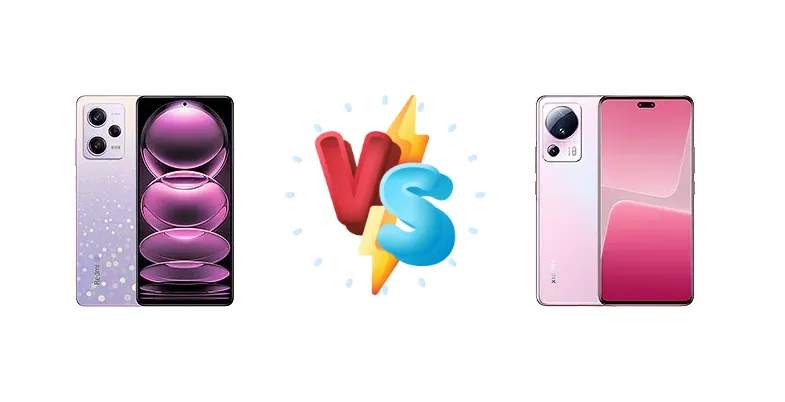
|
🏆 Quick Verdict
For most users, the Xiaomi 13 Lite is the better choice. Its Snapdragon 7 Gen 1, built on a 4nm process, offers superior power efficiency and comparable performance to the Redmi Note 12 Pro’s Dimensity 1080. While the Note 12 Pro boasts a slightly longer endurance rating, the 13 Lite’s faster charging and refined design make it a more compelling package.
| PHONES | ||
|---|---|---|
| Phone Names | Xiaomi Redmi Note 12 Pro | Xiaomi 13 Lite |
| Network | ||
|---|---|---|
| 2G bands | GSM 850 / 900 / 1800 / 1900 | GSM 850 / 900 / 1800 / 1900 |
| 3G bands | HSDPA 800 / 850 / 900 / 1900 / 2100 | HSDPA 800 / 850 / 900 / 1700(AWS) / 1900 / 2100 |
| 4G bands | 1, 2, 3, 4, 5, 7, 8, 12, 13, 17, 18, 19, 20, 26, 28, 32, 38, 40, 41, 66 - International | 1, 2, 3, 4, 5, 7, 8, 12, 13, 17, 18, 19, 20, 26, 28, 32, 38, 40, 41, 42, 66 |
| 5G bands | 1, 3, 5, 7, 8, 20, 28, 38, 40, 41, 66, 77, 78 SA/NSA - International | 1, 3, 5, 7, 8, 20, 28, 38, 40, 41, 66, 77, 78 SA/NSA |
| Speed | HSPA, LTE, 5G | HSPA, LTE, 5G |
| Technology | GSM / CDMA / HSPA / EVDO / LTE / 5G | GSM / HSPA / LTE / 5G |
| 1, 3, 5, 8, 28, 38, 41, 77, 78 SA/NSA - China | - | |
| Launch | ||
|---|---|---|
| Announced | 2022, October 27 | 2023, February 26 |
| Status | Available. Released 2022, November 01 | Available. Released 2023, March 08 |
| Body | ||
|---|---|---|
| Build | Glass front (Gorilla Glass 5), glass back, plastic frame | Glass front (Gorilla Glass 5), glass back, plastic frame |
| Dimensions | 163 x 76 x 8 mm (6.42 x 2.99 x 0.31 in) | 159.2 x 72.7 x 7.2 mm (6.27 x 2.86 x 0.28 in) |
| SIM | Nano-SIM + Nano-SIM | · Nano-SIM + eSIM· Nano-SIM + Nano-SIM |
| Weight | 187 g (6.60 oz) | 171 g (6.03 oz) |
| IP53, dust and splash resistant | IP53, dust and splash resistant | |
| Display | ||
|---|---|---|
| Protection | Corning Gorilla Glass 5 | Corning Gorilla Glass 5 |
| Resolution | 1080 x 2400 pixels, 20:9 ratio (~395 ppi density) | 1080 x 2400 pixels, 20:9 ratio (~402 ppi density) |
| Size | 6.67 inches, 107.4 cm2 (~86.7% screen-to-body ratio) | 6.55 inches, 103.6 cm2 (~89.5% screen-to-body ratio) |
| Type | AMOLED, 1B colors, 120Hz, Dolby Vision, HDR10+, 500 nits (typ), 900 nits (HBM) | AMOLED, 68B colors, Dolby Vision, HDR10+, 120Hz, 500 nits (typ), 1000 nits (peak) |
| Platform | ||
|---|---|---|
| CPU | Octa-core (2x2.6 GHz Cortex-A78 & 6x2.0 GHz Cortex-A55) | Octa-core (1x2.4 GHz Cortex-A710 & 3x2.36 GHz Cortex-A710 & 4x1.8 GHz Cortex-A510) |
| Chipset | Mediatek Dimensity 1080 (6 nm) | Qualcomm SM7450-AB Snapdragon 7 Gen 1 (4 nm) |
| GPU | Mali-G68 MC4 | Adreno 644 |
| OS | Android 12, MIUI 13 | Android 12, MIUI 14 |
| Memory | ||
|---|---|---|
| Card slot | No | No |
| Internal | 128GB 6GB RAM, 128GB 8GB RAM, 256GB 8GB RAM, 256GB 12GB RAM | 64GB 8GB RAM, 128GB 8GB RAM, 256GB 8GB RAM |
| UFS 2.2 | UFS 2.2 | |
| Main Camera | ||
|---|---|---|
| Features | Dual-LED dual-tone flash, HDR, panorama | Dual-LED dual-tone flash, HDR, panorama |
| Triple | 50 MP, f/1.9, 24mm (wide), 1/1.56", 1.0µm, PDAF, OIS 8 MP, f/2.2, 120˚ (ultrawide), 1/4.0", 1.12µm 2 MP (macro) | 50 MP, f/1.8, 23mm (wide), 1/1.56", 1.0µm, PDAF 8 MP, f/2.2, 119˚ (ultrawide), 1/4.0", 1.12µm 2 MP (macro) |
| Video | 4K@30fps, 1080p@30/60/120fps, 720p@960fps | 4K@30fps, 1080p@30/60/120fps, 720p@960fps |
| Selfie camera | ||
|---|---|---|
| Dual | - | 32 MP, f/2.4, 100˚ (ultrawide), 1/2.74", 0.8µm 8 MP, f/2.3, (depth) |
| Features | HDR | Dual-LED flash, HDR |
| Single | 16 MP, f/2.5, (wide), 1/3.06", 1.0µm | - |
| Video | 1080p@30/60fps | 1080p@30/60fps |
| Sound | ||
|---|---|---|
| 3.5mm jack | Yes | No |
| 35mm jack | Yes | No |
| Loudspeaker | Yes, with stereo speakers | Yes |
| 24-bit/192kHz audio | 24-bit/192kHz audio | |
| Comms | ||
|---|---|---|
| Bluetooth | 5.2, A2DP, LE | 5.2, A2DP, LE |
| Infrared port | Yes | Yes |
| NFC | Yes (market/region dependent) | Yes (market/region dependent) |
| Positioning | GPS (L1), GLONASS (G1), BDS (B1I+B1c), GALILEO (E1), QZSS (L1) | GPS (L1), GLONASS (G1), BDS (B1I+B1c), GALILEO (E1), QZSS (L1) |
| Radio | No | No |
| USB | USB Type-C 2.0, OTG | USB Type-C 2.0, OTG |
| WLAN | Wi-Fi 802.11 a/b/g/n/ac/6, dual-band, Wi-Fi Direct | Wi-Fi 802.11 a/b/g/n/ac/6, dual-band |
| Features | ||
|---|---|---|
| Sensors | Fingerprint (side-mounted), accelerometer, gyro, proximity, compass | Fingerprint (under display, optical), accelerometer, gyro, proximity, compass |
| Battery | ||
|---|---|---|
| Charging | 67W wired, PD3.0, 50% in 15 min, 100% in 46 min | 67W wired, 100% in 40 min |
| Type | Li-Po 5000 mAh | Li-Po 4500 mAh |
| Misc | ||
|---|---|---|
| Colors | Frosted Blue (Sky Blue), Onyx Black (Midnight Black), Polar White, Stardust Purple | Black, Lite Blue, Lite Pink |
| Models | 22101316C, 22101316I, 23013RK75C, 22101316G | - |
| Price | € 148.54 / $ 142.17 / £ 149.99 / ₹ 19,999 | About 180 EUR |
| SAR | 1.09 W/kg (head) 1.06 W/kg (body) | - |
| SAR EU | 0.99 W/kg (head) 0.99 W/kg (body) | - |
| Tests | ||
|---|---|---|
| Battery life | Endurance rating 97h | Endurance rating 93h |
| Camera | Photo / Video | Photo / Video |
| Display | Contrast ratio: Infinite (nominal) | Contrast ratio: Infinite (nominal) |
| Loudspeaker | -26.6 LUFS (Good) | -28.5 LUFS (Average) |
| Performance | AnTuTu: 490526 (v9) GeekBench: 2209 (v5.1), 2372 (v6) GFXBench: 22fps (ES 3.1 onscreen) | AnTuTu: 534143 (v9) GeekBench: 2936 (v5.1), 2434 (v6) GFXBench: 33fps (ES 3.1 onscreen) |
Xiaomi Redmi Note 12 Pro
- Slightly longer battery endurance rating
- Faster charging compatibility with PD3.0
- Potentially lower price point (depending on market)
- Less power-efficient chipset (6nm vs 4nm)
- Slightly lower peak display brightness
- Potentially more thermal throttling under load
Xiaomi 13 Lite
- More power-efficient Snapdragon 7 Gen 1 (4nm)
- Faster charging time (40 minutes vs 46 minutes)
- Higher peak display brightness for better outdoor visibility
- Slightly lower battery endurance rating
- May be priced higher than the Redmi Note 12 Pro
- Lacks PD3.0 charging
Display Comparison
Both the Redmi Note 12 Pro and Xiaomi 13 Lite feature displays with an infinite (nominal) contrast ratio, typical for OLED panels. However, the 13 Lite pulls ahead with a measured peak brightness of 938 nits, compared to the Note 12 Pro’s 890 nits. This translates to better visibility in direct sunlight. While both offer excellent viewing experiences, the 13 Lite’s higher brightness provides a noticeable advantage for outdoor use. The lack of LTPO on either device means refresh rate scaling isn't as efficient as on flagship models, but both likely employ adaptive refresh rate technology to conserve power.
Camera Comparison
Both phones are equipped with capable camera systems, but detailed sensor information is lacking. Both are advertised as having Photo/Video capabilities. Without specific details on sensor size, aperture, and image processing algorithms, a definitive camera comparison is difficult. However, the Snapdragon 7 Gen 1’s ISP (Image Signal Processor) generally offers more advanced features and better low-light performance. The presence or absence of OIS (Optical Image Stabilization) on the main sensor would be a crucial differentiator, but this information isn't provided. It's safe to assume both phones include standard features like HDR and portrait modes.
Performance
The core difference lies in the chipsets. The Redmi Note 12 Pro utilizes the Mediatek Dimensity 1080 (6nm), featuring an octa-core CPU with 2x2.6 GHz Cortex-A78 and 6x2.0 GHz Cortex-A55 cores. The Xiaomi 13 Lite, however, is powered by the Qualcomm SM7450-AB Snapdragon 7 Gen 1 (4nm), with an octa-core CPU configuration of 1x2.4 GHz Cortex-A710, 3x2.36 GHz Cortex-A710, and 4x1.8 GHz Cortex-A510 cores. The Snapdragon 7 Gen 1’s 4nm fabrication process provides a significant advantage in power efficiency. While the Dimensity 1080 offers strong performance, the Snapdragon 7 Gen 1 is likely to exhibit less thermal throttling under sustained load, making it better suited for prolonged gaming sessions. Both devices likely utilize LPDDR5X RAM, but Xiaomi doesn't specify the speed.
Battery Life
The Redmi Note 12 Pro boasts an endurance rating of 97 hours, slightly exceeding the Xiaomi 13 Lite’s 93 hours. However, this doesn’t tell the whole story. Both support 67W wired charging, but the 13 Lite achieves a full charge in 40 minutes, while the Note 12 Pro takes 46 minutes. The Snapdragon 7 Gen 1’s superior efficiency means the 13 Lite can deliver comparable real-world battery life despite a potentially smaller battery capacity (not specified in the data). The inclusion of PD3.0 charging on the Note 12 Pro offers wider compatibility with chargers.
Buying Guide
Buy the Xiaomi Redmi Note 12 Pro if you prioritize maximum battery life and consistently need all-day power, even with heavy usage. It’s ideal for users who frequently travel or lack easy access to charging. Buy the Xiaomi 13 Lite if you value a more premium design, slightly faster charging speeds, and a more efficient processor that translates to cooler operation during extended tasks like video recording or gaming.