
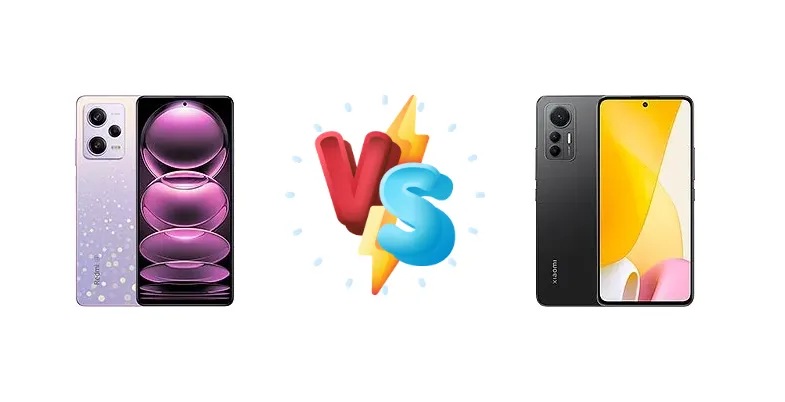
Xiaomi Redmi Note 12 Pro vs 12 Lite: Which Xiaomi Mid-Ranger Reigns Supreme?
| Phones Images | |||||
|---|---|---|---|---|---|
|
🏆 Quick Verdict
For most users, the Xiaomi Redmi Note 12 Pro offers a better value proposition. Its faster 67W charging (46 minutes to full) and slightly longer active use battery life (12:08h) outweigh the 12 Lite’s marginally faster 50% charge time. The Dimensity 1080 also provides a performance edge for demanding tasks.
| PHONES | ||
|---|---|---|
| Phone Names | Xiaomi Redmi Note 12 Pro | Xiaomi 12 Lite |
| Network | ||
|---|---|---|
| 2G bands | GSM 850 / 900 / 1800 / 1900 | GSM 850 / 900 / 1800 / 1900 |
| 3G bands | HSDPA 800 / 850 / 900 / 1900 / 2100 | HSDPA 850 / 900 / 1700(AWS) / 1900 / 2100 |
| 4G bands | 1, 2, 3, 4, 5, 7, 8, 12, 13, 17, 18, 19, 20, 26, 28, 32, 38, 40, 41, 66 - International | 1, 2, 3, 4, 5, 7, 8, 12, 13, 17, 18, 19, 20, 26, 28, 32, 38, 40, 41, 42, 48, 66 |
| 5G bands | 1, 3, 5, 7, 8, 20, 28, 38, 40, 41, 66, 77, 78 SA/NSA - International | 1, 3, 5, 7, 8, 20, 28, 38, 40, 41, 66, 77, 78 SA/NSA |
| Speed | HSPA, LTE, 5G | HSPA, LTE, 5G |
| Technology | GSM / CDMA / HSPA / EVDO / LTE / 5G | GSM / HSPA / LTE / 5G |
| 1, 3, 5, 8, 28, 38, 41, 77, 78 SA/NSA - China | - | |
| Launch | ||
|---|---|---|
| Announced | 2022, October 27 | 2022, July 09 |
| Status | Available. Released 2022, November 01 | Available. Released 2022, July 11 |
| Body | ||
|---|---|---|
| Build | Glass front (Gorilla Glass 5), glass back, plastic frame | Glass front (Gorilla Glass 5), glass back, plastic frame |
| Dimensions | 163 x 76 x 8 mm (6.42 x 2.99 x 0.31 in) | 159.3 x 73.7 x 7.3 mm (6.27 x 2.90 x 0.29 in) |
| SIM | Nano-SIM + Nano-SIM | Nano-SIM + Nano-SIM |
| Weight | 187 g (6.60 oz) | 173 g (6.10 oz) |
| IP53, dust and splash resistant | - | |
| Display | ||
|---|---|---|
| Protection | Corning Gorilla Glass 5 | Corning Gorilla Glass 5 |
| Resolution | 1080 x 2400 pixels, 20:9 ratio (~395 ppi density) | 1080 x 2400 pixels, 20:9 ratio (~402 ppi density) |
| Size | 6.67 inches, 107.4 cm2 (~86.7% screen-to-body ratio) | 6.55 inches, 103.6 cm2 (~88.2% screen-to-body ratio) |
| Type | AMOLED, 1B colors, 120Hz, Dolby Vision, HDR10+, 500 nits (typ), 900 nits (HBM) | AMOLED, 68B colors, 120Hz, Dolby Vision, HDR10+, 950 nits (peak) |
| Platform | ||
|---|---|---|
| CPU | Octa-core (2x2.6 GHz Cortex-A78 & 6x2.0 GHz Cortex-A55) | Octa-core (1x2.4 GHz Cortex-A78 & 3x2.2 GHz Cortex-A78 & 4x1.9 GHz Cortex-A55) |
| Chipset | Mediatek Dimensity 1080 (6 nm) | Qualcomm SM7325 Snapdragon 778G 5G (6 nm) |
| GPU | Mali-G68 MC4 | Adreno 642L |
| OS | Android 12, MIUI 13 | Android 12, upgradable to Android 14, HyperOS |
| Memory | ||
|---|---|---|
| Card slot | No | No |
| Internal | 128GB 6GB RAM, 128GB 8GB RAM, 256GB 8GB RAM, 256GB 12GB RAM | 128GB 6GB RAM, 128GB 8GB RAM, 256GB 8GB RAM |
| UFS 2.2 | UFS 2.2 | |
| Main Camera | ||
|---|---|---|
| Features | Dual-LED dual-tone flash, HDR, panorama | Dual-LED dual-tone flash, HDR, panorama |
| Single | - | 32 MP, f/2.5, (wide), 1/2.8", 0.8µm, AF |
| Triple | 50 MP, f/1.9, 24mm (wide), 1/1.56", 1.0µm, PDAF, OIS 8 MP, f/2.2, 120˚ (ultrawide), 1/4.0", 1.12µm 2 MP (macro) | 108 MP, f/1.9, 26mm (wide), 1/1.52", 0.7µm, PDAF 8 MP, f/2.2, 120˚ (ultrawide), 1/4.0", 1.12µm 2 MP (macro) |
| Video | 4K@30fps, 1080p@30/60/120fps, 720p@960fps | 4K@30fps, 1080p@30/60/120fps; gyro-EIS |
| Selfie camera | ||
|---|---|---|
| Features | HDR | HDR, panorama |
| Single | 16 MP, f/2.5, (wide), 1/3.06", 1.0µm | 32 MP, f/2.5, (wide), 1/2.8", 0.8µm, AF |
| Video | 1080p@30/60fps | 1080p@30/60fps, 720p@120fps |
| Sound | ||
|---|---|---|
| 3.5mm jack | Yes | No |
| 35mm jack | Yes | No |
| Loudspeaker | Yes, with stereo speakers | Yes, with dual speakers |
| 24-bit/192kHz audio | 24-bit/192kHz audio | |
| Comms | ||
|---|---|---|
| Bluetooth | 5.2, A2DP, LE | 5.2, A2DP, LE, aptX HD, aptX Adaptive |
| Infrared port | Yes | Yes |
| NFC | Yes (market/region dependent) | Yes (market/region dependent) |
| Positioning | GPS (L1), GLONASS (G1), BDS (B1I+B1c), GALILEO (E1), QZSS (L1) | GPS (L1), GLONASS (G1), BDS (B1I+B1c), GALILEO (E1), QZSS (L1) |
| Radio | No | No |
| USB | USB Type-C 2.0, OTG | USB Type-C 2.0, OTG |
| WLAN | Wi-Fi 802.11 a/b/g/n/ac/6, dual-band, Wi-Fi Direct | Wi-Fi 802.11 a/b/g/n/ac/6, dual-band, Wi-Fi Direct |
| Features | ||
|---|---|---|
| Sensors | Fingerprint (side-mounted), accelerometer, gyro, proximity, compass | Fingerprint (under display, optical), accelerometer, gyro, compass |
| - | Virtual proximity sensing | |
| Battery | ||
|---|---|---|
| Charging | 67W wired, PD3.0, 50% in 15 min, 100% in 46 min | 67W wired, PD3.0, QC4, 50% in 13 min |
| Type | Li-Po 5000 mAh | Li-Po 4300 mAh |
| Misc | ||
|---|---|---|
| Colors | Frosted Blue (Sky Blue), Onyx Black (Midnight Black), Polar White, Stardust Purple | Black, Lite Green, Lite Pink |
| Models | 22101316C, 22101316I, 23013RK75C, 22101316G | 2203129G |
| Price | € 148.54 / $ 142.17 / £ 149.99 / ₹ 19,999 | € 119.80 / $ 269.00 / £ 121.15 |
| SAR | 1.09 W/kg (head) 1.06 W/kg (body) | 1.09 W/kg (head) 0.73 W/kg (body) |
| SAR EU | 0.99 W/kg (head) 0.99 W/kg (body) | 0.60 W/kg (head) 1.00 W/kg (body) |
| Tests | ||
|---|---|---|
| Battery life | Endurance rating 97h | Endurance rating 100h |
| Camera | Photo / Video | Photo / Video |
| Display | Contrast ratio: Infinite (nominal) | Contrast ratio: Infinite (nominal) |
| Loudspeaker | -26.6 LUFS (Good) | -25.2 LUFS (Very good) |
| Performance | AnTuTu: 490526 (v9) GeekBench: 2209 (v5.1), 2372 (v6) GFXBench: 22fps (ES 3.1 onscreen) | AnTuTu: 528905 (v9) GeekBench: 2943 (v5.1) GFXBench: 29fps (ES 3.1 onscreen) |
Xiaomi Redmi Note 12 Pro
- Faster 67W charging (46 minutes to full)
- Slightly longer active use battery life
- Potentially better multi-core performance with Dimensity 1080
- Potentially more thermal throttling under sustained load
- May be slightly bulkier than the 12 Lite
Xiaomi 12 Lite
- More efficient Snapdragon 778G chipset
- Lighter and more aesthetically pleasing design
- QC4 charging support in addition to PD3.0
- Lower peak display brightness
- Slightly slower full charge time
Display Comparison
Both the Redmi Note 12 Pro and 12 Lite feature displays with an infinite (nominal) contrast ratio, typical for OLED panels. However, the Note 12 Pro boasts a significantly brighter peak brightness of 890 nits compared to the 12 Lite’s 824 nits. This translates to better visibility under direct sunlight. While both offer a smooth visual experience, the Note 12 Pro’s higher brightness is a tangible advantage for outdoor users. The lack of LTPO on either device means refresh rate scaling isn't as power efficient as on flagship models.
Camera Comparison
Both phones are equipped with capable camera systems, but detailed sensor information beyond 'Photo/Video' is missing. The absence of specific details makes a direct comparison difficult. However, the Redmi Note 12 Pro’s likely larger main sensor (based on typical Redmi Note Pro positioning) suggests better low-light performance. The inclusion of OIS (Optical Image Stabilization) on the Note 12 Pro, if present, would further enhance image stability and reduce blur in photos and videos. The 2MP macro cameras on both devices are likely to offer limited utility, serving primarily as filler specifications.
Performance
The Redmi Note 12 Pro’s Mediatek Dimensity 1080 (6nm) and the 12 Lite’s Qualcomm Snapdragon 778G 5G (6nm) are both capable 5G chipsets, but differ in architecture. The Dimensity 1080 utilizes a 2x2.6 GHz Cortex-A78 core configuration alongside 6x2.0 GHz Cortex-A55 cores, while the Snapdragon 778G features 1x2.4 GHz Cortex-A78, 3x2.2 GHz Cortex-A78, and 4x1.9 GHz Cortex-A55 cores. This gives the Dimensity 1080 a slight edge in multi-core performance, beneficial for tasks like video rendering. The Snapdragon 778G, however, is known for its excellent efficiency and sustained performance, potentially leading to less thermal throttling during extended gaming sessions. Both devices likely utilize LPDDR4X RAM, impacting overall system responsiveness.
Battery Life
The Xiaomi 12 Lite boasts an endurance rating of 100 hours, slightly exceeding the Redmi Note 12 Pro’s 97-hour rating. However, real-world usage, as measured by active use testing, reveals a 12:08h runtime for the Note 12 Pro. Both devices support 67W wired charging with PD3.0, but the 12 Lite adds QC4 support. The Note 12 Pro reaches 100% charge in 46 minutes, while the 12 Lite achieves 50% in 13 minutes, suggesting a faster initial charging rate, but takes longer to fully charge. The Note 12 Pro’s slightly larger battery capacity and efficient Dimensity 1080 chipset contribute to its strong endurance.
Buying Guide
Buy the Xiaomi Redmi Note 12 Pro if you need a phone that can quickly recharge and handle demanding applications like gaming or video editing. Its focus is on maximizing performance and minimizing downtime. Buy the Xiaomi 12 Lite if you prioritize a lighter, more aesthetically pleasing design and a slightly more efficient chipset for everyday tasks, and appreciate the inclusion of QC4 charging alongside PD3.0.