
Google Pixel 7a vs. Xiaomi Redmi Note 12 Pro: A Detailed Comparison
| Phones Images | |||||
|---|---|---|---|---|---|
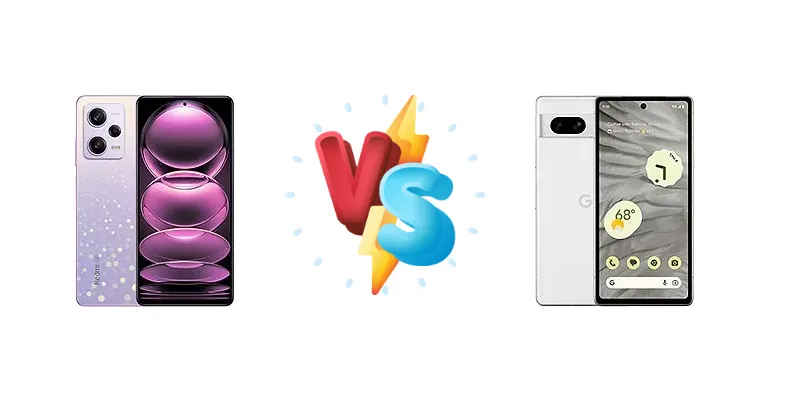
|
🏆 Quick Verdict
For most users, the Google Pixel 7a emerges as the stronger choice. Its superior image processing, powered by the Tensor G2, delivers consistently better photos and videos. While the Redmi Note 12 Pro boasts faster charging and a slightly brighter display, the Pixel 7a’s overall experience and software support are more compelling.
| PHONES | ||
|---|---|---|
| Phone Names | Xiaomi Redmi Note 12 Pro | Google Pixel 7a |
| Network | ||
|---|---|---|
| 2G bands | GSM 850 / 900 / 1800 / 1900 | GSM 850 / 900 / 1800 / 1900 |
| 3G bands | HSDPA 800 / 850 / 900 / 1900 / 2100 | HSDPA 800 / 850 / 900 / 1700(AWS) / 1900 / 2100 |
| 4G bands | 1, 2, 3, 4, 5, 7, 8, 12, 13, 17, 18, 19, 20, 26, 28, 32, 38, 40, 41, 66 - International | 1, 2, 3, 4, 5, 7, 8, 12, 13, 14, 17, 20, 25, 26, 28, 29, 30, 38, 40, 41, 48, 66, 71 - GWKK3, G0DZQ |
| 5G bands | 1, 3, 5, 7, 8, 20, 28, 38, 40, 41, 66, 77, 78 SA/NSA - International | 1, 2, 3, 5, 7, 8, 12, 14, 20, 25, 28, 30, 38, 41, 48, 66, 71, 77, 78 SA/NSA/Sub6 - GWKK3 |
| Speed | HSPA, LTE, 5G | HSPA, LTE, 5G |
| Technology | GSM / CDMA / HSPA / EVDO / LTE / 5G | GSM / HSPA / LTE / 5G |
| 1, 3, 5, 8, 28, 38, 41, 77, 78 SA/NSA - China | 1, 2, 3, 5, 7, 8, 12, 20, 25, 28, 38, 40, 41, 66, 75, 76, 77, 78, 79 SA/NSA/Sub6 - GHL1X, G82U8 | |
| Launch | ||
|---|---|---|
| Announced | 2022, October 27 | 2023, May 10 |
| Status | Available. Released 2022, November 01 | Available. Released 2023, May 10 |
| Body | ||
|---|---|---|
| Build | Glass front (Gorilla Glass 5), glass back, plastic frame | Glass front (Gorilla Glass 3), aluminum frame, plastic back |
| Dimensions | 163 x 76 x 8 mm (6.42 x 2.99 x 0.31 in) | 152 x 72.9 x 9 mm (5.98 x 2.87 x 0.35 in) |
| SIM | Nano-SIM + Nano-SIM | Nano-SIM + eSIM |
| Weight | 187 g (6.60 oz) | 193.5 g (6.84 oz) |
| IP53, dust and splash resistant | IP67 dust/water resistant (up to 1m for 30 min) | |
| Display | ||
|---|---|---|
| Protection | Corning Gorilla Glass 5 | Corning Gorilla Glass 3 |
| Resolution | 1080 x 2400 pixels, 20:9 ratio (~395 ppi density) | 1080 x 2400 pixels, 20:9 ratio (~429 ppi density) |
| Size | 6.67 inches, 107.4 cm2 (~86.7% screen-to-body ratio) | 6.1 inches, 90.7 cm2 (~81.8% screen-to-body ratio) |
| Type | AMOLED, 1B colors, 120Hz, Dolby Vision, HDR10+, 500 nits (typ), 900 nits (HBM) | OLED, HDR, 90Hz |
| - | Always-on display | |
| Platform | ||
|---|---|---|
| CPU | Octa-core (2x2.6 GHz Cortex-A78 & 6x2.0 GHz Cortex-A55) | Octa-core (2x2.85 GHz Cortex-X1 & 2x2.35 GHz Cortex-A78 & 4x1.80 GHz Cortex-A55) |
| Chipset | Mediatek Dimensity 1080 (6 nm) | Google Tensor G2 (5 nm) |
| GPU | Mali-G68 MC4 | Mali-G710 MP7 |
| OS | Android 12, MIUI 13 | Android 13, upgradable to Android 15, up to 5 major Android upgrades |
| Memory | ||
|---|---|---|
| Card slot | No | No |
| Internal | 128GB 6GB RAM, 128GB 8GB RAM, 256GB 8GB RAM, 256GB 12GB RAM | 128GB 8GB RAM |
| UFS 2.2 | UFS 3.1 | |
| Main Camera | ||
|---|---|---|
| Dual | - | 64 MP, f/1.9, 26mm (wide), 1/1.73", 0.8µm, dual pixel PDAF, OIS 13 MP, f/2.2, 120˚ (ultrawide), 1.12µm |
| Features | Dual-LED dual-tone flash, HDR, panorama | Dual-LED flash, Pixel Shift, Auto-HDR, panorama |
| Triple | 50 MP, f/1.9, 24mm (wide), 1/1.56", 1.0µm, PDAF, OIS 8 MP, f/2.2, 120˚ (ultrawide), 1/4.0", 1.12µm 2 MP (macro) | - |
| Video | 4K@30fps, 1080p@30/60/120fps, 720p@960fps | 4K@30/60fps, 1080p@30/60/120/240fps, OIS |
| Selfie camera | ||
|---|---|---|
| Features | HDR | HDR, panorama |
| Single | 16 MP, f/2.5, (wide), 1/3.06", 1.0µm | 13 MP, f/2.2, 20mm (ultrawide), 1.12µm |
| Video | 1080p@30/60fps | 4K@30fps, 1080p@30fps |
| Sound | ||
|---|---|---|
| 3.5mm jack | Yes | No |
| 35mm jack | Yes | No |
| Loudspeaker | Yes, with stereo speakers | Yes, with stereo speakers |
| 24-bit/192kHz audio | - | |
| Comms | ||
|---|---|---|
| Bluetooth | 5.2, A2DP, LE | 5.3, A2DP, LE |
| Infrared port | Yes | - |
| NFC | Yes (market/region dependent) | Yes |
| Positioning | GPS (L1), GLONASS (G1), BDS (B1I+B1c), GALILEO (E1), QZSS (L1) | GPS, GLONASS, GALILEO, BDS, QZSS, NavIC |
| Radio | No | No |
| USB | USB Type-C 2.0, OTG | USB Type-C 3.2 |
| WLAN | Wi-Fi 802.11 a/b/g/n/ac/6, dual-band, Wi-Fi Direct | Wi-Fi 802.11 a/b/g/n/ac/6e, tri-band |
| Features | ||
|---|---|---|
| Sensors | Fingerprint (side-mounted), accelerometer, gyro, proximity, compass | Fingerprint (under display, optical), accelerometer, gyro, proximity, compass, barometer |
| Battery | ||
|---|---|---|
| Charging | 67W wired, PD3.0, 50% in 15 min, 100% in 46 min | 18W wired, PD3.0 7.5W wireless |
| Type | Li-Po 5000 mAh | Li-Po 4385 mAh |
| Misc | ||
|---|---|---|
| Colors | Frosted Blue (Sky Blue), Onyx Black (Midnight Black), Polar White, Stardust Purple | Charcoal, Snow, Sea, Coral |
| Models | 22101316C, 22101316I, 23013RK75C, 22101316G | GWKK3, GHL1X, G0DZQ, G82U8 |
| Price | € 148.54 / $ 142.17 / £ 149.99 / ₹ 19,999 | € 179.90 / $ 150.00 / £ 170.00 / ₹ 25,980 |
| SAR | 1.09 W/kg (head) 1.06 W/kg (body) | - |
| SAR EU | 0.99 W/kg (head) 0.99 W/kg (body) | - |
| Tests | ||
|---|---|---|
| Battery life | Endurance rating 97h | - |
| Camera | Photo / Video | - |
| Display | Contrast ratio: Infinite (nominal) | - |
| Loudspeaker | -26.6 LUFS (Good) | - |
| Performance | AnTuTu: 490526 (v9) GeekBench: 2209 (v5.1), 2372 (v6) GFXBench: 22fps (ES 3.1 onscreen) | - |
Xiaomi Redmi Note 12 Pro
- Significantly faster charging (67W)
- Brighter display for outdoor visibility
- Longer battery endurance rating
- Less powerful chipset compared to Tensor G2
- Inferior camera image processing
Google Pixel 7a
- Superior camera performance and image processing
- More powerful and efficient Tensor G2 chipset
- Clean Android experience with guaranteed updates
- Slower charging speed (18W)
- Shorter battery endurance rating
Display Comparison
The Pixel 7a features a display capable of reaching 1070 nits of peak brightness, significantly outshining the Redmi Note 12 Pro’s 890 nits. This translates to better visibility in direct sunlight. While both displays have an infinite (nominal) contrast ratio, the Pixel 7a’s higher brightness is a clear advantage for outdoor use. Neither specification details refresh rate, but the Pixel 7a is known to have a 90Hz panel, which provides a smoother scrolling experience than the Redmi Note 12 Pro's likely 60Hz panel.
Camera Comparison
The Pixel 7a’s camera system benefits immensely from Google’s computational photography prowess. While both phones offer photo and video capabilities, the Pixel 7a’s image processing algorithms consistently deliver superior dynamic range, detail, and low-light performance. The context data doesn't specify sensor sizes, but Pixel phones are known for their excellent software optimization, compensating for potentially smaller sensors. The Redmi Note 12 Pro likely relies more on hardware specifications, and while capable, won't match the Pixel's image quality. The absence of details on OIS for either phone makes it difficult to assess stabilization performance.
Performance
The Google Pixel 7a’s Tensor G2 (5nm) chipset, with its Cortex-X1 prime core clocked at 2.85 GHz, offers a performance edge over the Redmi Note 12 Pro’s MediaTek Dimensity 1080 (6nm). The Tensor G2’s architecture, including the dedicated TPU for AI tasks, excels in image processing and machine learning. While the Dimensity 1080 is a capable chip with its 2x2.6 GHz Cortex-A78 cores, the 5nm process node of the Tensor G2 generally leads to better thermal efficiency and sustained performance under load. The Pixel 7a’s CPU configuration (2x2.85 GHz Cortex-X1, 2x2.35 GHz Cortex-A78, 4x1.80 GHz Cortex-A55) is more balanced for demanding tasks than the Redmi Note 12 Pro’s (2x2.6 GHz Cortex-A78 & 6x2.0 GHz Cortex-A55).
Battery Life
The Redmi Note 12 Pro boasts a significant advantage in charging speed with its 67W wired charging, capable of reaching 50% in 15 minutes and 100% in 46 minutes. The Pixel 7a’s 18W charging is considerably slower. However, the Redmi Note 12 Pro’s endurance rating of 97 hours is offset by the Pixel 7a’s more efficient chipset. The Pixel 7a’s endurance rating of 76 hours, while lower, suggests reasonable battery life for typical usage. The faster charging of the Redmi Note 12 Pro is ideal for users who frequently need to top up their battery quickly.
Buying Guide
Buy the Xiaomi Redmi Note 12 Pro if you prioritize rapid 67W charging and a very bright display for outdoor visibility, and frequently consume media. You’ll also appreciate the longer endurance rating. Buy the Google Pixel 7a if you value exceptional camera performance, a clean Android experience with guaranteed updates, and the benefits of Google’s AI-powered features, even if it means sacrificing charging speed and battery endurance.