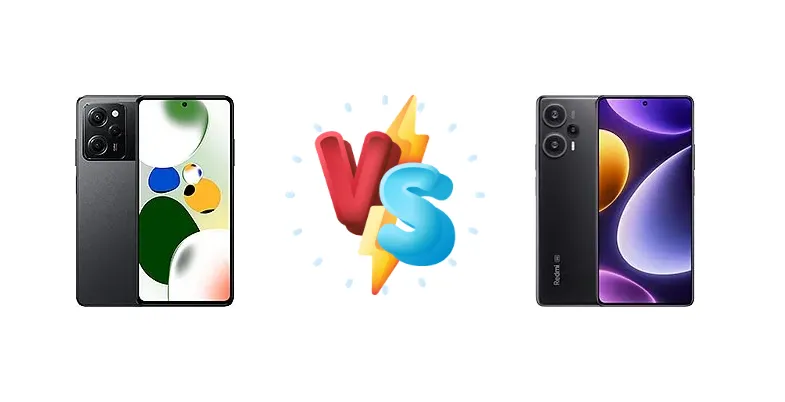
Xiaomi's Redmi Note series consistently delivers impressive value. The Note 12 Pro Speed and Note 12 Turbo are two compelling options, but which one reigns supreme? We'll break down their key differences to help you make the right choice.
🏆 Quick Verdict
The Redmi Note 12 Turbo is the clear winner, boasting a significantly faster Snapdragon 7+ Gen 2 chipset and a more efficient 4nm process. While both offer 67W charging, the Turbo's performance advantage makes it the better overall choice for most users.
| Network |
|---|
| 2G bands | GSM 850 / 900 / 1800 / 1900 | GSM 850 / 900 / 1800 / 1900 |
| 3G bands | HSDPA 850 / 900 / 2100 | HSDPA 800 / 850 / 900 / 2100 |
| 4G bands | 1, 3, 5, 8, 19, 34, 38, 39, 40, 41 | 1, 3, 5, 8, 19, 34, 38, 39, 40, 41, 42 |
| 5G bands | 1, 3, 5, 8, 28, 38, 41, 77, 78 SA/NSA | 1, 3, 5, 8, 28, 38, 41, 77, 78 SA/NSA |
| Speed | HSPA, LTE, 5G | HSPA, LTE, 5G |
| Technology | GSM / CDMA / HSPA / CDMA2000 / LTE / 5G | GSM / HSPA / CDMA2000 / LTE / 5G |
| | CDMA2000 1x | CDMA2000 1x |
| Launch |
|---|
| Announced | 2022, December 27 | 2023, March 28 |
| Status | Available. Released 2022, December 27 | Available. Released 2023, March 28 |
| Body |
|---|
| Build | - | Glass front, plastic frame, plastic back |
| Dimensions | 162.9 x 76 x 7.9 mm (6.41 x 2.99 x 0.31 in) | 161.1 x 75 x 7.9 mm (6.34 x 2.95 x 0.31 in) |
| SIM | Nano-SIM + Nano-SIM | Nano-SIM + Nano-SIM |
| Weight | 181 g (6.38 oz) | 181 g (6.38 oz) |
| | IP53, dust and splash resistant | - |
| Display |
|---|
| Resolution | 1080 x 2400 pixels, 20:9 ratio (~395 ppi density) | 1080 x 2400 pixels, 20:9 ratio (~395 ppi density) |
| Size | 6.67 inches, 107.4 cm2 (~86.8% screen-to-body ratio) | 6.67 inches, 107.4 cm2 (~88.9% screen-to-body ratio) |
| Type | OLED, 1B colors, 120Hz, Dolby Vision, HDR10+, 500 nits (typ), 900 nits (HBM) | OLED, 68B colors, 120Hz, Dolby Vision, HDR10+, 1000 nits (HBM) |
| Platform |
|---|
| CPU | Octa-core (1x2.4 GHz Cortex-A78 & 3x2.2 GHz Cortex-A78 & 4x1.9 GHz Cortex-A55) | Octa-core (1x2.91 GHz Cortex-X2 & 3x2.49 GHz Cortex-A710 & 4x1.8 GHz Cortex-A510) |
| Chipset | Qualcomm SM7325 Snapdragon 778G 5G (6 nm) | Qualcomm SM7475-AB Snapdragon 7+ Gen 2 (4 nm) |
| GPU | Adreno 642L | Adreno 725 |
| OS | Android 13, MIUI 14 | Android 13, MIUI 14 |
| Memory |
|---|
| Card slot | No | No |
| Internal | 128GB 6GB RAM, 256GB 8GB RAM, 256GB 12GB RAM | 256GB 8GB RAM, 256GB 12GB RAM, 256GB 16GB RAM, 512GB 12GB RAM, 1TB 16GB RAM |
| | UFS 2.2 | UFS 3.1 |
| Main Camera |
|---|
| Features | LED flash, HDR, panorama | LED flash, HDR, panorama |
| Triple | 108 MP, f/1.9, (wide), 1/1.52", 0.7µm, PDAF
8 MP, 119˚ (ultrawide), 1/4.0", 1.12µm
2 MP (macro) | 64 MP, f/1.8, (wide), 1/2.0", 0.7µm, PDAF, OIS
8 MP, f/2.2, 120˚ (ultrawide), 1/4.0", 1.12µm
2 MP (macro) |
| Video | 4K@30fps, 1080p@30/60/120fps, 720p@960fps, gyro-EIS | 4K@30fps, 1080p@30/60/120/240fps |
| Selfie camera |
|---|
| Features | HDR | - |
| Single | 16 MP, (wide), 1/3.06", 1.0µm | 16 MP, f/2.5, (wide) |
| Video | 1080p@30/60fps | 1080p@30/60fps |
| Sound |
|---|
| 3.5mm jack | Yes | Yes |
| 35mm jack | Yes | Yes |
| Loudspeaker | Yes, with stereo speakers | Yes, with stereo speakers |
| | 24-bit/192kHz audio | 24-bit/192kHz audio |
| Comms |
|---|
| Bluetooth | 5.2, A2DP, LE | 5.3, A2DP, LE |
| Infrared port | Yes | Yes |
| NFC | Yes | Yes |
| Positioning | GPS (L1), GLONASS (G1), BDS (B1I+B1c), GALILEO (E1), QZSS (L1) | GPS (L1), GLONASS (G1), BDS (B1I+B1c), GALILEO (E1), QZSS (L1) |
| Radio | Unspecified | No |
| USB | USB Type-C 2.0, OTG | USB Type-C 2.0, OTG |
| WLAN | Wi-Fi 802.11 a/b/g/n/ac/6, dual-band, Wi-Fi Direct | Wi-Fi 802.11 a/b/g/n/ac/6e, dual-band |
| Features |
|---|
| Sensors | Fingerprint (side-mounted), accelerometer, gyro, proximity, compass | Fingerprint (side-mounted), accelerometer, gyro, proximity, compass |
| Battery |
|---|
| Charging | 67W wired, PD3.0, QC3+ | 67W wired, PD3.0, QC4 |
| Type | Li-Po 5000 mAh | Li-Po 5000 mAh |
| Misc |
|---|
| Colors | Black, Blue, Green | Black, Blue, White, Harry Potter Edition |
| Models | 22101320C | 23049RAD8C |
| Price | About 230 EUR | About 270 EUR |
Xiaomi Redmi Note 12 Pro Speed
- Established chipset
- Potentially refined software
- Good value for money
- Older chipset
- Slightly lower performance
- Less efficient processor
Xiaomi Redmi Note 12 Turbo
- Significantly faster performance
- More efficient chipset
- Improved gaming experience
- Newer technology
- Potentially less refined software (depending on MIUI version)
- Slightly higher price
Display Comparison
Both phones likely feature a 6.67-inch AMOLED display with a 120Hz refresh rate. However, the Turbo might have slightly improved color accuracy or brightness due to its newer chipset's capabilities. Expect similar viewing experiences overall.
Camera Comparison
Both phones likely feature a 108MP main camera, but image processing differs. The Turbo's newer chipset may offer better computational photography capabilities, resulting in slightly improved image quality, especially in low light. Expect similar selfie camera performance.
Performance
This is where the Turbo shines. The Snapdragon 7+ Gen 2 is a substantial upgrade over the 778G. Expect noticeably faster app loading, smoother multitasking, and significantly improved gaming performance on the Turbo. The Turbo's Cortex-X2 core also contributes to single-core performance gains.
Battery Life
Both phones likely have a 5000mAh battery and 67W fast charging. The Turbo's more efficient chipset should translate to slightly better battery life under heavy use, despite similar battery capacity.
Buying Guide
The Redmi Note 12 Pro Speed is a good option for users prioritizing a slightly more established chipset and a potentially more refined software experience. The Redmi Note 12 Turbo is ideal for gamers and power users who demand the best possible performance within this price range.
Frequently Asked Questions
❓ Is the Redmi Note 12 Turbo worth the extra money?
If performance is a priority, especially for gaming, then yes. The Snapdragon 7+ Gen 2 offers a significant upgrade over the 778G.
❓ Which phone has better software support?
Xiaomi's software support is generally consistent across both devices. However, the Turbo might receive updates slightly later due to being a newer model.