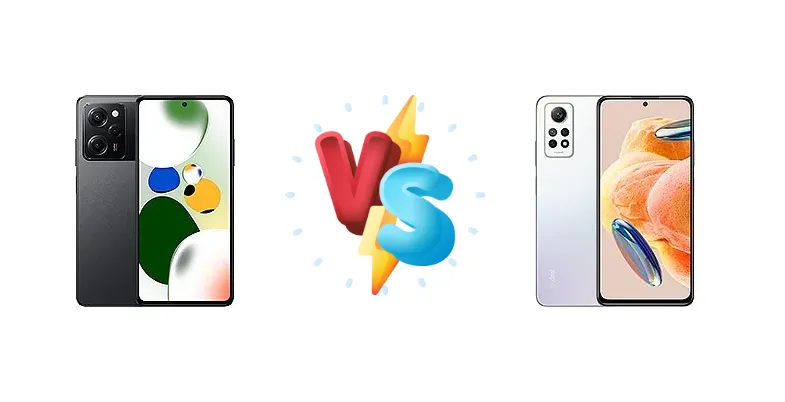
The Xiaomi Redmi Note series is renowned for offering excellent value. But with two versions of the Note 12 Pro – the Speed (5G) and the 4G – choosing the right one can be confusing. This comprehensive comparison will dissect their differences to help you make an informed decision.
🏆 Quick Verdict
The Redmi Note 12 Pro Speed is the clear winner for most users thanks to its significantly faster Snapdragon 778G 5G chipset, 5G connectivity, and faster charging protocol (PD3.0). However, the 4G version might be a better choice for those prioritizing budget and don't need 5G.
| Network |
|---|
| 2G bands | GSM 850 / 900 / 1800 / 1900 | GSM 850 / 900 / 1800 / 1900 |
| 3G bands | HSDPA 850 / 900 / 2100 | HSDPA 850 / 900 / 1700(AWS) / 1900 / 2100 |
| 4G bands | 1, 3, 5, 8, 19, 34, 38, 39, 40, 41 | 1, 2, 3, 4, 5, 7, 8, 20, 28, 38, 40, 41, 66 |
| 5G bands | 1, 3, 5, 8, 28, 38, 41, 77, 78 SA/NSA | - |
| Speed | HSPA, LTE, 5G | HSPA, LTE |
| Technology | GSM / CDMA / HSPA / CDMA2000 / LTE / 5G | GSM / HSPA / LTE |
| | CDMA2000 1x | - |
| Launch |
|---|
| Announced | 2022, December 27 | 2023, March 03 |
| Status | Available. Released 2022, December 27 | Available. Released 2023, April 11 |
| Body |
|---|
| Dimensions | 162.9 x 76 x 7.9 mm (6.41 x 2.99 x 0.31 in) | 164.2 x 76.1 x 8.1 mm (6.46 x 3.00 x 0.32 in) |
| SIM | Nano-SIM + Nano-SIM | Nano-SIM + Nano-SIM |
| Weight | 181 g (6.38 oz) | 201.8 g (7.13 oz) |
| | IP53, dust and splash resistant | - |
| Display |
|---|
| Resolution | 1080 x 2400 pixels, 20:9 ratio (~395 ppi density) | 1080 x 2400 pixels, 20:9 ratio (~395 ppi density) |
| Size | 6.67 inches, 107.4 cm2 (~86.8% screen-to-body ratio) | 6.67 inches, 107.4 cm2 (~86.0% screen-to-body ratio) |
| Type | OLED, 1B colors, 120Hz, Dolby Vision, HDR10+, 500 nits (typ), 900 nits (HBM) | AMOLED, 120Hz, Dolby Vision, 700 nits (HBM), 1100 nits (peak) |
| Platform |
|---|
| CPU | Octa-core (1x2.4 GHz Cortex-A78 & 3x2.2 GHz Cortex-A78 & 4x1.9 GHz Cortex-A55) | Octa-core (2x2.2 GHz Kryo 470 Gold & 6x1.8 GHz Kryo 470 Silver) |
| Chipset | Qualcomm SM7325 Snapdragon 778G 5G (6 nm) | Qualcomm SM7150 Snapdragon 732G (8 nm) |
| GPU | Adreno 642L | Adreno 618 |
| OS | Android 13, MIUI 14 | Android 11, MIUI 13 |
| Memory |
|---|
| Card slot | No | microSDXC (uses shared SIM slot) |
| Internal | 128GB 6GB RAM, 256GB 8GB RAM, 256GB 12GB RAM | 128GB 6GB RAM, 128GB 8GB RAM, 256GB 8GB RAM |
| | UFS 2.2 | UFS 2.2 |
| Main Camera |
|---|
| Features | LED flash, HDR, panorama | LED flash, HDR, panorama |
| Quad | - | 108 MP, f/1.9, (wide), 1/1.52", 0.7µm, PDAF
8 MP, 120˚, (ultrawide)
2 MP (macro)
Auxiliary lens |
| Triple | 108 MP, f/1.9, (wide), 1/1.52", 0.7µm, PDAF
8 MP, 119˚ (ultrawide), 1/4.0", 1.12µm
2 MP (macro) | - |
| Video | 4K@30fps, 1080p@30/60/120fps, 720p@960fps, gyro-EIS | 4K@30fps, 1080p@30/60fps |
| Selfie camera |
|---|
| Features | HDR | - |
| Single | 16 MP, (wide), 1/3.06", 1.0µm | 16 MP, f/2.4, (wide) |
| Video | 1080p@30/60fps | 1080p@30fps |
| Sound |
|---|
| 3.5mm jack | Yes | Yes |
| 35mm jack | Yes | Yes |
| Loudspeaker | Yes, with stereo speakers | Yes, with stereo speakers |
| | 24-bit/192kHz audio | - |
| Comms |
|---|
| Bluetooth | 5.2, A2DP, LE | 5.0, A2DP, LE |
| Infrared port | Yes | Yes |
| NFC | Yes | Yes (market/region dependent) |
| Positioning | GPS (L1), GLONASS (G1), BDS (B1I+B1c), GALILEO (E1), QZSS (L1) | GPS, GLONASS, GALILEO, BDS |
| Radio | Unspecified | Unspecified |
| USB | USB Type-C 2.0, OTG | USB Type-C 2.0, OTG |
| WLAN | Wi-Fi 802.11 a/b/g/n/ac/6, dual-band, Wi-Fi Direct | Wi-Fi 802.11 a/b/g/n/ac, dual-band |
| Features |
|---|
| Sensors | Fingerprint (side-mounted), accelerometer, gyro, proximity, compass | Fingerprint (side-mounted), accelerometer, gyro, compass |
| Battery |
|---|
| Charging | 67W wired, PD3.0, QC3+ | 67W wired |
| Type | Li-Po 5000 mAh | Li-Po 5000 mAh |
| Misc |
|---|
| Colors | Black, Blue, Green | Star Blue, Graphite Gray, Polar White, Ice blue |
| Models | 22101320C | 2209116AG, 2209116AG |
| Price | About 230 EUR | About 150 EUR |
Xiaomi Redmi Note 12 Pro Speed
- Faster Snapdragon 778G 5G chipset
- 5G Connectivity
- PD3.0 Fast Charging
- Potentially better gaming performance
- Slightly better image processing
- Potentially higher price
- May consume slightly more power under heavy load
Xiaomi Redmi Note 12 Pro 4G
- More affordable
- Good battery life
- Reliable 4G connectivity
- Sufficient performance for everyday tasks
- Slower Snapdragon 732G chipset
- No 5G support
- Older 8nm process
- Slower charging protocol
Display Comparison
Both phones likely feature a 6.67-inch AMOLED display with a 120Hz refresh rate and Full HD+ resolution. While the panels are likely similar in quality, the Speed version's faster processor might contribute to slightly smoother animations and transitions.
Camera Comparison
Both phones are expected to have a 50MP main camera, an 8MP ultrawide, and a 2MP macro lens. Image quality should be comparable in good lighting conditions, but the Speed's more powerful processor could lead to slightly better image processing and low-light performance.
Performance
This is where the biggest difference lies. The Snapdragon 778G 5G in the Speed model offers a substantial performance boost over the Snapdragon 732G in the 4G version. Expect faster app loading times, smoother multitasking, and better gaming performance on the Speed.
Battery Life
Both devices are equipped with a 5000mAh battery. While battery life should be similar in typical usage, the Speed's more efficient 6nm chipset might offer a slight edge in longevity.
Buying Guide
The Redmi Note 12 Pro Speed is ideal for users who want a smooth, responsive experience, faster download speeds, and future-proof 5G connectivity. The Redmi Note 12 Pro 4G is a good option for budget-conscious buyers who primarily use 4G networks and don't require the extra performance.
Frequently Asked Questions
❓ Is the Redmi Note 12 Pro Speed worth the extra cost?
If you value performance, 5G connectivity, and faster charging, then yes. The Snapdragon 778G 5G is a significant upgrade.
❓ Can the Redmi Note 12 Pro 4G handle gaming?
It can handle casual games, but demanding titles might experience lag or reduced frame rates compared to the Speed version.
❓ What is PD3.0 charging?
PD3.0 (Power Delivery 3.0) is a faster charging standard that allows for quicker charging speeds compared to the older QC3+ standard.