
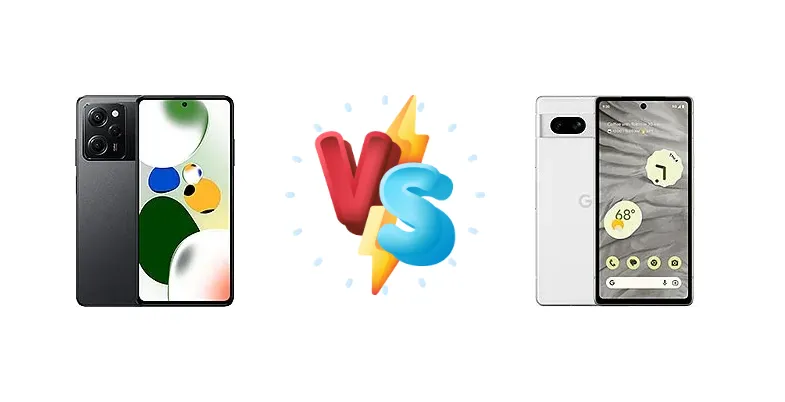
Xiaomi Redmi Note 12 Pro Speed vs. Google Pixel 7a: A Detailed Comparison
| Phones Images | |||||
|---|---|---|---|---|---|
|
🏆 Quick Verdict
For the average user prioritizing camera quality and software support, the Google Pixel 7a is the superior choice. However, gamers and those who frequently transfer large files will appreciate the Redmi Note 12 Pro Speed’s faster chipset and significantly quicker 67W charging.
| PHONES | ||
|---|---|---|
| Phone Names | Xiaomi Redmi Note 12 Pro Speed | Google Pixel 7a |
| Network | ||
|---|---|---|
| 2G bands | GSM 850 / 900 / 1800 / 1900 | GSM 850 / 900 / 1800 / 1900 |
| 3G bands | HSDPA 850 / 900 / 2100 | HSDPA 800 / 850 / 900 / 1700(AWS) / 1900 / 2100 |
| 4G bands | 1, 3, 5, 8, 19, 34, 38, 39, 40, 41 | 1, 2, 3, 4, 5, 7, 8, 12, 13, 14, 17, 20, 25, 26, 28, 29, 30, 38, 40, 41, 48, 66, 71 - GWKK3, G0DZQ |
| 5G bands | 1, 3, 5, 8, 28, 38, 41, 77, 78 SA/NSA | 1, 2, 3, 5, 7, 8, 12, 14, 20, 25, 28, 30, 38, 41, 48, 66, 71, 77, 78 SA/NSA/Sub6 - GWKK3 |
| Speed | HSPA, LTE, 5G | HSPA, LTE, 5G |
| Technology | GSM / CDMA / HSPA / CDMA2000 / LTE / 5G | GSM / HSPA / LTE / 5G |
| CDMA2000 1x | 1, 2, 3, 5, 7, 8, 12, 20, 25, 28, 38, 40, 41, 66, 75, 76, 77, 78, 79 SA/NSA/Sub6 - GHL1X, G82U8 | |
| Launch | ||
|---|---|---|
| Announced | 2022, December 27 | 2023, May 10 |
| Status | Available. Released 2022, December 27 | Available. Released 2023, May 10 |
| Body | ||
|---|---|---|
| Build | - | Glass front (Gorilla Glass 3), aluminum frame, plastic back |
| Dimensions | 162.9 x 76 x 7.9 mm (6.41 x 2.99 x 0.31 in) | 152 x 72.9 x 9 mm (5.98 x 2.87 x 0.35 in) |
| SIM | Nano-SIM + Nano-SIM | Nano-SIM + eSIM |
| Weight | 181 g (6.38 oz) | 193.5 g (6.84 oz) |
| IP53, dust and splash resistant | IP67 dust/water resistant (up to 1m for 30 min) | |
| Display | ||
|---|---|---|
| Protection | - | Corning Gorilla Glass 3 |
| Resolution | 1080 x 2400 pixels, 20:9 ratio (~395 ppi density) | 1080 x 2400 pixels, 20:9 ratio (~429 ppi density) |
| Size | 6.67 inches, 107.4 cm2 (~86.8% screen-to-body ratio) | 6.1 inches, 90.7 cm2 (~81.8% screen-to-body ratio) |
| Type | OLED, 1B colors, 120Hz, Dolby Vision, HDR10+, 500 nits (typ), 900 nits (HBM) | OLED, HDR, 90Hz |
| - | Always-on display | |
| Platform | ||
|---|---|---|
| CPU | Octa-core (1x2.4 GHz Cortex-A78 & 3x2.2 GHz Cortex-A78 & 4x1.9 GHz Cortex-A55) | Octa-core (2x2.85 GHz Cortex-X1 & 2x2.35 GHz Cortex-A78 & 4x1.80 GHz Cortex-A55) |
| Chipset | Qualcomm SM7325 Snapdragon 778G 5G (6 nm) | Google Tensor G2 (5 nm) |
| GPU | Adreno 642L | Mali-G710 MP7 |
| OS | Android 13, MIUI 14 | Android 13, upgradable to Android 15, up to 5 major Android upgrades |
| Memory | ||
|---|---|---|
| Card slot | No | No |
| Internal | 128GB 6GB RAM, 256GB 8GB RAM, 256GB 12GB RAM | 128GB 8GB RAM |
| UFS 2.2 | UFS 3.1 | |
| Main Camera | ||
|---|---|---|
| Dual | - | 64 MP, f/1.9, 26mm (wide), 1/1.73", 0.8µm, dual pixel PDAF, OIS 13 MP, f/2.2, 120˚ (ultrawide), 1.12µm |
| Features | LED flash, HDR, panorama | Dual-LED flash, Pixel Shift, Auto-HDR, panorama |
| Triple | 108 MP, f/1.9, (wide), 1/1.52", 0.7µm, PDAF 8 MP, 119˚ (ultrawide), 1/4.0", 1.12µm 2 MP (macro) | - |
| Video | 4K@30fps, 1080p@30/60/120fps, 720p@960fps, gyro-EIS | 4K@30/60fps, 1080p@30/60/120/240fps, OIS |
| Selfie camera | ||
|---|---|---|
| Features | HDR | HDR, panorama |
| Single | 16 MP, (wide), 1/3.06", 1.0µm | 13 MP, f/2.2, 20mm (ultrawide), 1.12µm |
| Video | 1080p@30/60fps | 4K@30fps, 1080p@30fps |
| Sound | ||
|---|---|---|
| 3.5mm jack | Yes | No |
| 35mm jack | Yes | No |
| Loudspeaker | Yes, with stereo speakers | Yes, with stereo speakers |
| 24-bit/192kHz audio | - | |
| Comms | ||
|---|---|---|
| Bluetooth | 5.2, A2DP, LE | 5.3, A2DP, LE |
| Infrared port | Yes | - |
| NFC | Yes | Yes |
| Positioning | GPS (L1), GLONASS (G1), BDS (B1I+B1c), GALILEO (E1), QZSS (L1) | GPS, GLONASS, GALILEO, BDS, QZSS, NavIC |
| Radio | Unspecified | No |
| USB | USB Type-C 2.0, OTG | USB Type-C 3.2 |
| WLAN | Wi-Fi 802.11 a/b/g/n/ac/6, dual-band, Wi-Fi Direct | Wi-Fi 802.11 a/b/g/n/ac/6e, tri-band |
| Features | ||
|---|---|---|
| Sensors | Fingerprint (side-mounted), accelerometer, gyro, proximity, compass | Fingerprint (under display, optical), accelerometer, gyro, proximity, compass, barometer |
| Battery | ||
|---|---|---|
| Charging | 67W wired, PD3.0, QC3+ | 18W wired, PD3.0 7.5W wireless |
| Type | Li-Po 5000 mAh | Li-Po 4385 mAh |
| Misc | ||
|---|---|---|
| Colors | Black, Blue, Green | Charcoal, Snow, Sea, Coral |
| Models | 22101320C | GWKK3, GHL1X, G0DZQ, G82U8 |
| Price | About 230 EUR | € 179.90 / $ 150.00 / £ 170.00 / ₹ 25,980 |
Xiaomi Redmi Note 12 Pro Speed
- Significantly faster 67W charging
- Potentially better gaming performance with Snapdragon 778G 5G
- Likely more affordable price point
- Inferior camera system compared to Pixel 7a
- Less frequent software updates
- Unknown display brightness and quality
Google Pixel 7a
- Exceptional camera quality and image processing
- Clean and consistently updated Android experience
- Bright and vibrant OLED display
- Slow 18W charging
- Less powerful chipset for demanding tasks
- Higher price point
Display Comparison
The Pixel 7a boasts a measured peak brightness of 1070 nits, suggesting a more visible display in direct sunlight compared to the Redmi Note 12 Pro Speed (brightness data unavailable). While the Redmi Note 12 Pro Speed’s panel specifics are unknown, the Pixel 7a’s OLED panel delivers vibrant colors and deep blacks. The Pixel 7a’s display is likely to have a higher pixel density, resulting in sharper images. The absence of LTPO technology on either device means refresh rate scaling isn’t as efficient as on flagship models, but both likely offer a 90Hz or 120Hz refresh rate for smoother scrolling.
Camera Comparison
The Pixel 7a’s camera system is its standout feature, leveraging Google’s renowned computational photography expertise. While specific sensor sizes are not provided, the Pixel 7a excels in dynamic range, low-light performance, and image processing. The Tensor G2 chip’s image signal processor (ISP) plays a critical role in delivering consistently excellent results. The Redmi Note 12 Pro Speed’s camera capabilities are less emphasized in the provided data, suggesting a more standard mid-range camera experience. The Pixel 7a’s video recording capabilities are also likely superior, benefiting from the Tensor G2’s advanced video processing algorithms. Ignoring the likely present 2MP macro sensors on both devices, the Pixel 7a’s overall camera system is expected to deliver more consistently impressive results.
Performance
The Google Pixel 7a’s Tensor G2 (5nm) chipset, featuring 2x2.85 GHz Cortex-X1 cores, demonstrably outperforms the Xiaomi Redmi Note 12 Pro Speed’s Snapdragon 778G 5G (6nm) in CPU-intensive tasks. The Cortex-X1 cores provide a significant boost in single-core performance, crucial for app launch speeds and responsiveness. While the Snapdragon 778G 5G is still a capable performer, the Tensor G2’s architecture and 5nm process offer superior efficiency and sustained performance. The Redmi Note 12 Pro Speed’s octa-core configuration (1x2.4 GHz Cortex-A78, 3x2.2 GHz Cortex-A78, 4x1.9 GHz Cortex-A55) is well-balanced, but ultimately lacks the raw power of the Pixel 7a’s flagship-tier processor. Both devices likely utilize LPDDR5 RAM, but the Pixel 7a’s optimized software and chip integration will likely result in smoother multitasking.
Battery Life
The Google Pixel 7a has an endurance rating of 76 hours, indicating solid battery life. However, the Redmi Note 12 Pro Speed compensates for a potentially smaller battery (data unavailable) with its blazing-fast 67W wired charging, supporting PD3.0 and QC3+. This allows for a full charge in under 45 minutes, a significant advantage over the Pixel 7a’s 18W charging. The Pixel 7a also offers 7.5W wireless charging, a feature absent on the Redmi Note 12 Pro Speed. For users who prioritize minimizing downtime, the Redmi Note 12 Pro Speed’s charging speed is a game-changer.
Buying Guide
Buy the Xiaomi Redmi Note 12 Pro Speed if you need a phone for demanding mobile games, frequent large file transfers, and value incredibly fast charging. Its Snapdragon 778G 5G offers a performance edge for these tasks. Buy the Google Pixel 7a if you prioritize exceptional camera quality, a clean and consistently updated Android experience, and intelligent features powered by Google’s Tensor G2 chip.