
Xiaomi Redmi Note 12 Pro+ vs Redmi Note 12 Pro: A Detailed Showdown
| Phones Images | |||||
|---|---|---|---|---|---|
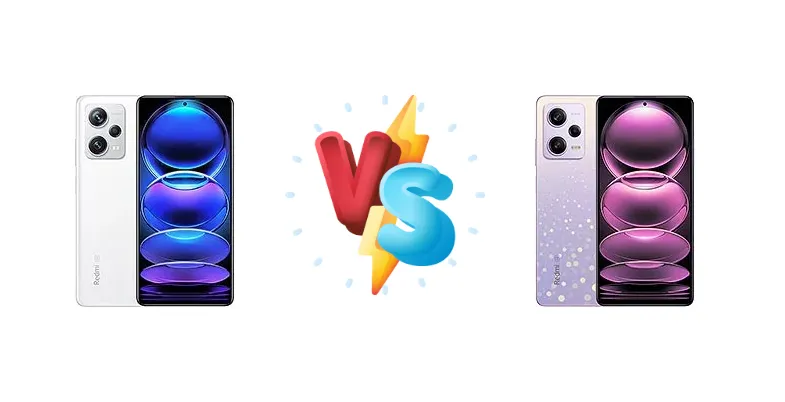
|
🏆 Quick Verdict
The Redmi Note 12 Pro+ boasts significantly faster 120W charging and potentially a slightly better camera system, but the Pro offers a brighter display and a more competitive price. For speed demons and camera enthusiasts, the Pro+ wins; otherwise, the Pro is a fantastic value.
| PHONES | ||
|---|---|---|
| Phone Names | Xiaomi Redmi Note 12 Pro+ | Xiaomi Redmi Note 12 Pro |
| Network | ||
|---|---|---|
| 2G bands | GSM 850 / 900 / 1800 / 1900 - SIM 1 & SIM 2 | GSM 850 / 900 / 1800 / 1900 |
| 3G bands | HSDPA 800 / 850 / 900 / 1900 / 2100 | HSDPA 800 / 850 / 900 / 1900 / 2100 |
| 4G bands | 1, 3, 5, 8, 19, 34, 38, 39, 40, 41 - International, China | 1, 2, 3, 4, 5, 7, 8, 12, 13, 17, 18, 19, 20, 26, 28, 32, 38, 40, 41, 66 - International |
| 5G bands | 1, 3, 5, 8, 28, 38, 40, 41, 77, 78 SA/NSA - International | 1, 3, 5, 7, 8, 20, 28, 38, 40, 41, 66, 77, 78 SA/NSA - International |
| Speed | HSPA, LTE-A (CA), 5G | HSPA, LTE, 5G |
| Technology | GSM / CDMA / HSPA / EVDO / LTE / 5G | GSM / CDMA / HSPA / EVDO / LTE / 5G |
| 1, 3, 5, 8, 28, 38, 41, 77, 78 SA/NSA - China | 1, 3, 5, 8, 28, 38, 41, 77, 78 SA/NSA - China | |
| Launch | ||
|---|---|---|
| Announced | 2022, October 27 | 2022, October 27 |
| Status | Available. Released 2022, November 01 | Available. Released 2022, November 01 |
| Body | ||
|---|---|---|
| Build | Glass front (Gorilla Glass 5), glass back | Glass front (Gorilla Glass 5), glass back, plastic frame |
| Dimensions | 162.9 x 76 x 8.9 mm (6.41 x 2.99 x 0.35 in) | 163 x 76 x 8 mm (6.42 x 2.99 x 0.31 in) |
| SIM | Dual SIM (Nano-SIM, dual stand-by) | Nano-SIM + Nano-SIM |
| Weight | 208.4 g (7.34 oz) | 187 g (6.60 oz) |
| IP53, dust and splash resistant | IP53, dust and splash resistant | |
| Display | ||
|---|---|---|
| Protection | Corning Gorilla Glass 5 | Corning Gorilla Glass 5 |
| Resolution | 1080 x 2400 pixels, 20:9 ratio (~395 ppi density) | 1080 x 2400 pixels, 20:9 ratio (~395 ppi density) |
| Size | 6.67 inches, 107.4 cm2 (~86.8% screen-to-body ratio) | 6.67 inches, 107.4 cm2 (~86.7% screen-to-body ratio) |
| Type | OLED, 1B colors, 120Hz, Dolby Vision, HDR10+, 500 nits (typ), 900 nits (HBM) | AMOLED, 1B colors, 120Hz, Dolby Vision, HDR10+, 500 nits (typ), 900 nits (HBM) |
| Platform | ||
|---|---|---|
| CPU | Octa-core (2x2.6 GHz Cortex-A78 & 6x2.0 GHz Cortex-A55) | Octa-core (2x2.6 GHz Cortex-A78 & 6x2.0 GHz Cortex-A55) |
| Chipset | Mediatek MT6877V Dimensity 1080 (6 nm) | Mediatek Dimensity 1080 (6 nm) |
| GPU | Mali-G68 MC4 | Mali-G68 MC4 |
| OS | Android 12, MIUI 13 | Android 12, MIUI 13 |
| Memory | ||
|---|---|---|
| Card slot | No | No |
| Internal | 256GB 8GB RAM, 256GB 12GB RAM | 128GB 6GB RAM, 128GB 8GB RAM, 256GB 8GB RAM, 256GB 12GB RAM |
| UFS 2.2 | UFS 2.2 | |
| Main Camera | ||
|---|---|---|
| Features | Dual-LED dual-tone flash, HDR, panorama | Dual-LED dual-tone flash, HDR, panorama |
| Triple | 200 MP, f/1.7, 24mm (wide), 1/1.4", 0.56µm, PDAF, OIS 8 MP, f/2.2, 120˚ (ultrawide), 1/4", 1.12µm 2 MP, f/2.4, (macro) | 50 MP, f/1.9, 24mm (wide), 1/1.56", 1.0µm, PDAF, OIS 8 MP, f/2.2, 120˚ (ultrawide), 1/4.0", 1.12µm 2 MP (macro) |
| Video | 4K@30fps, 1080p@30/60/120fps, 720p@960fps | 4K@30fps, 1080p@30/60/120fps, 720p@960fps |
| Selfie camera | ||
|---|---|---|
| Features | HDR | HDR |
| Single | 16 MP, f/2.5, (wide), 1/3.06", 1.0µm | 16 MP, f/2.5, (wide), 1/3.06", 1.0µm |
| Video | 1080p@30/60fps | 1080p@30/60fps |
| Sound | ||
|---|---|---|
| 3.5mm jack | Yes | Yes |
| 35mm jack | - | Yes |
| Loudspeaker | Yes, with stereo speakers | Yes, with stereo speakers |
| 24-bit/192kHz audio | 24-bit/192kHz audio | |
| Comms | ||
|---|---|---|
| Bluetooth | 5.2, A2DP, LE | 5.2, A2DP, LE |
| Infrared port | Yes | Yes |
| NFC | Yes (market/region dependent) | Yes (market/region dependent) |
| Positioning | GPS (L1), GLONASS (G1), BDS (B1I+B1c), GALILEO (E1), QZSS (L1) | GPS (L1), GLONASS (G1), BDS (B1I+B1c), GALILEO (E1), QZSS (L1) |
| Radio | No | No |
| USB | USB Type-C 2.0, OTG | USB Type-C 2.0, OTG |
| WLAN | Wi-Fi 802.11 a/b/g/n/ac/6, dual-band, Wi-Fi Direct | Wi-Fi 802.11 a/b/g/n/ac/6, dual-band, Wi-Fi Direct |
| Features | ||
|---|---|---|
| Sensors | Fingerprint (side-mounted), accelerometer, proximity, gyro, compass | Fingerprint (side-mounted), accelerometer, gyro, proximity, compass |
| Battery | ||
|---|---|---|
| Charging | 120W wired, PD3.0, 100% in 19 min (advertised) | 67W wired, PD3.0, 50% in 15 min, 100% in 46 min |
| Type | Li-Po 5000 mAh, non-removable | Li-Po 5000 mAh |
| Misc | ||
|---|---|---|
| Colors | Arctic White, Iceberg Blue, Obsidian Black, Trend edition | Frosted Blue (Sky Blue), Onyx Black (Midnight Black), Polar White, Stardust Purple |
| Models | 22101316UCP, 22101316UG | 22101316C, 22101316I, 23013RK75C, 22101316G |
| Price | $ 348.00 / £ 439.00 / € 399.00 / ₹ 29,949 | € 148.54 / $ 142.17 / £ 149.99 / ₹ 19,999 |
| SAR | - | 1.09 W/kg (head) 1.06 W/kg (body) |
| SAR EU | - | 0.99 W/kg (head) 0.99 W/kg (body) |
| Tests | ||
|---|---|---|
| Battery life | Endurance rating 88h | Endurance rating 97h |
| Camera | Photo / Video | Photo / Video |
| Display | Contrast ratio: Infinite (nominal) | Contrast ratio: Infinite (nominal) |
| Loudspeaker | -26.7 LUFS (Good) | -26.6 LUFS (Good) |
| Performance | AnTuTu: 498710 (v9) GeekBench: 2208 (v5.1), 2372 (v6) GFXBench: 22fps (ES 3.1 onscreen) | AnTuTu: 490526 (v9) GeekBench: 2209 (v5.1), 2372 (v6) GFXBench: 22fps (ES 3.1 onscreen) |
Xiaomi Redmi Note 12 Pro+
- 120W Super-Fast Charging
- Potentially Superior Camera (200MP)
- Sleek Design
- Good Performance
- Higher Price
- Unconfirmed Camera Specs
- Potentially Less Bright Display
Xiaomi Redmi Note 12 Pro
- Brighter Display (890 nits)
- Competitive Price
- Excellent Battery Life (97h Endurance)
- Solid Performance
- Slower Charging (67W)
- Potentially Less Detailed Camera
Display Comparison
The Redmi Note 12 Pro+ advertises an 'infinite' contrast ratio, a common marketing term. However, the Redmi Note 12 Pro measures a more concrete 890 nits of peak brightness, making it noticeably better for outdoor visibility. Both phones feature AMOLED displays with vibrant colors and smooth 120Hz refresh rates, but the Pro's brightness edge is significant.
Camera Comparison
The Redmi Note 12 Pro+ is rumored to have a 200MP main camera, a significant upgrade over the Pro's likely 50MP or 108MP sensor (specifications are not fully confirmed). This could translate to more detailed photos and better low-light performance on the Pro+. Both phones offer video recording capabilities, but the Pro+ may offer slightly improved stabilization or higher resolution options.
Performance
Both devices share the same Mediatek Dimensity 1080 chipset and CPU configuration. Expect similar performance in everyday tasks and gaming. While the Pro+ might have slightly better thermal management due to potentially improved cooling, the difference in real-world performance will be minimal for most users.
Battery Life
The Redmi Note 12 Pro+ boasts a claimed 120W charging speed, capable of charging from 0% to 100% in around 19 minutes. The Redmi Note 12 Pro offers 67W charging, taking approximately 46 minutes for a full charge. Both phones have similar battery capacities, and the endurance rating suggests comparable battery life during active use (around 12 hours). The Pro+'s charging speed is a major advantage.
Buying Guide
Who should buy the Xiaomi Redmi Note 12 Pro+? Users prioritizing incredibly fast charging and potentially superior camera capabilities, and are willing to pay a premium. Who should buy the Xiaomi Redmi Note 12 Pro? Budget-conscious buyers seeking a well-rounded smartphone with a bright display, solid performance, and excellent battery life.