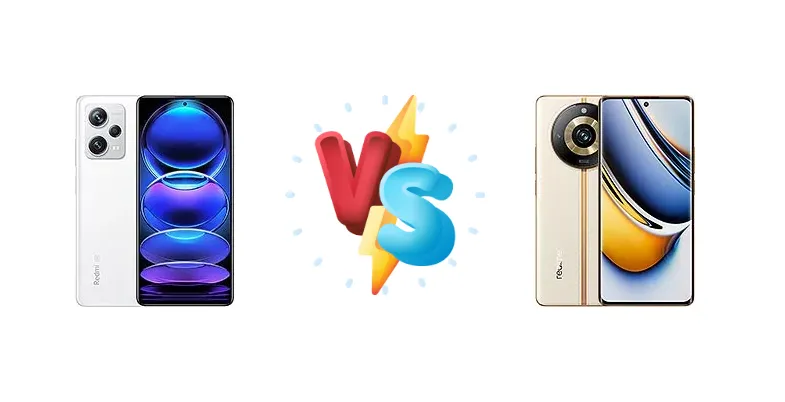
The mid-range smartphone market is fiercely competitive, and the Xiaomi Redmi Note 12 Pro+ and Realme 11 Pro+ are two of the strongest contenders. Both offer impressive features at attractive price points, but which one truly reigns supreme? Let's dive into a comprehensive comparison to help you decide.
🏆 Quick Verdict
The Redmi Note 12 Pro+ boasts significantly faster charging and a potentially more powerful chipset. However, the Realme 11 Pro+ excels in battery endurance and offers a brighter display. Ultimately, the choice depends on your priorities: speed vs. longevity.
| Network |
|---|
| 2G bands | GSM 850 / 900 / 1800 / 1900 - SIM 1 & SIM 2 | GSM 850 / 900 / 1800 / 1900 |
| 3G bands | HSDPA 800 / 850 / 900 / 1900 / 2100 | HSDPA 850 / 900 / 2100 |
| 4G bands | 1, 3, 5, 8, 19, 34, 38, 39, 40, 41 - International, China | 1, 3, 5, 8, 28, 38, 40, 41 - India |
| 5G bands | 1, 3, 5, 8, 28, 38, 40, 41, 77, 78 SA/NSA - International | 1, 3, 5, 8, 28, 40, 41, 77, 78 SA/NSA - International |
| Speed | HSPA, LTE-A (CA), 5G | HSPA, LTE, 5G |
| Technology | GSM / CDMA / HSPA / EVDO / LTE / 5G | GSM / CDMA / HSPA / CDMA2000 / LTE / 5G |
| | 1, 3, 5, 8, 28, 38, 41, 77, 78 SA/NSA - China | CDMA2000 1x |
| Launch |
|---|
| Announced | 2022, October 27 | 2023, May 10 |
| Status | Available. Released 2022, November 01 | Available. Released 2023, May 15 |
| Body |
|---|
| Build | Glass front (Gorilla Glass 5), glass back | Glass front, leather or plastic back, plastic frame |
| Dimensions | 162.9 x 76 x 8.9 mm (6.41 x 2.99 x 0.35 in) | 161.6 x 73.9 x 8.2 mm or 8.7 mm |
| SIM | Dual SIM (Nano-SIM, dual stand-by) | Nano-SIM + Nano-SIM |
| Weight | 208.4 g (7.34 oz) | 183 g or 189 g (6.46 oz) |
| | IP53, dust and splash resistant | - |
| Display |
|---|
| Protection | Corning Gorilla Glass 5 | - |
| Resolution | 1080 x 2400 pixels, 20:9 ratio (~395 ppi density) | 1080 x 2412 pixels, 20:9 ratio (~394 ppi density) |
| Size | 6.67 inches, 107.4 cm2 (~86.8% screen-to-body ratio) | 6.7 inches, 108.0 cm2 (~90.5% screen-to-body ratio) |
| Type | OLED, 1B colors, 120Hz, Dolby Vision, HDR10+, 500 nits (typ), 900 nits (HBM) | AMOLED, 1B colors, HDR10+, 120Hz, 950 nits (peak) |
| Platform |
|---|
| CPU | Octa-core (2x2.6 GHz Cortex-A78 & 6x2.0 GHz Cortex-A55) | Octa-core (2x2.6 GHz Cortex-A78 & 6x2.0 GHz Cortex-A55) |
| Chipset | Mediatek MT6877V Dimensity 1080 (6 nm) | Mediatek Dimensity 7050 (6 nm) |
| GPU | Mali-G68 MC4 | Mali-G68 MC4 |
| OS | Android 12, MIUI 13 | Android 13, up to 2 major Android upgrades, Realme UI 5.0 |
| Memory |
|---|
| Card slot | No | No |
| Internal | 256GB 8GB RAM, 256GB 12GB RAM | 256GB 8GB RAM, 256GB 12GB RAM, 512GB 12GB RAM, 1TB 12GB RAM |
| | UFS 2.2 | - |
| Main Camera |
|---|
| Features | Dual-LED dual-tone flash, HDR, panorama | LED flash, HDR, panorama |
| Triple | 200 MP, f/1.7, 24mm (wide), 1/1.4", 0.56µm, PDAF, OIS
8 MP, f/2.2, 120˚ (ultrawide), 1/4", 1.12µm
2 MP, f/2.4, (macro) | 200 MP, f/1.7, 23mm (wide), 1/1.4", 0.56µm, PDAF, OIS
8 MP, f/2.2, 16mm, 112˚ (ultrawide)
2 MP (macro) |
| Video | 4K@30fps, 1080p@30/60/120fps, 720p@960fps | 4K@30fps, 1080p@30/60/120/480fps, 720p@960fps, gyro-EIS |
| Selfie camera |
|---|
| Features | HDR | Panorama |
| Single | 16 MP, f/2.5, (wide), 1/3.06", 1.0µm | 32 MP, f/2.5, 22mm (wide) |
| Video | 1080p@30/60fps | 1080p@30fps |
| Sound |
|---|
| 3.5mm jack | Yes | No |
| 35mm jack | - | No |
| Loudspeaker | Yes, with stereo speakers | Yes, with stereo speakers |
| | 24-bit/192kHz audio | 24-bit/192kHz audio |
| Comms |
|---|
| Bluetooth | 5.2, A2DP, LE | 5.2, A2DP, LE, aptX HD |
| Infrared port | Yes | - |
| NFC | Yes (market/region dependent) | Yes |
| Positioning | GPS (L1), GLONASS (G1), BDS (B1I+B1c), GALILEO (E1), QZSS (L1) | GPS, GLONASS, GALILEO, BDS, QZSS, NavIC |
| Radio | No | No |
| USB | USB Type-C 2.0, OTG | USB Type-C 2.0 |
| WLAN | Wi-Fi 802.11 a/b/g/n/ac/6, dual-band, Wi-Fi Direct | Wi-Fi 802.11 a/b/g/n/ac/6, dual-band |
| Features |
|---|
| Sensors | Fingerprint (side-mounted), accelerometer, proximity, gyro, compass | Fingerprint (under display, optical), accelerometer, gyro, proximity, compass |
| Battery |
|---|
| Charging | 120W wired, PD3.0, 100% in 19 min (advertised) | 100W wired |
| Type | Li-Po 5000 mAh, non-removable | 5000 mAh |
| Misc |
|---|
| Colors | Arctic White, Iceberg Blue, Obsidian Black, Trend edition | Astral Black, Sunrise Beige, Oasis Green |
| Models | 22101316UCP, 22101316UG | RMX3740, RMX3741 |
| Price | $ 348.00 / £ 439.00 / € 399.00 / ₹ 29,949 | € 399.90 / ₹ 27,990 |
| Tests |
|---|
| Battery life |
Endurance rating 88h
| - |
| Camera |
Photo / Video | - |
| Display |
Contrast ratio: Infinite (nominal) | - |
| Loudspeaker |
-26.7 LUFS (Good)
| - |
| Performance |
AnTuTu: 498710 (v9)
GeekBench: 2208 (v5.1), 2372 (v6)
GFXBench: 22fps (ES 3.1 onscreen) | - |
Xiaomi Redmi Note 12 Pro+
- Faster Charging (120W)
- Potentially More Powerful Chipset (Dimensity 1080)
- Vibrant AMOLED Display
- Good Value for Money
- Lower Battery Endurance
- Nominal Contrast Ratio Specification
- Camera Performance Needs Further Evaluation
Realme 11 Pro+
- Excellent Battery Life (112h Endurance)
- Brighter Display (793 nits)
- Clean User Interface
- Stylish Design
- Slightly Less Powerful Chipset (Dimensity 7050)
- Slower Charging (100W)
- Camera Performance Needs Further Evaluation
Display Comparison
Both phones feature AMOLED displays, but the Realme 11 Pro+ takes the lead with a measured peak brightness of 793 nits, making it easier to see in direct sunlight. The Redmi Note 12 Pro+ boasts an 'infinite' contrast ratio, which is a nominal value and doesn't provide a concrete comparison point. Color accuracy and refresh rates (likely 120Hz on both) are expected to be similar.
Camera Comparison
Camera performance is subjective and requires detailed testing. Both phones are advertised as having 'Photo / Video' capabilities, but specifics like sensor size, aperture, and software processing are crucial. Expect both to offer versatile camera systems with multiple lenses, including a main sensor, ultrawide, and potentially a macro lens. Low-light performance and video stabilization will be key differentiators.
Performance
The Redmi Note 12 Pro+ utilizes the Dimensity 1080, generally considered a slightly more powerful chipset than the Dimensity 7050 in the Realme 11 Pro+. This translates to potentially smoother performance in demanding games and applications. Both feature octa-core CPUs with similar core configurations, but the Dimensity 1080's GPU typically offers a slight edge.
Battery Life
The Realme 11 Pro+ clearly wins in the battery department, boasting an endurance rating of 112h compared to the Redmi Note 12 Pro+'s 88h. While the Redmi Note 12 Pro+ compensates with incredibly fast 120W charging (advertised 19-minute full charge), the Realme 11 Pro+'s larger battery provides significantly longer usage time between charges.
Buying Guide
The Xiaomi Redmi Note 12 Pro+ is ideal for users who prioritize fast charging, gaming performance, and a vibrant display. The Realme 11 Pro+ is a better fit for those who value long battery life, a brighter screen for outdoor visibility, and a more streamlined user experience.
Frequently Asked Questions
❓ Which phone is better for gaming?
The Redmi Note 12 Pro+ likely offers slightly better gaming performance due to its Dimensity 1080 chipset.
❓ How long does the Realme 11 Pro+'s battery last?
The Realme 11 Pro+ boasts an impressive endurance rating of 112 hours, suggesting excellent battery life.
❓ Is the 120W charging on the Redmi Note 12 Pro+ worth it?
Yes, the 120W charging is incredibly fast, allowing for a full charge in under 20 minutes, which is a significant convenience.
❓ Which phone has a better camera?
It's difficult to say definitively without extensive camera testing. Both phones offer versatile camera systems, but their strengths and weaknesses will depend on specific scenarios.