
Xiaomi Redmi Note 12 Pro vs Redmi Note 12 Pro 4G: The Ultimate Showdown
| Phones Images | |||||
|---|---|---|---|---|---|
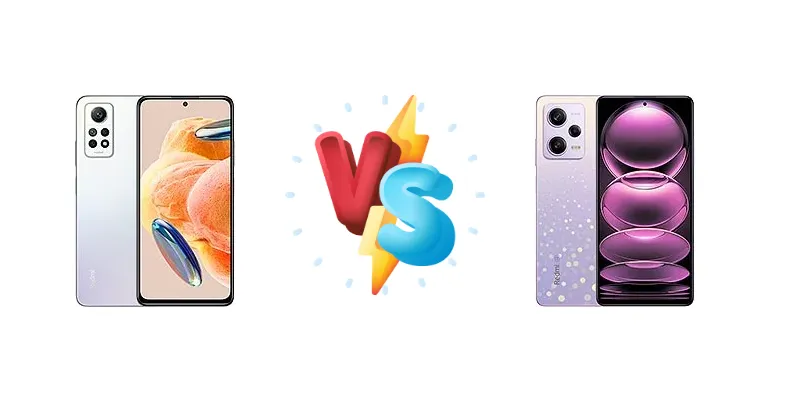
|
🏆 Quick Verdict
The Redmi Note 12 Pro edges out the 4G variant thanks to its superior Dimensity 1080 chipset, offering better performance and 5G connectivity. While both boast excellent battery life and 67W charging, the Pro's faster charging speeds and brighter display give it a slight advantage.
| PHONES | ||
|---|---|---|
| Phone Names | Xiaomi Redmi Note 12 Pro 4G | Xiaomi Redmi Note 12 Pro |
| Network | ||
|---|---|---|
| 2G bands | GSM 850 / 900 / 1800 / 1900 | GSM 850 / 900 / 1800 / 1900 |
| 3G bands | HSDPA 850 / 900 / 1700(AWS) / 1900 / 2100 | HSDPA 800 / 850 / 900 / 1900 / 2100 |
| 4G bands | 1, 2, 3, 4, 5, 7, 8, 20, 28, 38, 40, 41, 66 | 1, 2, 3, 4, 5, 7, 8, 12, 13, 17, 18, 19, 20, 26, 28, 32, 38, 40, 41, 66 - International |
| 5G bands | - | 1, 3, 5, 7, 8, 20, 28, 38, 40, 41, 66, 77, 78 SA/NSA - International |
| Speed | HSPA, LTE | HSPA, LTE, 5G |
| Technology | GSM / HSPA / LTE | GSM / CDMA / HSPA / EVDO / LTE / 5G |
| - | 1, 3, 5, 8, 28, 38, 41, 77, 78 SA/NSA - China | |
| Launch | ||
|---|---|---|
| Announced | 2023, March 03 | 2022, October 27 |
| Status | Available. Released 2023, April 11 | Available. Released 2022, November 01 |
| Body | ||
|---|---|---|
| Build | - | Glass front (Gorilla Glass 5), glass back, plastic frame |
| Dimensions | 164.2 x 76.1 x 8.1 mm (6.46 x 3.00 x 0.32 in) | 163 x 76 x 8 mm (6.42 x 2.99 x 0.31 in) |
| SIM | Nano-SIM + Nano-SIM | Nano-SIM + Nano-SIM |
| Weight | 201.8 g (7.13 oz) | 187 g (6.60 oz) |
| - | IP53, dust and splash resistant | |
| Display | ||
|---|---|---|
| Protection | - | Corning Gorilla Glass 5 |
| Resolution | 1080 x 2400 pixels, 20:9 ratio (~395 ppi density) | 1080 x 2400 pixels, 20:9 ratio (~395 ppi density) |
| Size | 6.67 inches, 107.4 cm2 (~86.0% screen-to-body ratio) | 6.67 inches, 107.4 cm2 (~86.7% screen-to-body ratio) |
| Type | AMOLED, 120Hz, Dolby Vision, 700 nits (HBM), 1100 nits (peak) | AMOLED, 1B colors, 120Hz, Dolby Vision, HDR10+, 500 nits (typ), 900 nits (HBM) |
| Platform | ||
|---|---|---|
| CPU | Octa-core (2x2.2 GHz Kryo 470 Gold & 6x1.8 GHz Kryo 470 Silver) | Octa-core (2x2.6 GHz Cortex-A78 & 6x2.0 GHz Cortex-A55) |
| Chipset | Qualcomm SM7150 Snapdragon 732G (8 nm) | Mediatek Dimensity 1080 (6 nm) |
| GPU | Adreno 618 | Mali-G68 MC4 |
| OS | Android 11, MIUI 13 | Android 12, MIUI 13 |
| Memory | ||
|---|---|---|
| Card slot | microSDXC (uses shared SIM slot) | No |
| Internal | 128GB 6GB RAM, 128GB 8GB RAM, 256GB 8GB RAM | 128GB 6GB RAM, 128GB 8GB RAM, 256GB 8GB RAM, 256GB 12GB RAM |
| UFS 2.2 | UFS 2.2 | |
| Main Camera | ||
|---|---|---|
| Features | LED flash, HDR, panorama | Dual-LED dual-tone flash, HDR, panorama |
| Quad | 108 MP, f/1.9, (wide), 1/1.52", 0.7µm, PDAF 8 MP, 120˚, (ultrawide) 2 MP (macro) Auxiliary lens | - |
| Triple | - | 50 MP, f/1.9, 24mm (wide), 1/1.56", 1.0µm, PDAF, OIS 8 MP, f/2.2, 120˚ (ultrawide), 1/4.0", 1.12µm 2 MP (macro) |
| Video | 4K@30fps, 1080p@30/60fps | 4K@30fps, 1080p@30/60/120fps, 720p@960fps |
| Selfie camera | ||
|---|---|---|
| Features | - | HDR |
| Single | 16 MP, f/2.4, (wide) | 16 MP, f/2.5, (wide), 1/3.06", 1.0µm |
| Video | 1080p@30fps | 1080p@30/60fps |
| Sound | ||
|---|---|---|
| 3.5mm jack | Yes | Yes |
| 35mm jack | Yes | Yes |
| Loudspeaker | Yes, with stereo speakers | Yes, with stereo speakers |
| - | 24-bit/192kHz audio | |
| Comms | ||
|---|---|---|
| Bluetooth | 5.0, A2DP, LE | 5.2, A2DP, LE |
| Infrared port | Yes | Yes |
| NFC | Yes (market/region dependent) | Yes (market/region dependent) |
| Positioning | GPS, GLONASS, GALILEO, BDS | GPS (L1), GLONASS (G1), BDS (B1I+B1c), GALILEO (E1), QZSS (L1) |
| Radio | Unspecified | No |
| USB | USB Type-C 2.0, OTG | USB Type-C 2.0, OTG |
| WLAN | Wi-Fi 802.11 a/b/g/n/ac, dual-band | Wi-Fi 802.11 a/b/g/n/ac/6, dual-band, Wi-Fi Direct |
| Features | ||
|---|---|---|
| Sensors | Fingerprint (side-mounted), accelerometer, gyro, compass | Fingerprint (side-mounted), accelerometer, gyro, proximity, compass |
| Battery | ||
|---|---|---|
| Charging | 67W wired | 67W wired, PD3.0, 50% in 15 min, 100% in 46 min |
| Type | Li-Po 5000 mAh | Li-Po 5000 mAh |
| Misc | ||
|---|---|---|
| Colors | Star Blue, Graphite Gray, Polar White, Ice blue | Frosted Blue (Sky Blue), Onyx Black (Midnight Black), Polar White, Stardust Purple |
| Models | 2209116AG, 2209116AG | 22101316C, 22101316I, 23013RK75C, 22101316G |
| Price | About 150 EUR | € 148.54 / $ 142.17 / £ 149.99 / ₹ 19,999 |
| SAR | - | 1.09 W/kg (head) 1.06 W/kg (body) |
| SAR EU | - | 0.99 W/kg (head) 0.99 W/kg (body) |
| Tests | ||
|---|---|---|
| Battery life | - | Endurance rating 97h |
| Camera | - | Photo / Video |
| Display | - | Contrast ratio: Infinite (nominal) |
| Loudspeaker | - | -26.6 LUFS (Good) |
| Performance | - | AnTuTu: 490526 (v9) GeekBench: 2209 (v5.1), 2372 (v6) GFXBench: 22fps (ES 3.1 onscreen) |
Xiaomi Redmi Note 12 Pro 4G
- More affordable
- Excellent battery life
- 67W fast charging
- Good display quality
- Slower processor
- No 5G connectivity
- Lower peak brightness
Xiaomi Redmi Note 12 Pro
- Faster processor (Dimensity 1080)
- 5G connectivity
- Brighter display
- Slightly faster charging (PD3.0)
- Slightly more expensive
- Battery life marginally less impressive (though still excellent)
Display Comparison
The Redmi Note 12 Pro takes the display crown with a measured peak brightness of 890 nits, significantly brighter than the 4G model. While both feature AMOLED panels with vibrant colors and deep blacks, the Pro's higher brightness enhances visibility in outdoor conditions. The 'Infinite' contrast ratio mentioned for the Pro is nominal and doesn't provide concrete data, but suggests excellent contrast.
Camera Comparison
Both phones feature capable camera systems, but detailed camera comparisons require more in-depth testing. Generally, the Redmi Note 12 Pro is expected to offer slightly better image processing and low-light performance due to the more powerful chipset. Both likely offer similar primary sensor resolution, but the Pro's image signal processor (ISP) will play a crucial role.
Performance
Here, the Redmi Note 12 Pro shines. Its Dimensity 1080 chipset (6nm) offers a noticeable performance boost over the Snapdragon 732G (8nm) in the 4G model. Expect smoother multitasking, faster app loading times, and better gaming performance on the Pro. The Dimensity 1080's architecture also contributes to improved power efficiency.
Battery Life
Battery life is a strong point for both devices. The Redmi Note 12 Pro boasts an impressive endurance rating of 97 hours, and active use scores of 12:08h. The 4G model also delivers excellent battery life, though specific figures are less readily available. Both benefit from 67W wired charging, allowing for rapid top-ups.
Buying Guide
The Redmi Note 12 Pro 4G is ideal for users prioritizing 4G connectivity, a slightly more affordable price point, and don't need the extra performance or 5G capabilities. The Redmi Note 12 Pro is the better choice for those seeking a faster processor, 5G support, a brighter display, and slightly quicker charging.