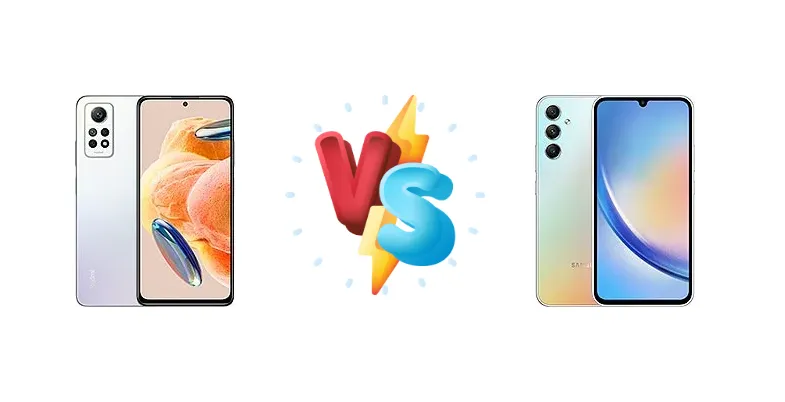
The mid-range smartphone market is fiercely competitive, and the Xiaomi Redmi Note 12 Pro 4G and Samsung Galaxy A34 are two strong contenders. Both offer compelling features at accessible prices, but cater to slightly different needs. Let's dive into a detailed comparison to help you determine which one is right for you.
🏆 Quick Verdict
The Samsung Galaxy A34 takes the crown thanks to its brighter display, longer software support, and significantly faster charging. While the Redmi Note 12 Pro 4G offers a slightly more powerful chipset, the A34's overall package is more polished and user-friendly.
| Network |
|---|
| 2G bands | GSM 850 / 900 / 1800 / 1900 | GSM 850 / 900 / 1800 / 1900 |
| 3G bands | HSDPA 850 / 900 / 1700(AWS) / 1900 / 2100 | HSDPA 850 / 900 / 1700(AWS) / 1900 / 2100 |
| 4G bands | 1, 2, 3, 4, 5, 7, 8, 20, 28, 38, 40, 41, 66 | 1, 2, 3, 4, 5, 7, 8, 12, 17, 20, 26, 28, 32, 38, 40, 41, 66 |
| 5G bands | - | 1, 3, 7, 8, 20, 28, 38, 40, 41, 77, 78 SA/NSA/Sub6 |
| Speed | HSPA, LTE | HSPA, LTE, 5G |
| Technology | GSM / HSPA / LTE | GSM / HSPA / LTE / 5G |
| Launch |
|---|
| Announced | 2023, March 03 | 2023, March 14 |
| Status | Available. Released 2023, April 11 | Available. Released 2023, March 24 |
| Body |
|---|
| Build | - | Glass front (Gorilla Glass 5), plastic frame, plastic back |
| Dimensions | 164.2 x 76.1 x 8.1 mm (6.46 x 3.00 x 0.32 in) | 161.3 x 78.1 x 8.2 mm (6.35 x 3.07 x 0.32 in) |
| SIM | Nano-SIM + Nano-SIM | · Nano-SIM· Nano-SIM + Nano-SIM |
| Weight | 201.8 g (7.13 oz) | 199 g (7.02 oz) |
| | - | IP67 dust/water resistant (up to 1m for 30 min) |
| Display |
|---|
| Protection | - | Corning Gorilla Glass 5 |
| Resolution | 1080 x 2400 pixels, 20:9 ratio (~395 ppi density) | 1080 x 2340 pixels, 19.5:9 ratio (~390 ppi density) |
| Size | 6.67 inches, 107.4 cm2 (~86.0% screen-to-body ratio) | 6.6 inches, 106.9 cm2 (~84.9% screen-to-body ratio) |
| Type | AMOLED, 120Hz, Dolby Vision, 700 nits (HBM), 1100 nits (peak) | Super AMOLED, 120Hz, 1000 nits (HBM) |
| Platform |
|---|
| CPU | Octa-core (2x2.2 GHz Kryo 470 Gold & 6x1.8 GHz Kryo 470 Silver) | Octa-core (2x2.6 GHz Cortex-A78 & 6x2.0 GHz Cortex-A55) |
| Chipset | Qualcomm SM7150 Snapdragon 732G (8 nm) | Mediatek Dimensity 1080 (6 nm) |
| GPU | Adreno 618 | Mali-G68 MC4 |
| OS | Android 11, MIUI 13 | Android 13, up to 4 major Android upgrades, One UI 6.1 |
| Memory |
|---|
| Card slot | microSDXC (uses shared SIM slot) | microSDXC (uses shared SIM slot) |
| Internal | 128GB 6GB RAM, 128GB 8GB RAM, 256GB 8GB RAM | 128GB 4GB RAM, 128GB 6GB RAM, 128GB 8GB RAM, 256GB 6GB RAM, 256GB 8GB RAM |
| | UFS 2.2 | - |
| Main Camera |
|---|
| Features | LED flash, HDR, panorama | LED flash, panorama, HDR |
| Quad | 108 MP, f/1.9, (wide), 1/1.52", 0.7µm, PDAF
8 MP, 120˚, (ultrawide)
2 MP (macro)
Auxiliary lens | - |
| Triple | - | 48 MP, f/1.8, 26mm (wide), 1/2.0", 0.8µm, PDAF, OIS
8 MP, f/2.2, 123˚, (ultrawide), 1/4.0", 1.12µm
5 MP (macro) |
| Video | 4K@30fps, 1080p@30/60fps | 4K@30fps, 1080p@30/60fps, 720p@480fps |
| Selfie camera |
|---|
| Single | 16 MP, f/2.4, (wide) | 13 MP, f/2.2, 26mm (wide), 1/3.1", 1.12µm |
| Video | 1080p@30fps | 4K@30fps, 1080p@30fps |
| Sound |
|---|
| 3.5mm jack | Yes | No |
| 35mm jack | Yes | No |
| Loudspeaker | Yes, with stereo speakers | Yes, with stereo speakers |
| Comms |
|---|
| Bluetooth | 5.0, A2DP, LE | 5.3, A2DP, LE |
| Infrared port | Yes | - |
| NFC | Yes (market/region dependent) | Yes (market/region dependent) |
| Positioning | GPS, GLONASS, GALILEO, BDS | GPS, GLONASS, GALILEO, BDS |
| Radio | Unspecified | No |
| USB | USB Type-C 2.0, OTG | USB Type-C 2.0, OTG |
| WLAN | Wi-Fi 802.11 a/b/g/n/ac, dual-band | Wi-Fi 802.11 a/b/g/n/ac, dual-band, Wi-Fi Direct |
| Features |
|---|
| Sensors | Fingerprint (side-mounted), accelerometer, gyro, compass | Fingerprint (under display, optical), accelerometer, gyro, compass |
| | - | Virtual proximity sensing |
| Battery |
|---|
| Charging | 67W wired | 25W wired |
| Type | Li-Po 5000 mAh | Li-Ion 5000 mAh |
| Misc |
|---|
| Colors | Star Blue, Graphite Gray, Polar White, Ice blue | Lime, Graphite, Violet, Silver |
| Models | 2209116AG, 2209116AG | SM-A346E, SM-A346B, SM-A346B/DS, SM-A346B/DSN, SM-A346E/DS, SM-A346E/DSN, SM-A346M, SM-A346M/N, SM-A346M/DSN, SM-A3460 |
| Price | About 150 EUR | € 169.99 / $ 175.00 / £ 164.99 / ₹ 23,999 |
| SAR EU | - | 0.55 W/kg (head) 1.49 W/kg (body) |
| Tests |
|---|
| Battery life | - |
Endurance rating 133h
|
| Camera | - |
Photo / Video |
| Display | - |
Contrast ratio: Infinite (nominal) |
| Loudspeaker | - |
-26.1 LUFS (Good)
|
| Performance | - |
AnTuTu: 472126 (v9)
GeekBench: 2316 (v5.5), 2518 (v6)
GFXBench: 23fps (ES 3.1 onscreen) |
Xiaomi Redmi Note 12 Pro 4G
- Slightly more powerful chipset
- Faster charging (67W)
- Good AMOLED display
- Competitive price
- Less bright display
- Shorter software support
- Image processing can be inconsistent
Samsung Galaxy A34
- Brighter display (1009 nits)
- Excellent battery life (133h endurance)
- Longer software support
- Consistent camera performance
- Slower charging (25W)
- Slightly less powerful chipset
- Nominal 'Infinite' contrast ratio
Display Comparison
The Samsung Galaxy A34 boasts a significantly brighter display, reaching 1009 nits peak brightness, making it much easier to view outdoors. While the Redmi Note 12 Pro 4G has a good quality AMOLED panel, it lacks the A34's impressive brightness. The A34's 'Infinite' contrast ratio is a nominal value, but the display is still excellent.
Camera Comparison
Both phones offer capable camera systems, but the Galaxy A34 generally produces more consistent and pleasing results. The A34's image processing tends to be more natural, while the Redmi Note 12 Pro 4G can sometimes over-saturate colors. Video recording capabilities are comparable.
Performance
The Redmi Note 12 Pro 4G's Snapdragon 732G chipset offers a slight edge in raw processing power compared to the Galaxy A34's Dimensity 1080. This translates to slightly smoother performance in demanding games and applications. However, in everyday use, the difference is often negligible.
Battery Life
The Galaxy A34 shines in battery life, boasting an endurance rating of 133 hours. The Redmi Note 12 Pro 4G's battery life is respectable, but falls short of the A34's longevity. The A34's 25W charging is slower than the Redmi Note 12 Pro 4G's 67W, but the larger battery compensates for this.
Buying Guide
The Xiaomi Redmi Note 12 Pro 4G is ideal for users prioritizing raw performance for gaming and demanding apps. The Samsung Galaxy A34 is a better choice for those who value a vibrant display, longer battery life, and guaranteed software updates for years to come.
Frequently Asked Questions
❓ Which phone has better gaming performance?
The Xiaomi Redmi Note 12 Pro 4G has a slightly more powerful chipset, potentially offering a small advantage in demanding games. However, the Galaxy A34 is still capable of handling most games smoothly.
❓ How long will Samsung provide software updates for the Galaxy A34?
Samsung typically provides 4 years of OS updates and 5 years of security updates for its A-series phones, offering longer support than Xiaomi.