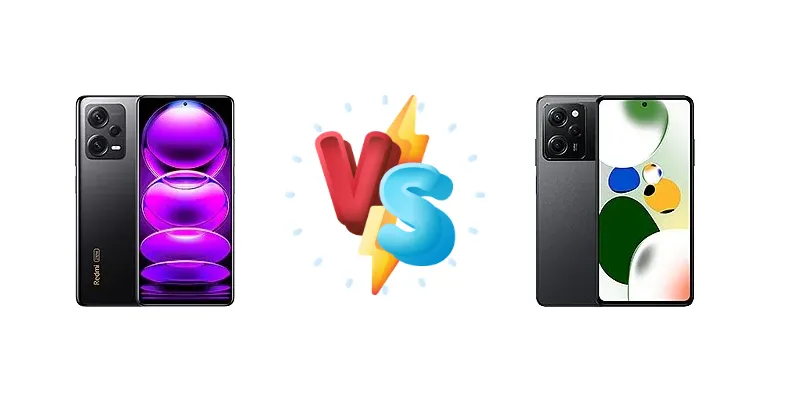
The Xiaomi Redmi Note series consistently delivers impressive value, and the Note 12 Discovery and Pro Speed are no exception. But with subtle differences in their core components, choosing between them can be tricky. This comprehensive comparison will break down each phone's strengths and weaknesses to help you make the right decision.
🏆 Quick Verdict
The Redmi Note 12 Discovery boasts significantly faster charging and a slightly more powerful chipset. However, the Pro Speed often offers a more refined camera experience and potentially better software support. For charging speed enthusiasts, the Discovery wins; for overall balance, the Pro Speed is compelling.
| Network |
|---|
| 2G bands | GSM 850 / 900 / 1800 / 1900 | GSM 850 / 900 / 1800 / 1900 |
| 3G bands | HSDPA 850 / 900 / 1900 / 2100 | HSDPA 850 / 900 / 2100 |
| 4G bands | 1, 3, 5, 8, 19, 34, 38, 39, 40, 41 | 1, 3, 5, 8, 19, 34, 38, 39, 40, 41 |
| 5G bands | 1, 3, 5, 8, 28, 38, 41, 77, 78 SA/NSA | 1, 3, 5, 8, 28, 38, 41, 77, 78 SA/NSA |
| Speed | HSPA, LTE, 5G | HSPA, LTE, 5G |
| Technology | GSM / CDMA / HSPA / EVDO / LTE / 5G | GSM / CDMA / HSPA / CDMA2000 / LTE / 5G |
| | CDMA2000 1xEV-DO | CDMA2000 1x |
| Launch |
|---|
| Announced | 2022, October 27 | 2022, December 27 |
| Status | Available. Released 2022, November 01 | Available. Released 2022, December 27 |
| Body |
|---|
| Build | Glass front, glass back, aluminum frame | - |
| Dimensions | 162.9 x 76 x 9 mm (6.41 x 2.99 x 0.35 in) | 162.9 x 76 x 7.9 mm (6.41 x 2.99 x 0.31 in) |
| SIM | Nano-SIM + Nano-SIM | Nano-SIM + Nano-SIM |
| Weight | 207.5 g (7.34 oz) | 181 g (6.38 oz) |
| | IP53, dust and splash resistant | IP53, dust and splash resistant |
| Display |
|---|
| Resolution | 1080 x 2400 pixels, 20:9 ratio (~395 ppi density) | 1080 x 2400 pixels, 20:9 ratio (~395 ppi density) |
| Size | 6.67 inches, 107.4 cm2 (~86.8% screen-to-body ratio) | 6.67 inches, 107.4 cm2 (~86.8% screen-to-body ratio) |
| Type | OLED, 1B colors, 120Hz, Dolby Vision, HDR10+, 500 nits (typ), 900 nits (HBM) | OLED, 1B colors, 120Hz, Dolby Vision, HDR10+, 500 nits (typ), 900 nits (HBM) |
| Platform |
|---|
| CPU | Octa-core (2x2.6 GHz Cortex-A78 & 6x2.0 GHz Cortex-A55) | Octa-core (1x2.4 GHz Cortex-A78 & 3x2.2 GHz Cortex-A78 & 4x1.9 GHz Cortex-A55) |
| Chipset | Mediatek Dimensity 1080 (6 nm) | Qualcomm SM7325 Snapdragon 778G 5G (6 nm) |
| GPU | Mali-G68 MC4 | Adreno 642L |
| OS | Android 12, MIUI 13 | Android 13, MIUI 14 |
| Memory |
|---|
| Card slot | No | No |
| Internal | 256GB 8GB RAM | 128GB 6GB RAM, 256GB 8GB RAM, 256GB 12GB RAM |
| | UFS 2.2 | UFS 2.2 |
| Main Camera |
|---|
| Features | Dual-LED dual-tone flash, HDR, panorama | LED flash, HDR, panorama |
| Triple | 200 MP, f/1.7, 24mm (wide), 1/1.4", 0.56µm, PDAF, OIS
8 MP, f/1.9, 119˚ (ultrawide), 1/4.0", 1.12µm
2 MP (macro) | 108 MP, f/1.9, (wide), 1/1.52", 0.7µm, PDAF
8 MP, 119˚ (ultrawide), 1/4.0", 1.12µm
2 MP (macro) |
| Video | 4K@30fps, 1080p@30/60/120fps, 720p@960fps | 4K@30fps, 1080p@30/60/120fps, 720p@960fps, gyro-EIS |
| Selfie camera |
|---|
| Features | HDR | HDR |
| Single | 16 MP, (wide), 1/3.06", 1.0µm | 16 MP, (wide), 1/3.06", 1.0µm |
| Video | 1080p@30/60fps | 1080p@30/60fps |
| Sound |
|---|
| 3.5mm jack | Yes | Yes |
| 35mm jack | Yes | Yes |
| Loudspeaker | Yes, with stereo speakers | Yes, with stereo speakers |
| | 24-bit/192kHz audio | 24-bit/192kHz audio |
| Comms |
|---|
| Bluetooth | 5.2, A2DP, LE | 5.2, A2DP, LE |
| Infrared port | Yes | Yes |
| NFC | Yes | Yes |
| Positioning | GPS (L1), GLONASS (G1), BDS (B1I+B1c), GALILEO (E1), QZSS (L1) | GPS (L1), GLONASS (G1), BDS (B1I+B1c), GALILEO (E1), QZSS (L1) |
| Radio | Unspecified | Unspecified |
| USB | USB Type-C 2.0, OTG | USB Type-C 2.0, OTG |
| WLAN | Wi-Fi 802.11 a/b/g/n/ac/6, dual-band, Wi-Fi Direct | Wi-Fi 802.11 a/b/g/n/ac/6, dual-band, Wi-Fi Direct |
| Features |
|---|
| Sensors | Fingerprint (side-mounted), accelerometer, gyro, proximity, compass | Fingerprint (side-mounted), accelerometer, gyro, proximity, compass |
| Battery |
|---|
| Charging | 210W wired, PD3.0, 66% in 5 min, 100% in 9 min | 67W wired, PD3.0, QC3+ |
| Type | Li-Po 4300 mAh | Li-Po 5000 mAh |
| Misc |
|---|
| Colors | Black | Black, Blue, Green |
| Models | 22101316UP | 22101320C |
| Price | About 380 EUR | About 230 EUR |
Xiaomi Redmi Note 12 Discovery
- Incredibly fast 210W charging
- Slightly more powerful chipset (Dimensity 1080)
- Potentially brighter display
- Camera might not be as refined as the Pro Speed
- Software support potentially shorter than Pro Speed
Xiaomi Redmi Note 12 Pro Speed
- Refined camera system with better image processing
- Excellent 5G connectivity (Snapdragon 778G)
- Potentially longer software support
- Slower 67W charging
- Slightly less powerful chipset compared to Discovery
Display Comparison
Both phones likely feature AMOLED displays with a 120Hz refresh rate, offering vibrant colors and smooth scrolling. The Discovery might have a slightly brighter panel, but the Pro Speed could have better color accuracy. Screen size is likely similar, around 6.67 inches. Resolution is likely FHD+ on both.
Camera Comparison
The Pro Speed is expected to have a more refined camera system, potentially with better image processing and low-light performance. While the Discovery likely has a high-resolution main sensor, the Pro Speed's software optimization could give it an advantage. Both likely feature multiple lenses including ultrawide and macro.
Performance
The Dimensity 1080 in the Discovery holds a slight edge in raw CPU and GPU performance compared to the Snapdragon 778G 5G in the Pro Speed. However, real-world performance differences might be minimal for everyday tasks. The Snapdragon 778G is known for its efficiency and excellent 5G connectivity.
Battery Life
The Discovery's 210W charging is a game-changer, allowing for incredibly fast top-ups. The Pro Speed's 67W charging is still fast, but significantly slower. Battery capacity is likely similar, around 5000mAh on both devices.
Buying Guide
The Xiaomi Redmi Note 12 Discovery is ideal for users prioritizing incredibly fast charging and a bit more raw processing power. The Redmi Note 12 Pro Speed is a better choice for those who value a well-rounded experience with a focus on camera quality and potentially longer software update support.
Frequently Asked Questions
❓ Is the 210W charging on the Discovery worth it?
Absolutely, if you value incredibly fast charging. It can significantly reduce downtime.
❓ Which phone has better gaming performance?
The Redmi Note 12 Discovery likely has a slight edge due to the Dimensity 1080, but both phones should handle most games well.
❓ Will the Pro Speed receive more software updates?
Historically, Pro models in the Redmi Note series have received slightly longer software support, but this isn't guaranteed.