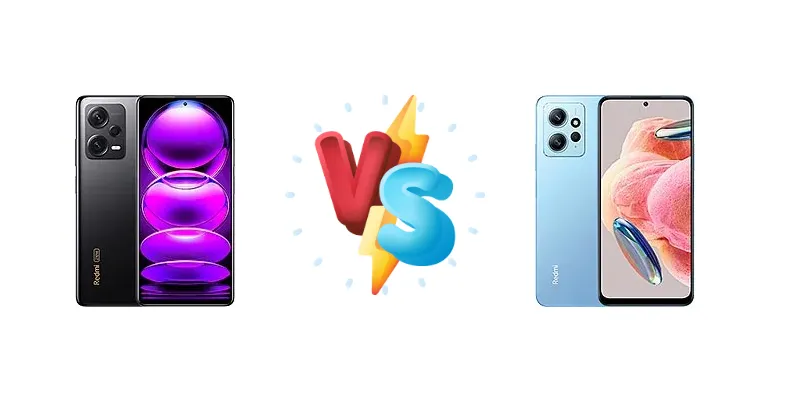
The Xiaomi Redmi Note series consistently delivers impressive value, but the Note 12 lineup presents a bit of a conundrum: the Discovery edition boasts blazing-fast charging and a powerful chipset, while the standard 4G model prioritizes exceptional battery life. This comparison will break down the key differences to help you choose the best fit for your needs.
🏆 Quick Verdict
The Redmi Note 12 Discovery is the clear winner for performance and charging speed, thanks to its Dimensity 1080 and 210W charging. However, the Redmi Note 12 4G offers unparalleled battery endurance and a more budget-friendly price point, making it ideal for users prioritizing longevity over raw power.
| Network |
|---|
| 2G bands | GSM 850 / 900 / 1800 / 1900 | GSM 850 / 900 / 1800 / 1900 |
| 3G bands | HSDPA 850 / 900 / 1900 / 2100 | HSDPA 850 / 900 / 2100 |
| 4G bands | 1, 3, 5, 8, 19, 34, 38, 39, 40, 41 | 1, 3, 5, 7, 8, 20, 28, 38, 40, 41 |
| 5G bands | 1, 3, 5, 8, 28, 38, 41, 77, 78 SA/NSA | - |
| Speed | HSPA, LTE, 5G | HSPA, LTE, 5G |
| Technology | GSM / CDMA / HSPA / EVDO / LTE / 5G | GSM / HSPA / LTE |
| | CDMA2000 1xEV-DO | - |
| Launch |
|---|
| Announced | 2022, October 27 | 2023, March 23 |
| Status | Available. Released 2022, November 01 | Available. Released 2023, March 30 |
| Body |
|---|
| Build | Glass front, glass back, aluminum frame | Glass front (Gorilla Glass 3), plastic frame, plastic back |
| Dimensions | 162.9 x 76 x 9 mm (6.41 x 2.99 x 0.35 in) | 165.7 x 76 x 7.9 mm (6.52 x 2.99 x 0.31 in) |
| SIM | Nano-SIM + Nano-SIM | Nano-SIM + Nano-SIM |
| Weight | 207.5 g (7.34 oz) | 183.5 g (6.49 oz) |
| | IP53, dust and splash resistant | IP53, dust and splash resistant |
| Display |
|---|
| Protection | - | Corning Gorilla Glass 3 |
| Resolution | 1080 x 2400 pixels, 20:9 ratio (~395 ppi density) | 1080 x 2400 pixels, 20:9 ratio (~395 ppi density) |
| Size | 6.67 inches, 107.4 cm2 (~86.8% screen-to-body ratio) | 6.67 inches, 107.4 cm2 (~85.3% screen-to-body ratio) |
| Type | OLED, 1B colors, 120Hz, Dolby Vision, HDR10+, 500 nits (typ), 900 nits (HBM) | AMOLED, 120Hz, 450 nits (typ), 700 nits (HBM), 1200 nits (peak) |
| Platform |
|---|
| CPU | Octa-core (2x2.6 GHz Cortex-A78 & 6x2.0 GHz Cortex-A55) | Octa-core (4x2.8 GHz Cortex-A73 & 4x1.9 GHz Cortex-A53) |
| Chipset | Mediatek Dimensity 1080 (6 nm) | Qualcomm SM6225 Snapdragon 685 (6 nm) |
| GPU | Mali-G68 MC4 | Adreno 610 |
| OS | Android 12, MIUI 13 | Android 13, upgradable to Android 14, HyperOS |
| Memory |
|---|
| Card slot | No | microSDXC (dedicated slot) |
| Internal | 256GB 8GB RAM | 64GB 4GB RAM, 64GB 6GB RAM, 128GB 4GB RAM, 128GB 6GB RAM, 128GB 8GB RAM, 256GB 8GB RAM |
| | UFS 2.2 | UFS 2.2 |
| Main Camera |
|---|
| Features | Dual-LED dual-tone flash, HDR, panorama | LED flash, HDR, panorama |
| Triple | 200 MP, f/1.7, 24mm (wide), 1/1.4", 0.56µm, PDAF, OIS
8 MP, f/1.9, 119˚ (ultrawide), 1/4.0", 1.12µm
2 MP (macro) | 50 MP, f/1.8, (wide), 1/2.76", 0.64µm, PDAF
8 MP, f/2.2, 120˚ (ultrawide), 1/4.0", 1.12µm
2 MP (macro) |
| Video | 4K@30fps, 1080p@30/60/120fps, 720p@960fps | 1080p@30fps |
| Selfie camera |
|---|
| Features | HDR | HDR |
| Single | 16 MP, (wide), 1/3.06", 1.0µm | 13 MP, f/2.5, (wide), 1/3.0" |
| Video | 1080p@30/60fps | 1080p@30fps |
| Sound |
|---|
| 3.5mm jack | Yes | Yes |
| 35mm jack | Yes | Yes |
| Loudspeaker | Yes, with stereo speakers | Yes |
| | 24-bit/192kHz audio | - |
| Comms |
|---|
| Bluetooth | 5.2, A2DP, LE | 5.0, A2DP, LE |
| Infrared port | Yes | Yes |
| NFC | Yes | Yes (market/region dependent) |
| Positioning | GPS (L1), GLONASS (G1), BDS (B1I+B1c), GALILEO (E1), QZSS (L1) | GPS, GLONASS, GALILEO |
| Radio | Unspecified | Unspecified |
| USB | USB Type-C 2.0, OTG | USB Type-C 2.0, OTG |
| WLAN | Wi-Fi 802.11 a/b/g/n/ac/6, dual-band, Wi-Fi Direct | Wi-Fi 802.11 a/b/g/n/ac, dual-band |
| Features |
|---|
| Sensors | Fingerprint (side-mounted), accelerometer, gyro, proximity, compass | Fingerprint (side-mounted), accelerometer, gyro, proximity, compass |
| Battery |
|---|
| Charging | 210W wired, PD3.0, 66% in 5 min, 100% in 9 min | 33W wired |
| Type | Li-Po 4300 mAh | Li-Po 5000 mAh |
| Misc |
|---|
| Colors | Black | Onyx Gray, Mint Green, Ice Blue |
| Models | 22101316UP | 23021RAAEG, 23021RAA2Y, 23027RAD4I, 23028RA60L |
| Price | About 380 EUR | £ 189.99 / € 107.98 / ₹ 9,998 |
| SAR | - | 1.09 W/kg (head) 0.89 W/kg (body) |
| SAR EU | - | 0.90 W/kg (head) 0.99 W/kg (body) |
| Tests |
|---|
| Battery life | - |
Endurance rating 117h
|
| Camera | - |
Photo / Video |
| Display | - |
Contrast ratio: Infinite (nominal) |
| Loudspeaker | - |
-27.9 LUFS (Good)
|
| Performance | - |
AnTuTu: 319219 (v9)
GeekBench: 1797 (v5.1), 1341 (v6)
GFXBench: 7.5fps (ES 3.1 onscreen) |
Xiaomi Redmi Note 12 Discovery
- Blazing-fast 210W charging
- Powerful Dimensity 1080 chipset
- Likely higher refresh rate display
- Improved image processing potential
- Likely shorter battery life compared to 4G
- Potentially higher price
- Camera details are unclear
Xiaomi Redmi Note 12 4G
- Exceptional 117-hour battery endurance
- Budget-friendly price
- Reliable Snapdragon 685 chipset
- Good display with high contrast
- Slower performance compared to Discovery
- 33W charging is relatively slow
- Camera details are unclear
Display Comparison
Both phones feature AMOLED displays, offering vibrant colors and deep blacks. The Discovery model likely has a slightly higher refresh rate (potentially 120Hz, based on typical Discovery series features) for smoother scrolling, while the 4G model is reported to have a 744 nits max brightness. Contrast ratio is listed as 'infinite' for the 4G, which is a nominal value and doesn't provide concrete data.
Camera Comparison
Camera specs are listed as 'Photo / Video' for both, suggesting a similar overall camera experience. However, the Discovery's more powerful processor likely allows for better image processing and potentially improved low-light performance. Specific sensor details and features would need further investigation.
Performance
The Discovery edition's Dimensity 1080 chipset provides a significant performance advantage over the Snapdragon 685 in the 4G model. Expect noticeably faster app loading times, smoother multitasking, and better gaming performance on the Discovery. The 1080 is a mid-range powerhouse, while the 685 is more suited for basic tasks.
Battery Life
This is where the 4G model truly shines. Its endurance rating of 117 hours is exceptional, far surpassing what the Discovery model is likely to achieve. While the Discovery's 210W charging is incredibly fast, the 4G's larger battery capacity and efficient chipset contribute to its superior longevity.
Buying Guide
The Redmi Note 12 Discovery is perfect for gamers, power users, and anyone who values rapid charging. The Redmi Note 12 4G is an excellent choice for budget-conscious users, students, or anyone who needs a phone that can easily last for multiple days on a single charge.
Frequently Asked Questions
❓ Is the Redmi Note 12 Discovery worth the extra cost?
If you prioritize performance and fast charging, then yes. However, if battery life is your top concern and you're on a budget, the 4G model is a better value.
❓ What is the difference in camera quality between the two phones?
While both have 'Photo / Video' capabilities, the Discovery's more powerful processor likely results in slightly better image processing and low-light performance. However, a detailed camera comparison would require more specific sensor information and testing.