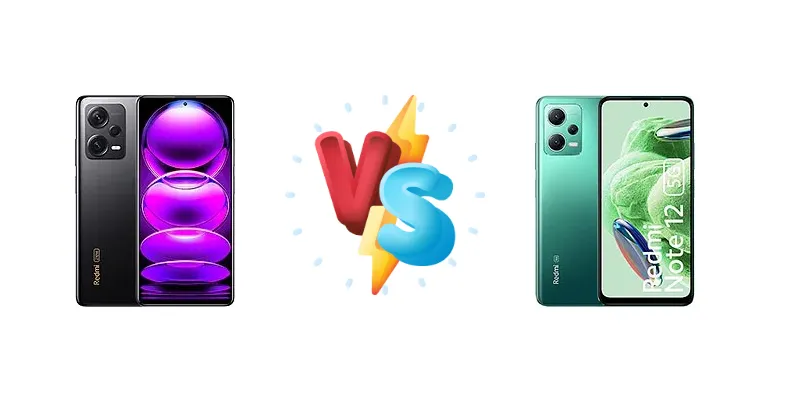
The Xiaomi Redmi Note series consistently delivers impressive value, but the recent additions of the standard Note 12 and the Note 12 Discovery have created a bit of confusion. Both offer compelling features, but cater to slightly different users. Let's break down the key differences to help you decide which one is right for you.
🏆 Quick Verdict
The Redmi Note 12 Discovery boasts significantly faster charging and a more powerful chipset, making it ideal for power users. However, the standard Redmi Note 12 excels with its exceptional battery life and potentially more refined camera experience, offering a strong all-around package for everyday use.
| Network |
|---|
| 2G bands | GSM 850 / 900 / 1800 / 1900 | GSM 850 / 900 / 1800 / 1900 |
| 3G bands | HSDPA 850 / 900 / 1900 / 2100 | HSDPA 850 / 900 / 2100 |
| 4G bands | 1, 3, 5, 8, 19, 34, 38, 39, 40, 41 | 1, 3, 5, 8, 40, 41 |
| 5G bands | 1, 3, 5, 8, 28, 38, 41, 77, 78 SA/NSA | 1, 3, 5, 8, 28, 40, 78 SA/NSA |
| Speed | HSPA, LTE, 5G | HSPA, LTE, 5G |
| Technology | GSM / CDMA / HSPA / EVDO / LTE / 5G | GSM / HSPA / LTE / 5G |
| | CDMA2000 1xEV-DO | - |
| Launch |
|---|
| Announced | 2022, October 27 | 2022, October 27 |
| Status | Available. Released 2022, November 01 | Available. Released 2023, January 11 |
| Body |
|---|
| Build | Glass front, glass back, aluminum frame | - |
| Dimensions | 162.9 x 76 x 9 mm (6.41 x 2.99 x 0.35 in) | 165.9 x 76.2 x 8 mm (6.53 x 3.00 x 0.31 in) |
| SIM | Nano-SIM + Nano-SIM | Nano-SIM + Nano-SIM |
| Weight | 207.5 g (7.34 oz) | 188 g (6.63 oz) |
| | IP53, dust and splash resistant | IP53, dust and splash resistant |
| Display |
|---|
| Protection | - | Corning Gorilla Glass 3 |
| Resolution | 1080 x 2400 pixels, 20:9 ratio (~395 ppi density) | 1080 x 2400 pixels, 20:9 ratio (~395 ppi density) |
| Size | 6.67 inches, 107.4 cm2 (~86.8% screen-to-body ratio) | 6.67 inches, 107.4 cm2 (~85.0% screen-to-body ratio) |
| Type | OLED, 1B colors, 120Hz, Dolby Vision, HDR10+, 500 nits (typ), 900 nits (HBM) | AMOLED, 120Hz, 1200 nits (peak) |
| Platform |
|---|
| CPU | Octa-core (2x2.6 GHz Cortex-A78 & 6x2.0 GHz Cortex-A55) | Octa-core (2x2.0 GHz Cortex-A78 & 6x1.8 GHz Cortex-A55) |
| Chipset | Mediatek Dimensity 1080 (6 nm) | Qualcomm SM4375 Snapdragon 4 Gen 1 (6 nm) |
| GPU | Mali-G68 MC4 | Adreno 619 |
| OS | Android 12, MIUI 13 | Android 12, MIUI 14 (International), MIUI 13 (India) |
| Memory |
|---|
| Card slot | No | microSDXC (uses shared SIM slot) |
| Internal | 256GB 8GB RAM | 128GB 4GB RAM, 128GB 6GB RAM, 256GB 8GB RAM |
| | UFS 2.2 | UFS 2.2 |
| Main Camera |
|---|
| Features | Dual-LED dual-tone flash, HDR, panorama | Dual-LED dual-tone flash, HDR, panorama |
| Triple | 200 MP, f/1.7, 24mm (wide), 1/1.4", 0.56µm, PDAF, OIS
8 MP, f/1.9, 119˚ (ultrawide), 1/4.0", 1.12µm
2 MP (macro) | 48 MP, f/1.8, (wide), PDAF
8 MP, f/2.2, 120˚ (ultrawide), 1/4.0", 1.12µm
2 MP (macro) |
| Video | 4K@30fps, 1080p@30/60/120fps, 720p@960fps | 1080p@30fps |
| Selfie camera |
|---|
| Features | HDR | HDR |
| Single | 16 MP, (wide), 1/3.06", 1.0µm | 13 MP, f/2.5, (wide), 1/3.0" |
| Video | 1080p@30/60fps | 1080p@30fps |
| Sound |
|---|
| 3.5mm jack | Yes | Yes |
| 35mm jack | Yes | Yes |
| Loudspeaker | Yes, with stereo speakers | Yes |
| | 24-bit/192kHz audio | 24-bit/192kHz audio |
| Comms |
|---|
| Bluetooth | 5.2, A2DP, LE | 5.1, A2DP, LE |
| Infrared port | Yes | Yes |
| NFC | Yes | Yes (market/region dependent) |
| Positioning | GPS (L1), GLONASS (G1), BDS (B1I+B1c), GALILEO (E1), QZSS (L1) | GPS, GLONASS |
| Radio | Unspecified | Unspecified |
| USB | USB Type-C 2.0, OTG | USB Type-C 2.0, OTG |
| WLAN | Wi-Fi 802.11 a/b/g/n/ac/6, dual-band, Wi-Fi Direct | Wi-Fi 802.11 a/b/g/n/ac, dual-band |
| Features |
|---|
| Sensors | Fingerprint (side-mounted), accelerometer, gyro, proximity, compass | Fingerprint (side-mounted), accelerometer, gyro, proximity, compass |
| Battery |
|---|
| Charging | 210W wired, PD3.0, 66% in 5 min, 100% in 9 min | 33W wired, 50% in 22 min |
| Type | Li-Po 4300 mAh | Li-Po 5000 mAh |
| Misc |
|---|
| Colors | Black | Frosted Green, Matte Black, Mystique Blue |
| Models | 22101316UP | 22111317I, 22111317G |
| Price | About 380 EUR | € 151.99 / $ 219.99 / ₹ 11,999 |
| SAR | - | 1.09 W/kg (head) 1.05 W/kg (body) |
| SAR EU | - | 0.68 W/kg (head) 0.91 W/kg (body) |
| Tests |
|---|
| Battery life | - |
Endurance rating 101h
|
| Camera | - |
Photo / Video |
| Display | - |
Contrast ratio: Infinite (nominal) |
| Loudspeaker | - |
-28.0 LUFS (Good)
|
| Performance | - |
AnTuTu: 360745 (v9)
GeekBench: 1998 (v5.1), 2017 (v6) |
Xiaomi Redmi Note 12 Discovery
- Blazing-fast 210W charging
- More powerful Dimensity 1080 chipset
- Likely brighter display
- Potentially better camera processing
- Shorter battery life compared to the standard Note 12
- Potentially higher price
Xiaomi Redmi Note 12
- Exceptional battery life (101h endurance rating)
- Excellent value for money
- Reliable camera for everyday use
- Infinite contrast ratio display
- Less powerful chipset
- Slower 33W charging
- Potentially lower peak brightness
Display Comparison
Both phones feature AMOLED displays, offering vibrant colors and deep blacks. The Note 12 Discovery likely has a slightly higher peak brightness, but the Note 12's 'infinite' contrast ratio suggests excellent image quality. Actual brightness measurements show the Note 12 at 706 nits, so the Discovery should be brighter.
Camera Comparison
While both offer 'Photo / Video' capabilities, the Discovery's more powerful chipset could translate to better image processing and video recording. The standard Note 12's camera is likely well-optimized for everyday photography, potentially offering a more consistent experience. Specific camera specs (megapixels, sensor size) are needed for a more accurate comparison.
Performance
The Dimensity 1080 in the Discovery provides a noticeable performance advantage over the Snapdragon 4 Gen 1 in the standard Note 12. Expect smoother multitasking, faster app loading times, and better gaming performance on the Discovery. The Dimensity 1080's 6nm process also contributes to better efficiency.
Battery Life
The standard Redmi Note 12 shines here. Its endurance rating of 101h is exceptional, significantly outperforming the Discovery. While the Discovery's 210W charging is incredibly fast, the Note 12's longevity means you'll need to charge it less frequently.
Buying Guide
The Xiaomi Redmi Note 12 Discovery is perfect for users who prioritize fast charging and performance for gaming or demanding apps. The standard Redmi Note 12 is a great choice for those who value long battery life, a reliable camera, and a more balanced overall experience without breaking the bank.
Frequently Asked Questions
❓ Is the 210W charging on the Discovery worth it?
If you frequently forget to charge your phone or need a quick top-up, the 210W charging is a game-changer. However, if you're a moderate user, the slower charging on the standard Note 12 might not be a significant drawback.
❓ Which phone is better for gaming?
The Redmi Note 12 Discovery's Dimensity 1080 chipset provides a noticeable performance advantage, making it the better choice for demanding games and smoother gameplay.