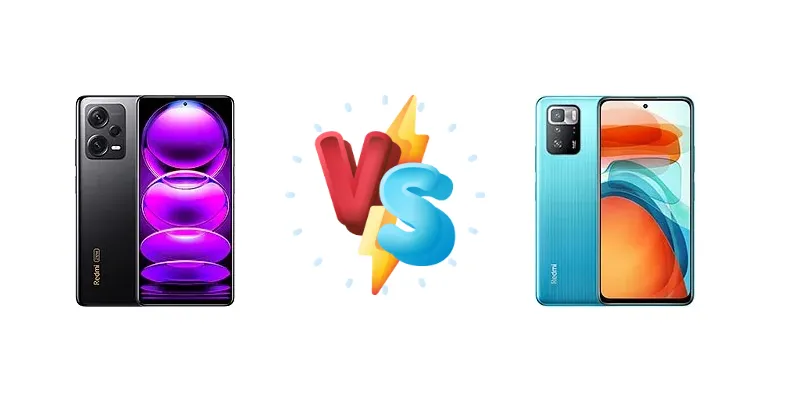
The Xiaomi Redmi Note series consistently delivers impressive value, but choosing between models can be tricky. We're pitting the Redmi Note 12 Discovery against the Redmi Note 10 Pro (China) to see which offers the best blend of features and performance. Let's dive in!
🏆 Quick Verdict
The Redmi Note 12 Discovery takes the lead thanks to its significantly faster 210W charging and a slightly more powerful chipset. However, the Note 10 Pro (China) remains a compelling option, especially if you prioritize a potentially better camera and a more established software experience.
| Network |
|---|
| 2G bands | GSM 850 / 900 / 1800 / 1900 | GSM 850 / 900 / 1800 / 1900 |
| 3G bands | HSDPA 850 / 900 / 1900 / 2100 | HSDPA 850 / 900 / 1700(AWS) / 1900 / 2100 |
| 4G bands | 1, 3, 5, 8, 19, 34, 38, 39, 40, 41 | 1, 2, 3, 4, 5, 7, 8, 18, 19, 26, 34, 38, 39, 40, 41, 42 |
| 5G bands | 1, 3, 5, 8, 28, 38, 41, 77, 78 SA/NSA | 1, 3, 28, 41, 77, 78 SA/NSA/Sub6 |
| Speed | HSPA, LTE, 5G | HSPA, LTE, 5G |
| Technology | GSM / CDMA / HSPA / EVDO / LTE / 5G | GSM / CDMA / HSPA / EVDO / LTE / 5G |
| | CDMA2000 1xEV-DO | CDMA2000 1xEV-DO |
| Launch |
|---|
| Announced | 2022, October 27 | 2021, May 26 |
| Status | Available. Released 2022, November 01 | Available. Released 2021, June 02 |
| Body |
|---|
| Build | Glass front, glass back, aluminum frame | Glass front (Gorilla Glass Victus), plastic frame, plastic back |
| Dimensions | 162.9 x 76 x 9 mm (6.41 x 2.99 x 0.35 in) | 163.3 x 75.9 x 8.9 mm (6.43 x 2.99 x 0.35 in) |
| SIM | Nano-SIM + Nano-SIM | Nano-SIM + Nano-SIM |
| Weight | 207.5 g (7.34 oz) | 193 g (6.81 oz) |
| | IP53, dust and splash resistant | IP53, dust and splash resistant |
| Display |
|---|
| Protection | - | Corning Gorilla Glass Victus |
| Resolution | 1080 x 2400 pixels, 20:9 ratio (~395 ppi density) | 1080 x 2400 pixels, 20:9 ratio (~399 ppi density) |
| Size | 6.67 inches, 107.4 cm2 (~86.8% screen-to-body ratio) | 6.6 inches, 105.2 cm2 (~84.9% screen-to-body ratio) |
| Type | OLED, 1B colors, 120Hz, Dolby Vision, HDR10+, 500 nits (typ), 900 nits (HBM) | IPS LCD, 120Hz, HDR10, 450 nits (typ) |
| Platform |
|---|
| CPU | Octa-core (2x2.6 GHz Cortex-A78 & 6x2.0 GHz Cortex-A55) | Octa-core (4x2.6 GHz Cortex-A78 & 4x2.0 GHz Cortex-A55) |
| Chipset | Mediatek Dimensity 1080 (6 nm) | Mediatek Dimensity 1100 (6 nm) |
| GPU | Mali-G68 MC4 | Mali-G77 MC9 |
| OS | Android 12, MIUI 13 | Android 11, MIUI 12.5 |
| Memory |
|---|
| Card slot | No | No |
| Internal | 256GB 8GB RAM | 128GB 6GB RAM, 128GB 8GB RAM, 256GB 8GB RAM |
| | UFS 2.2 | UFS 3.1 |
| Main Camera |
|---|
| Features | Dual-LED dual-tone flash, HDR, panorama | Color spectrum sensor, LED flash, HDR, panorama |
| Single | - | 16 MP, f/2.5, (wide), 1/3.06", 1.0µm |
| Triple | 200 MP, f/1.7, 24mm (wide), 1/1.4", 0.56µm, PDAF, OIS
8 MP, f/1.9, 119˚ (ultrawide), 1/4.0", 1.12µm
2 MP (macro) | 64 MP, f/1.8, 26mm (wide), 1/1.97", 0.7µm, PDAF
8 MP, f/2.2, 120˚ (ultrawide), 1/4.0", 1.12µm
2 MP (macro) |
| Video | 4K@30fps, 1080p@30/60/120fps, 720p@960fps | 4K@30fps, 1080p@30/60/120fps, 720p@960fps, HDR |
| Selfie camera |
|---|
| Features | HDR | Panorama, HDR |
| Single | 16 MP, (wide), 1/3.06", 1.0µm | 16 MP, f/2.5, (wide), 1/3.06", 1.0µm |
| Video | 1080p@30/60fps | 1080p@30fps, 720p@120fps, HDR |
| Sound |
|---|
| 3.5mm jack | Yes | No |
| 35mm jack | Yes | No |
| Loudspeaker | Yes, with stereo speakers | Yes, with stereo speakers |
| | 24-bit/192kHz audio | 24-bit/192kHz audio
Tuned by JBL |
| Comms |
|---|
| Bluetooth | 5.2, A2DP, LE | 5.2, A2DP, LE |
| Infrared port | Yes | Yes |
| NFC | Yes | Yes |
| Positioning | GPS (L1), GLONASS (G1), BDS (B1I+B1c), GALILEO (E1), QZSS (L1) | GPS, GLONASS, GALILEO, BDS, QZSS |
| Radio | Unspecified | No |
| USB | USB Type-C 2.0, OTG | USB Type-C 2.0 |
| WLAN | Wi-Fi 802.11 a/b/g/n/ac/6, dual-band, Wi-Fi Direct | Wi-Fi 802.11 a/b/g/n/ac/6, dual-band, Wi-Fi Direct |
| Features |
|---|
| Sensors | Fingerprint (side-mounted), accelerometer, gyro, proximity, compass | Fingerprint (side-mounted), accelerometer, gyro, compass |
| | - | Virtual proximity sensing |
| Battery |
|---|
| Charging | 210W wired, PD3.0, 66% in 5 min, 100% in 9 min | 67W wired, PD3.0, 100% in 42 min |
| Type | Li-Po 4300 mAh | Li-Po 5000 mAh |
| Misc |
|---|
| Colors | Black | Stargaze Black, Wave Blue, Cloud White |
| Models | 22101316UP | - |
| Price | About 380 EUR | About 200 EUR |
Xiaomi Redmi Note 12 Discovery
- Incredibly fast 210W charging
- Slightly more modern chipset (Dimensity 1080)
- Potentially brighter display
- Modern design
- Software might be less mature than Note 10 Pro
- Camera performance needs further evaluation
Xiaomi Redmi Note 10 Pro (China)
- Potentially better camera (108MP main sensor)
- More established MIUI version
- Good value for money
- Reliable performance
- Slower 67W charging
- Older chipset (Dimensity 1100)
- Design may feel dated
Display Comparison
Both phones likely feature AMOLED displays with a 120Hz refresh rate, offering smooth visuals. The Note 12 Discovery may have a slightly brighter panel, but real-world differences will be minimal. Expect vibrant colors and deep blacks on both.
Camera Comparison
The Note 10 Pro (China) is rumored to have a 108MP main camera, potentially offering better image quality in certain conditions. The Note 12 Discovery likely features a capable camera setup, but detailed camera comparisons would require in-depth testing. Expect both to capture decent photos and videos.
Performance
The Dimensity 1080 in the Note 12 Discovery holds a slight edge over the Dimensity 1100 in the Note 10 Pro (China). While both are capable mid-range chipsets, the 1080 offers improved efficiency and potentially better sustained performance. Gaming performance should be comparable, but the 12 Discovery might handle more demanding titles slightly better.
Battery Life
This is where the Note 12 Discovery truly shines. Its 210W charging is a game-changer, allowing for incredibly fast top-ups. The Note 10 Pro (China) with its 67W charging is still relatively fast, but the difference is substantial. Both phones likely have similar battery capacities (around 5000mAh), so battery life should be comparable between charges.
Buying Guide
The Redmi Note 12 Discovery is ideal for users who prioritize incredibly fast charging and appreciate a modern chipset. The Redmi Note 10 Pro (China) is a good choice for those seeking a well-rounded phone with a potentially superior camera and a more mature MIUI version, and who don't need the extreme charging speeds.
Frequently Asked Questions
❓ Is the 210W charging on the Note 12 Discovery safe?
Xiaomi has implemented safety measures to ensure the fast charging is safe. However, it's always recommended to use the provided charger and follow manufacturer guidelines.
❓ Which phone has better software support?
The Redmi Note 10 Pro (China) likely has a more mature MIUI version and potentially longer software update support, although Xiaomi's update policies can vary.