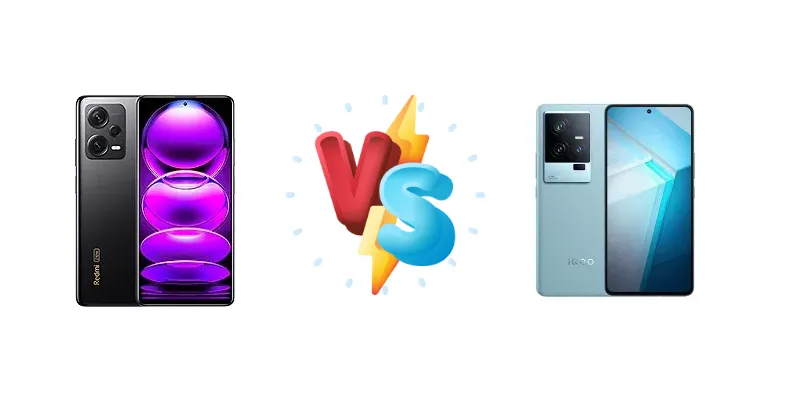
The vivo iQOO 11S and Xiaomi Redmi Note 12 Discovery represent distinct approaches to the smartphone market. The iQOO 11S aims for near-flagship performance with Qualcomm’s Snapdragon 8 Gen 2, while the Redmi Note 12 Discovery focuses on delivering a premium experience, particularly in charging speed, at a more accessible price point with the Mediatek Dimensity 1080. This comparison dissects their key differences to help you choose the right device.
🏆 Quick Verdict
For users prioritizing raw performance and sustained gaming, the vivo iQOO 11S is the clear winner thanks to its Snapdragon 8 Gen 2 chipset. However, the Redmi Note 12 Discovery offers an incredibly compelling package for those who value ultra-fast 210W charging and a more budget-friendly price.
| Network |
|---|
| 2G bands | GSM 850 / 900 / 1800 / 1900 | GSM 850 / 900 / 1800 / 1900 |
| 3G bands | HSDPA 850 / 900 / 1900 / 2100 | HSDPA 800 / 850 / 900 / 1700(AWS) / 1900 / 2100 |
| 4G bands | 1, 3, 5, 8, 19, 34, 38, 39, 40, 41 | 1, 2, 3, 4, 5, 7, 8, 12, 17, 18, 19, 20, 26, 28, 34, 38, 39, 40, 41 |
| 5G bands | 1, 3, 5, 8, 28, 38, 41, 77, 78 SA/NSA | 1, 3, 5, 8, 28, 40, 41, 77, 78 SA/NSA |
| Speed | HSPA, LTE, 5G | HSPA, LTE, 5G |
| Technology | GSM / CDMA / HSPA / EVDO / LTE / 5G | GSM / CDMA / HSPA / CDMA2000 / LTE / 5G |
| | CDMA2000 1xEV-DO | - |
| Launch |
|---|
| Announced | 2022, October 27 | 2023, July 04 |
| Status | Available. Released 2022, November 01 | Available. Released 2023, July 10 |
| Body |
|---|
| Build | Glass front, glass back, aluminum frame | - |
| Dimensions | 162.9 x 76 x 9 mm (6.41 x 2.99 x 0.35 in) | 164.9 x 77.1 x 8.4 mm or 8.7 mm |
| SIM | Nano-SIM + Nano-SIM | Nano-SIM + Nano-SIM |
| Weight | 207.5 g (7.34 oz) | 207 g or 210 g (7.30 oz) |
| | IP53, dust and splash resistant | - |
| Display |
|---|
| Protection | - | Corning Gorilla Glass Victus |
| Resolution | 1080 x 2400 pixels, 20:9 ratio (~395 ppi density) | 1440 x 3200 pixels, 20:9 ratio (~518 ppi density) |
| Size | 6.67 inches, 107.4 cm2 (~86.8% screen-to-body ratio) | 6.78 inches, 111.0 cm2 (~87.3% screen-to-body ratio) |
| Type | OLED, 1B colors, 120Hz, Dolby Vision, HDR10+, 500 nits (typ), 900 nits (HBM) | LTPO4 AMOLED, 1B colors, 144Hz, HDR10+, 1800 nits (peak) |
| Platform |
|---|
| CPU | Octa-core (2x2.6 GHz Cortex-A78 & 6x2.0 GHz Cortex-A55) | Octa-core (1x3.2 GHz Cortex-X3 & 2x2.8 GHz Cortex-A715 & 2x2.8 GHz Cortex-A710 & 3x2.0 GHz Cortex-A510) |
| Chipset | Mediatek Dimensity 1080 (6 nm) | Qualcomm SM8550-AB Snapdragon 8 Gen 2 (4 nm) |
| GPU | Mali-G68 MC4 | Adreno 740 |
| OS | Android 12, MIUI 13 | Android 13, OriginOS 3 (China) |
| Memory |
|---|
| Card slot | No | No |
| Internal | 256GB 8GB RAM | 256GB 12GB RAM, 256GB 16GB RAM, 512GB 16GB RAM, 1TB 16GB RAM |
| | UFS 2.2 | - |
| Main Camera |
|---|
| Features | Dual-LED dual-tone flash, HDR, panorama | Dual-LED flash, HDR, panorama |
| Triple | 200 MP, f/1.7, 24mm (wide), 1/1.4", 0.56µm, PDAF, OIS
8 MP, f/1.9, 119˚ (ultrawide), 1/4.0", 1.12µm
2 MP (macro) | 50 MP, f/1.9, 23mm (wide), 1/1.49", 1.0µm, PDAF, OIS
13 MP, f/2.5, 47mm (telephoto), PDAF, 2x optical zoom
8 MP, f/2.2, 16mm (ultrawide) |
| Video | 4K@30fps, 1080p@30/60/120fps, 720p@960fps | 8K@30fps, 4K@30/60fps, 1080p@30/60/120/240fps, gyro-EIS |
| Selfie camera |
|---|
| Features | HDR | HDR |
| Single | 16 MP, (wide), 1/3.06", 1.0µm | 16 MP, f/2.5, (wide) |
| Video | 1080p@30/60fps | 1080p@30fps, gyro-EIS |
| Sound |
|---|
| 3.5mm jack | Yes | - |
| 35mm jack | Yes | No |
| Loudspeaker | Yes, with stereo speakers | Yes, with stereo speakers |
| | 24-bit/192kHz audio | - |
| Comms |
|---|
| Bluetooth | 5.2, A2DP, LE | 5.3, A2DP, LE, aptX HD, aptX Adaptive, aptX Lossless |
| Infrared port | Yes | Yes |
| NFC | Yes | Yes |
| Positioning | GPS (L1), GLONASS (G1), BDS (B1I+B1c), GALILEO (E1), QZSS (L1) | GPS, GLONASS, GALILEO, BDS, NavIC |
| Radio | Unspecified | No |
| USB | USB Type-C 2.0, OTG | USB Type-C 2.0, OTG |
| WLAN | Wi-Fi 802.11 a/b/g/n/ac/6, dual-band, Wi-Fi Direct | Wi-Fi 802.11 a/b/g/n/ac/6, dual-band, Wi-Fi Direct |
| Features |
|---|
| Sensors | Fingerprint (side-mounted), accelerometer, gyro, proximity, compass | Fingerprint (under display, optical), accelerometer, gyro, proximity, compass |
| Battery |
|---|
| Charging | 210W wired, PD3.0, 66% in 5 min, 100% in 9 min | 200W wired, PD3.0, UFCS |
| Type | Li-Po 4300 mAh | 4700 mAh |
| Misc |
|---|
| Colors | Black | Black, Sky Blue, Legendary White (BMW M branding) |
| Models | 22101316UP | V2304A |
| Price | About 380 EUR | About 500 EUR |
Xiaomi Redmi Note 12 Discovery
- Incredibly fast 210W charging
- More affordable price point
- Smooth performance for everyday tasks
- Less powerful chipset compared to Snapdragon 8 Gen 2
- Potential for more thermal throttling during intense gaming
vivo iQOO 11S
- Flagship-level performance with Snapdragon 8 Gen 2
- Superior thermal efficiency
- Potentially better camera performance
- Higher price tag
- Charging speed slightly slower than Redmi Note 12 Discovery
Display Comparison
While specific display details are absent, both phones likely feature high refresh rate AMOLED panels. However, the iQOO 11S, being positioned higher, may benefit from a slightly brighter panel and potentially LTPO technology for adaptive refresh rates, improving power efficiency. The Redmi Note 12 Discovery’s display will likely focus on color accuracy and viewing angles to deliver a pleasing visual experience, but may not reach the peak brightness of the iQOO 11S.
Camera Comparison
Without detailed camera specs, it’s difficult to make a definitive judgment. However, the iQOO 11S, as a higher-tier device, is likely to feature a larger main sensor and more sophisticated image processing algorithms. The Snapdragon 8 Gen 2’s ISP (Image Signal Processor) is also more capable than the Dimensity 1080’s, resulting in better dynamic range, noise reduction, and overall image quality. The Redmi Note 12 Discovery will likely focus on providing a versatile camera experience, but may not match the iQOO 11S in low-light performance or detail capture.
Performance
The core difference lies in the chipsets. The iQOO 11S’s Snapdragon 8 Gen 2 (4nm) is a significant leap ahead of the Redmi Note 12 Discovery’s Dimensity 1080 (6nm). The Snapdragon 8 Gen 2’s Cortex-X3 prime core, clocked at 3.2 GHz, provides substantially more processing power than the Dimensity 1080’s Cortex-A78 cores at 2.6 GHz. This translates to faster app loading, smoother multitasking, and significantly better performance in graphically demanding games. The 4nm process node of the Snapdragon 8 Gen 2 also contributes to improved thermal efficiency, reducing throttling during extended gaming sessions. The iQOO 11S will also benefit from faster LPDDR5x RAM, further enhancing performance.
Battery Life
Both phones feature impressive charging capabilities. The Redmi Note 12 Discovery’s 210W charging is a standout feature, promising a full charge in just 9 minutes. The iQOO 11S’s 200W charging is also incredibly fast, but slightly slower. While battery capacity isn’t specified, the iQOO 11S’s more efficient Snapdragon 8 Gen 2 chipset may offset a potentially smaller battery, providing comparable real-world battery life. The Redmi Note 12 Discovery’s Dimensity 1080, while efficient, will likely require more frequent charging due to its higher power draw under load.
Buying Guide
Buy the Xiaomi Redmi Note 12 Discovery if you need the absolute fastest charging available and prioritize a smooth, responsive experience for everyday tasks and moderate gaming. Buy the vivo iQOO 11S if you prefer uncompromising performance for demanding games, resource-intensive applications, and future-proofing your smartphone investment.
Frequently Asked Questions
❓ Will the Redmi Note 12 Discovery’s 210W charging degrade the battery health quickly?
While extremely fast charging can theoretically impact long-term battery health, Xiaomi incorporates intelligent charging algorithms and safety mechanisms to mitigate this. The phone monitors battery temperature and adjusts the charging rate to minimize degradation. However, consistent use of extremely fast charging *may* result in slightly faster battery wear over several years compared to slower charging methods.
❓ Is the Snapdragon 8 Gen 2 in the iQOO 11S powerful enough to handle graphically demanding games like Genshin Impact at maximum settings?
Yes, the Snapdragon 8 Gen 2 is more than capable of handling Genshin Impact and other demanding games at maximum settings. Its powerful GPU and efficient architecture ensure smooth frame rates and minimal thermal throttling, providing a consistently excellent gaming experience. Expect to be able to maintain high frame rates even during prolonged gaming sessions.
❓ Does the Dimensity 1080 in the Redmi Note 12 Discovery support 5G connectivity?
Yes, the MediaTek Dimensity 1080 is a 5G-enabled chipset. The Redmi Note 12 Discovery will support 5G networks, allowing you to experience faster download and upload speeds where 5G coverage is available. However, the specific 5G bands supported may vary depending on the region.
❓ How does the thermal management compare between the iQOO 11S and the Redmi Note 12 Discovery during extended gaming?
The iQOO 11S is expected to have superior thermal management due to the Snapdragon 8 Gen 2’s 4nm process node, which generates less heat. While the Redmi Note 12 Discovery will likely have adequate cooling, the Dimensity 1080’s 6nm process may lead to more noticeable throttling during prolonged, intensive gaming sessions. The iQOO 11S should maintain higher sustained performance.