
Xiaomi Redmi Note 12 Discovery vs Samsung Galaxy S23 FE: A Deep Dive Comparison
| Phones Images | |||||
|---|---|---|---|---|---|
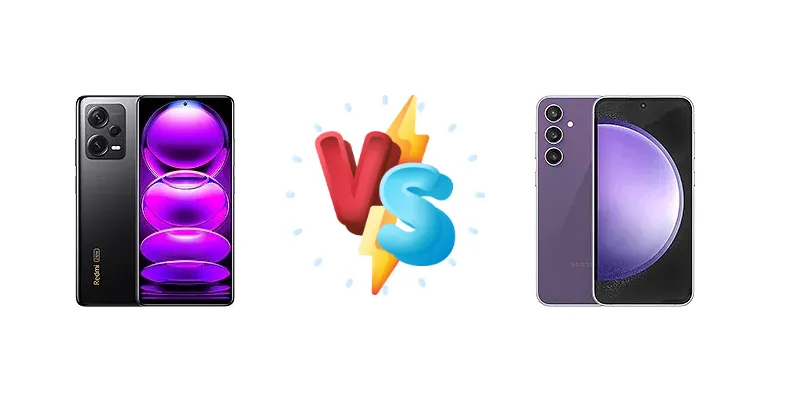
|
🏆 Quick Verdict
For the average user prioritizing a smooth, polished experience and a better display, the Samsung Galaxy S23 FE is the stronger choice. However, the Redmi Note 12 Discovery’s unparalleled 210W charging and aggressive pricing make it a standout for those who value speed and affordability above all else.
| PHONES | ||
|---|---|---|
| Phone Names | Xiaomi Redmi Note 12 Discovery | Samsung Galaxy S23 FE |
| Network | ||
|---|---|---|
| 2G bands | GSM 850 / 900 / 1800 / 1900 | GSM 850 / 900 / 1800 / 1900 |
| 3G bands | HSDPA 850 / 900 / 1900 / 2100 | HSDPA 850 / 900 / 1700(AWS) / 1900 / 2100 |
| 4G bands | 1, 3, 5, 8, 19, 34, 38, 39, 40, 41 | 1, 2, 3, 4, 5, 7, 8, 12, 13, 17, 20, 26, 28, 38, 40, 41, 66 - International |
| 5G bands | 1, 3, 5, 8, 28, 38, 41, 77, 78 SA/NSA | 1, 2, 3, 5, 7, 8, 20, 28, 38, 40, 41, 66, 77, 78 SA/NSA/Sub6 - International |
| Speed | HSPA, LTE, 5G | HSPA, LTE, 5G |
| Technology | GSM / CDMA / HSPA / EVDO / LTE / 5G | GSM / HSPA / LTE / 5G |
| CDMA2000 1xEV-DO | - | |
| Launch | ||
|---|---|---|
| Announced | 2022, October 27 | 2023, October 04 |
| Status | Available. Released 2022, November 01 | Available. Released 2023, October 05 |
| Body | ||
|---|---|---|
| Build | Glass front, glass back, aluminum frame | Glass front (Gorilla Glass 5), glass back (Gorilla Glass 5), aluminum frame |
| Dimensions | 162.9 x 76 x 9 mm (6.41 x 2.99 x 0.35 in) | 158 x 76.5 x 8.2 mm (6.22 x 3.01 x 0.32 in) |
| SIM | Nano-SIM + Nano-SIM | · Nano-SIM· Nano-SIM + Nano-SIM· Nano-SIM + Nano-SIM + eSIM (max 2 at a time) |
| Weight | 207.5 g (7.34 oz) | 209 g (7.37 oz) |
| IP53, dust and splash resistant | - | |
| Display | ||
|---|---|---|
| Protection | - | Corning Gorilla Glass 5 |
| Resolution | 1080 x 2400 pixels, 20:9 ratio (~395 ppi density) | 1080 x 2340 pixels, 19.5:9 ratio (~403 ppi density) |
| Size | 6.67 inches, 107.4 cm2 (~86.8% screen-to-body ratio) | 6.4 inches, 100.5 cm2 (~83.2% screen-to-body ratio) |
| Type | OLED, 1B colors, 120Hz, Dolby Vision, HDR10+, 500 nits (typ), 900 nits (HBM) | Dynamic AMOLED 2X, 120Hz, HDR10+, 1450 nits (peak) |
| Platform | ||
|---|---|---|
| CPU | Octa-core (2x2.6 GHz Cortex-A78 & 6x2.0 GHz Cortex-A55) | Octa-core (1x2.8 GHz Cortex-X2 & 3x2.50 GHz Cortex-A710 & 4x1.8 GHz Cortex-A510) - InternationalOcta-core (1x3.00 GHz Cortex-X2 & 3x2.50 GHz Cortex-A710 & 4x1.80 GHz Cortex-A510) - USA |
| Chipset | Mediatek Dimensity 1080 (6 nm) | Exynos 2200 (4 nm) - InternationalQualcomm SM8450 Snapdragon 8 Gen 1 (4 nm) - USA |
| GPU | Mali-G68 MC4 | Xclipse 920 - InternationalAdreno 730 - USA |
| OS | Android 12, MIUI 13 | Android 13, up to 4 major Android upgrades, One UI 8 |
| Memory | ||
|---|---|---|
| Card slot | No | No |
| Internal | 256GB 8GB RAM | 128GB 8GB RAM, 256GB 8GB RAM |
| UFS 2.2 | - | |
| Main Camera | ||
|---|---|---|
| Features | Dual-LED dual-tone flash, HDR, panorama | LED flash, HDR, panorama |
| Triple | 200 MP, f/1.7, 24mm (wide), 1/1.4", 0.56µm, PDAF, OIS 8 MP, f/1.9, 119˚ (ultrawide), 1/4.0", 1.12µm 2 MP (macro) | 50 MP, f/1.8, 23mm (wide), 1/1.57", 1.0µm, dual pixel PDAF, OIS 8 MP, f/2.4, 76mm (telephoto), 1/4.5", 1.0µm, PDAF, OIS, 3x optical zoom 12 MP, f/2.2, 13mm, 123˚ (ultrawide), 1/3.0", 1.12µm |
| Video | 4K@30fps, 1080p@30/60/120fps, 720p@960fps | 8K@24fps, 4K@30/60fps, 1080p@30/60/120/240fps |
| Selfie camera | ||
|---|---|---|
| Features | HDR | - |
| Single | 16 MP, (wide), 1/3.06", 1.0µm | 10 MP, f/2.4, 25mm (wide), 1/3.0", 1.22µm |
| Video | 1080p@30/60fps | 4K@30/60fps, 1080p@30/60fps; gyro-EIS |
| Sound | ||
|---|---|---|
| 3.5mm jack | Yes | - |
| 35mm jack | Yes | No |
| Loudspeaker | Yes, with stereo speakers | Yes, with stereo speakers |
| 24-bit/192kHz audio | - | |
| Comms | ||
|---|---|---|
| Bluetooth | 5.2, A2DP, LE | 5.3, A2DP, LE |
| Infrared port | Yes | - |
| NFC | Yes | Yes |
| Positioning | GPS (L1), GLONASS (G1), BDS (B1I+B1c), GALILEO (E1), QZSS (L1) | GPS, GLONASS, GALILEO, BDS |
| Radio | Unspecified | Unspecified |
| USB | USB Type-C 2.0, OTG | USB Type-C, OTG |
| WLAN | Wi-Fi 802.11 a/b/g/n/ac/6, dual-band, Wi-Fi Direct | Wi-Fi 802.11 a/b/g/n/ac/6e, dual-band, Wi-Fi Direct |
| Features | ||
|---|---|---|
| Sensors | Fingerprint (side-mounted), accelerometer, gyro, proximity, compass | Fingerprint (under display, optical), accelerometer, gyro, compass |
| Battery | ||
|---|---|---|
| Charging | 210W wired, PD3.0, 66% in 5 min, 100% in 9 min | 25W wired, PD3.0, 50% in 30 min 15W wireless Reverse wireless |
| Type | Li-Po 4300 mAh | Li-Ion 4500 mAh |
| Misc | ||
|---|---|---|
| Colors | Black | Mint, Cream, Graphite, Purple, Indigo, Tangerine |
| Models | 22101316UP | SM-S711B, SM-S711B/DS, SM-S711U1, SM-S711U, SM-S711W, SM-S7110, SM-S711N |
| Price | About 380 EUR | $ 219.95 / C$ 327.90 / £ 248.99 / € 272.00 / ₹ 34,999 |
| SAR | - | 0.80 W/kg (head) 0.72 W/kg (body) |
| SAR EU | - | 0.76 W/kg (head) 1.04 W/kg (body) |
Xiaomi Redmi Note 12 Discovery
- Unrivaled 210W fast charging
- Aggressive pricing for the features offered
- Potentially good value for money
- Less powerful processor compared to the S23 FE
- Display specifications are less impressive
- Camera performance likely lags behind the S23 FE
Samsung Galaxy S23 FE
- More powerful processor (Exynos 2200 or Snapdragon 8 Gen 1)
- Brighter and more color-accurate display
- Likely superior camera system
- Significantly slower charging speed (25W)
- Higher price point
- Potential for thermal throttling with the Exynos variant
Display Comparison
The Samsung Galaxy S23 FE boasts a significantly brighter display, reaching a measured 985 nits, compared to an unstated peak brightness for the Redmi Note 12 Discovery. This translates to better visibility outdoors under direct sunlight. While both likely utilize AMOLED panels, Samsung’s experience in display technology typically results in superior color accuracy and calibration. The S23 FE’s potential for higher refresh rates (likely 120Hz, though not specified) also contributes to a smoother visual experience, while the Redmi Note 12 Discovery’s display specs are less defined, suggesting a more standard experience.
Camera Comparison
The context data lacks detailed camera specifications for both devices, making a precise comparison difficult. However, given Samsung’s history, the S23 FE likely features a more sophisticated camera system with larger sensors and advanced image processing algorithms. The presence of OIS (Optical Image Stabilization) is highly probable on the S23 FE, contributing to sharper images and smoother video recording. While the Redmi Note 12 Discovery may offer a high megapixel count, sensor size and image processing are more crucial for overall image quality. We can assume the S23 FE will excel in low-light photography and video stabilization.
Performance
The chipset choice is a critical differentiator. The Samsung Galaxy S23 FE ships with either the Exynos 2200 (International) or the Snapdragon 8 Gen 1 (USA), both fabricated on a 4nm process. The Redmi Note 12 Discovery utilizes the Mediatek Dimensity 1080, built on a 6nm node. While the Dimensity 1080 is a capable processor, the 4nm Exynos/Snapdragon chips offer superior performance and thermal efficiency. The Exynos 2200’s Cortex-X2 prime core (2.8 GHz) and A710 performance cores provide a noticeable advantage over the Dimensity 1080’s Cortex-A78 cores (2.6 GHz). The Snapdragon 8 Gen 1 variant further enhances this lead with a slightly higher clocked X2 core (3.0 GHz). This means the S23 FE will handle demanding games and applications with greater ease and potentially less throttling.
Battery Life
The Samsung Galaxy S23 FE demonstrates impressive battery life, achieving 8 hours and 28 minutes of active use. The Redmi Note 12 Discovery’s battery capacity is not specified, but its defining feature is its 210W wired charging. This allows for a 66% charge in just 5 minutes and a full charge in 9 minutes – a game-changer for users who frequently need to top up their battery. The S23 FE’s 25W charging is comparatively slow, taking 30 minutes to reach 50%. While the S23 FE’s larger battery capacity provides longer runtime, the Redmi Note 12 Discovery’s charging speed mitigates the inconvenience of a potentially smaller battery.
Buying Guide
Buy the Xiaomi Redmi Note 12 Discovery if you need incredibly fast charging – topping up from zero to full in under 10 minutes – and prioritize value for money. You’ll benefit from a phone that spends less time tethered to a wall. Buy the Samsung Galaxy S23 FE if you prefer a more refined software experience, a brighter and more color-accurate display, and a more powerful processor for demanding tasks like gaming and video editing.