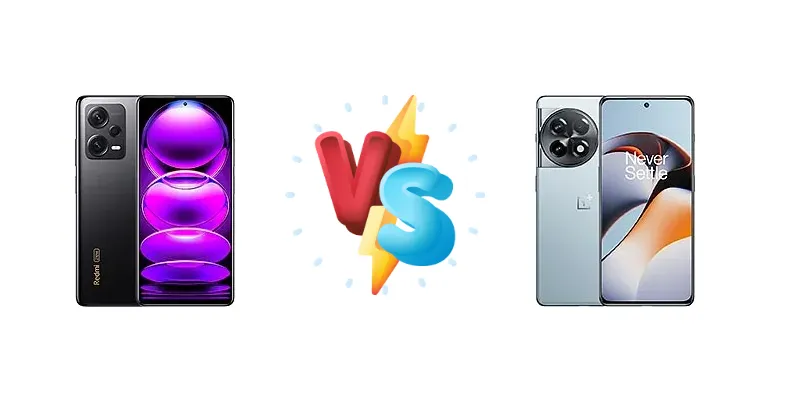
The Xiaomi Redmi Note 12 Discovery and OnePlus 11R represent compelling options in the increasingly competitive mid-range smartphone market. While both aim to deliver a premium experience without the flagship price tag, they take drastically different approaches – Xiaomi prioritizing charging speed and a modern design, while OnePlus focuses on established flagship-level processing power with the Snapdragon 8+ Gen 1. This comparison will dissect their key differences to help you choose the right device.
🏆 Quick Verdict
For the average user prioritizing raw performance and a proven track record, the OnePlus 11R is the better choice. Its Snapdragon 8+ Gen 1 chipset offers a significant performance advantage. However, the Xiaomi Redmi Note 12 Discovery’s groundbreaking 210W charging is a game-changer for those who value speed and convenience above all else.
| Network |
|---|
| 2G bands | GSM 850 / 900 / 1800 / 1900 | GSM 850 / 900 / 1800 / 1900 |
| 3G bands | HSDPA 850 / 900 / 1900 / 2100 | HSDPA 850 / 900 / 1700(AWS) / 2100 |
| 4G bands | 1, 3, 5, 8, 19, 34, 38, 39, 40, 41 | 1, 3, 4, 5, 8, 28, 34, 38, 39, 40, 41 |
| 5G bands | 1, 3, 5, 8, 28, 38, 41, 77, 78 SA/NSA | 1, 3, 5, 8, 28, 40, 41, 77, 78 SA/NSA |
| Speed | HSPA, LTE, 5G | HSPA, LTE (3CA), 5G |
| Technology | GSM / CDMA / HSPA / EVDO / LTE / 5G | GSM / CDMA / HSPA / LTE / 5G |
| | CDMA2000 1xEV-DO | CDMA 800 |
| Launch |
|---|
| Announced | 2022, October 27 | 2023, February 07 |
| Status | Available. Released 2022, November 01 | Available. Released 2023, February 21 |
| Body |
|---|
| Build | Glass front, glass back, aluminum frame | Glass front, glass back (Gorilla Glass 5), plastic frame |
| Dimensions | 162.9 x 76 x 9 mm (6.41 x 2.99 x 0.35 in) | 163.4 x 74.3 x 8.7 mm (6.43 x 2.93 x 0.34 in) |
| SIM | Nano-SIM + Nano-SIM | Nano-SIM + Nano-SIM |
| Weight | 207.5 g (7.34 oz) | 204 g (7.20 oz) |
| | IP53, dust and splash resistant | - |
| Display |
|---|
| Resolution | 1080 x 2400 pixels, 20:9 ratio (~395 ppi density) | 1240 x 2772 pixels, 20:9 ratio (~451 ppi density) |
| Size | 6.67 inches, 107.4 cm2 (~86.8% screen-to-body ratio) | 6.74 inches, 109.2 cm2 (~90.0% screen-to-body ratio) |
| Type | OLED, 1B colors, 120Hz, Dolby Vision, HDR10+, 500 nits (typ), 900 nits (HBM) | Fluid AMOLED, 1B colors, 120Hz, HDR10+, 1450 nits (peak) |
| Platform |
|---|
| CPU | Octa-core (2x2.6 GHz Cortex-A78 & 6x2.0 GHz Cortex-A55) | Octa-core (1x3.0 GHz Cortex-X2 & 3x2.5 GHz Cortex-A710 & 4x1.80 GHz Cortex-A510) |
| Chipset | Mediatek Dimensity 1080 (6 nm) | Qualcomm SM8475 Snapdragon 8+ Gen 1 (4 nm) |
| GPU | Mali-G68 MC4 | Adreno 730 |
| OS | Android 12, MIUI 13 | Android 13, upgradable to Android 15, OxygenOS 15 |
| Memory |
|---|
| Card slot | No | No |
| Internal | 256GB 8GB RAM | 128GB 8GB RAM, 256GB 16GB RAM, 512GB 18GB RAM |
| | UFS 2.2 | UFS 3.1 |
| Main Camera |
|---|
| Features | Dual-LED dual-tone flash, HDR, panorama | Color spectrum sensor, LED flash, HDR, panorama |
| Single | - | 16 MP, f/2.4, 24mm (wide), 1/3.09", 1.0µm |
| Triple | 200 MP, f/1.7, 24mm (wide), 1/1.4", 0.56µm, PDAF, OIS
8 MP, f/1.9, 119˚ (ultrawide), 1/4.0", 1.12µm
2 MP (macro) | 50 MP, f/1.8, 24mm (wide), 1/1.56", 1.0µm, multi-directional PDAF, OIS
8 MP, f/2.2, 120˚ (ultrawide), 1/4.0", 1.12µm
2 MP (macro) |
| Video | 4K@30fps, 1080p@30/60/120fps, 720p@960fps | 4K@30/60fps, 1080p@30/60/240fps, gyro-EIS |
| Selfie camera |
|---|
| Features | HDR | HDR |
| Single | 16 MP, (wide), 1/3.06", 1.0µm | 16 MP, f/2.4, 24mm (wide), 1/3.09", 1.0µm |
| Video | 1080p@30/60fps | 1080p@30fps |
| Sound |
|---|
| 3.5mm jack | Yes | No |
| 35mm jack | Yes | No |
| Loudspeaker | Yes, with stereo speakers | Yes, with stereo speakers |
| | 24-bit/192kHz audio | 24-bit/192kHz audio |
| Comms |
|---|
| Bluetooth | 5.2, A2DP, LE | 5.3, A2DP, LE, aptX HD |
| Infrared port | Yes | Yes |
| NFC | Yes | Yes |
| Positioning | GPS (L1), GLONASS (G1), BDS (B1I+B1c), GALILEO (E1), QZSS (L1) | GPS (L1+L5), GLONASS (G1), BDS (B1I+B1c+B2a), GALILEO (E1+E5a), QZSS (L1+L5) |
| Radio | Unspecified | No |
| USB | USB Type-C 2.0, OTG | USB Type-C 2.0 |
| WLAN | Wi-Fi 802.11 a/b/g/n/ac/6, dual-band, Wi-Fi Direct | Wi-Fi 802.11 a/b/g/n/ac/6, dual-band |
| Features |
|---|
| Sensors | Fingerprint (side-mounted), accelerometer, gyro, proximity, compass | Fingerprint (under display, optical), accelerometer, gyro, proximity, compass |
| Battery |
|---|
| Charging | 210W wired, PD3.0, 66% in 5 min, 100% in 9 min | 100W wired |
| Type | Li-Po 4300 mAh | Li-Po 5000 mAh |
| Misc |
|---|
| Colors | Black | Galactic Silver, Sonic Black, Solar Red |
| Models | 22101316UP | CPH2487 |
| Price | About 380 EUR | About 600 EUR |
| SAR | - | 1.16 W/kg (head) 0.61 W/kg (body) |
Xiaomi Redmi Note 12 Discovery
- Unmatched 210W charging speed
- Modern and stylish design (assumed)
- Potentially more affordable price point
- Less powerful chipset compared to Snapdragon 8+ Gen 1
- Limited information on camera capabilities
OnePlus 11R
- Powerful Snapdragon 8+ Gen 1 processor
- Excellent performance for gaming and demanding apps
- Fast 100W charging
- Charging speed significantly slower than Redmi Note 12 Discovery
- Potentially higher price point
Display Comparison
Neither device boasts a cutting-edge display, but differences exist. While specific display specs (resolution, refresh rate) are missing for the Redmi Note 12 Discovery, OnePlus 11R is expected to have a 120Hz AMOLED panel. The focus here isn't on display innovation, but on delivering a smooth and vibrant viewing experience. The absence of LTPO technology on either device suggests both will rely on adaptive refresh rate scaling rather than variable refresh rates for power efficiency.
Camera Comparison
Without detailed camera specifications for the Redmi Note 12 Discovery, a direct comparison is limited. However, the OnePlus 11R is expected to feature a capable camera system, likely with a 50MP main sensor. The Snapdragon 8+ Gen 1’s ISP (Image Signal Processor) provides excellent image processing capabilities. The Redmi Note 12 Discovery will likely focus on software enhancements to compensate for potentially less advanced hardware. The absence of information regarding OIS (Optical Image Stabilization) on either device suggests reliance on EIS (Electronic Image Stabilization).
Performance
The core difference lies in the chipsets. The OnePlus 11R’s Snapdragon 8+ Gen 1 (4nm) is a significant step up from the Redmi Note 12 Discovery’s Mediatek Dimensity 1080 (6nm). The Snapdragon 8+ Gen 1 features a Cortex-X2 prime core clocked at 3.0 GHz, alongside Cortex-A710 and A510 cores, offering superior single-core and multi-core performance. The Dimensity 1080, while capable with its Cortex-A78 and A55 cores, is geared towards efficiency rather than outright speed. The 4nm process of the Snapdragon 8+ Gen 1 also translates to better thermal efficiency, potentially reducing throttling during extended gaming sessions. This benefits gamers and users running demanding applications.
Battery Life
The OnePlus 11R features 100W wired charging, which is fast, but the Redmi Note 12 Discovery’s 210W charging is revolutionary. The Redmi Note 12 Discovery can reach 100% charge in just 9 minutes, a massive advantage for users constantly on the go. While battery capacity is unknown for the Redmi Note 12 Discovery, the OnePlus 11R’s 5000mAh battery provides all-day battery life for most users. The faster charging of the Redmi Note 12 Discovery effectively mitigates any potential disadvantage from a smaller battery capacity.
Buying Guide
Buy the Xiaomi Redmi Note 12 Discovery if you need the absolute fastest charging available on a smartphone and appreciate a modern aesthetic. Its 210W charging capability is unmatched, refilling the battery in under 10 minutes. Buy the OnePlus 11R if you prefer a more established chipset with proven performance, particularly for gaming and demanding applications. The Snapdragon 8+ Gen 1 provides a smoother experience for power users and those who prioritize sustained performance.
Frequently Asked Questions
❓ Will the Snapdragon 8+ Gen 1 in the OnePlus 11R get noticeably hotter than the Dimensity 1080 during prolonged gaming?
The Snapdragon 8+ Gen 1 is a more powerful chip and will generate more heat under sustained load. However, the 4nm process node and OnePlus’s thermal management system are designed to mitigate this. While it may get warmer, it’s less likely to experience significant throttling compared to the 6nm Dimensity 1080 if pushed to its limits.
❓ How much faster is the 210W charging on the Redmi Note 12 Discovery compared to the 100W on the OnePlus 11R in real-world use?
The Redmi Note 12 Discovery can fully charge in approximately 9 minutes, while the OnePlus 11R takes considerably longer. This translates to a significant time saving, especially for users who frequently need to top up their battery quickly. The difference is particularly noticeable when charging from a low battery percentage.
❓ Does the OnePlus 11R support high refresh rate gaming, and what frame rates can I expect in popular titles like PUBG Mobile?
The OnePlus 11R’s 120Hz display and powerful Snapdragon 8+ Gen 1 chipset support high refresh rate gaming. Expect to achieve stable 60fps in most titles, and potentially 90fps in PUBG Mobile with optimized settings. Sustained high frame rates will depend on the game’s optimization and thermal management.