
Xiaomi Redmi Note 12 Discovery vs Motorola Edge 40 Pro: A Deep Dive Comparison
| Phones Images | |||||
|---|---|---|---|---|---|
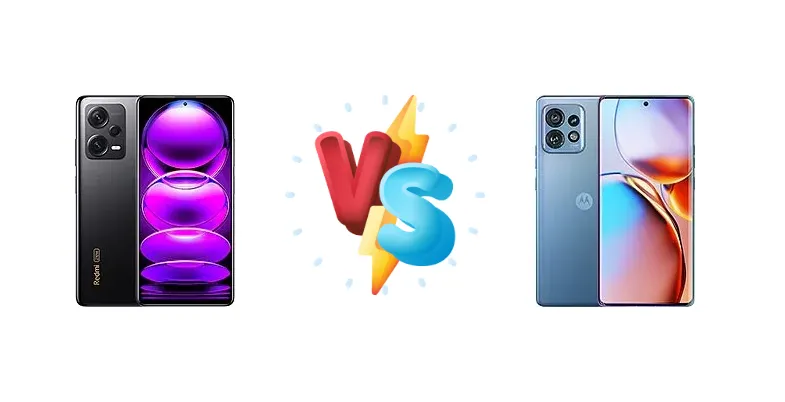
|
🏆 Quick Verdict
For the average user prioritizing raw performance and a more refined experience, the Motorola Edge 40 Pro is the superior choice. Its Snapdragon 8 Gen 2 chipset delivers significantly faster processing and graphics capabilities. However, the Redmi Note 12 Discovery’s 210W charging is a game-changer for those who value speed above all else.
| PHONES | ||
|---|---|---|
| Phone Names | Xiaomi Redmi Note 12 Discovery | Motorola Edge 40 Pro |
| Network | ||
|---|---|---|
| 2G bands | GSM 850 / 900 / 1800 / 1900 | GSM 850 / 900 / 1800 / 1900 |
| 3G bands | HSDPA 850 / 900 / 1900 / 2100 | HSDPA 850 / 900 / 1700(AWS) / 1900 / 2100 |
| 4G bands | 1, 3, 5, 8, 19, 34, 38, 39, 40, 41 | 1, 2, 3, 4, 5, 7, 8, 12, 13, 17, 18, 19, 20, 25, 26, 28, 32, 38, 39, 40, 41, 42, 43, 48, 66 |
| 5G bands | 1, 3, 5, 8, 28, 38, 41, 77, 78 SA/NSA | 1, 2, 3, 5, 7, 8, 20, 28, 38, 40, 41, 66, 77, 78 SA/NSA/Sub6 |
| Speed | HSPA, LTE, 5G | HSPA, LTE, 5G |
| Technology | GSM / CDMA / HSPA / EVDO / LTE / 5G | GSM / HSPA / LTE / 5G |
| CDMA2000 1xEV-DO | - | |
| Launch | ||
|---|---|---|
| Announced | 2022, October 27 | 2023, April 04 |
| Status | Available. Released 2022, November 01 | Available. Released 2023, April 04 |
| Body | ||
|---|---|---|
| Build | Glass front, glass back, aluminum frame | Glass front (Gorilla Glass Victus), glass back (Gorilla Glass Victus), aluminum frame |
| Dimensions | 162.9 x 76 x 9 mm (6.41 x 2.99 x 0.35 in) | 161.2 x 74 x 8.6 mm (6.35 x 2.91 x 0.34 in) |
| SIM | Nano-SIM + Nano-SIM | Nano-SIM + eSIM |
| Weight | 207.5 g (7.34 oz) | 199 g (7.02 oz) |
| IP53, dust and splash resistant | IP68 dust/water resistant (up to 1.5m for 30 min) | |
| Display | ||
|---|---|---|
| Protection | - | Corning Gorilla Glass Victus |
| Resolution | 1080 x 2400 pixels, 20:9 ratio (~395 ppi density) | 1080 x 2400 pixels, 20:9 ratio (~394 ppi density) |
| Size | 6.67 inches, 107.4 cm2 (~86.8% screen-to-body ratio) | 6.67 inches, 108.0 cm2 (~90.5% screen-to-body ratio) |
| Type | OLED, 1B colors, 120Hz, Dolby Vision, HDR10+, 500 nits (typ), 900 nits (HBM) | OLED, 1B colors, 165Hz, HDR10+, Dolby Vision, 1300 nits (peak) |
| Platform | ||
|---|---|---|
| CPU | Octa-core (2x2.6 GHz Cortex-A78 & 6x2.0 GHz Cortex-A55) | Octa-core (1x3.2 GHz Cortex-X3 & 2x2.8 GHz Cortex-A715 & 2x2.8 GHz Cortex-A710 & 3x2.0 GHz Cortex-A510) |
| Chipset | Mediatek Dimensity 1080 (6 nm) | Qualcomm SM8550-AB Snapdragon 8 Gen 2 (4 nm) |
| GPU | Mali-G68 MC4 | Adreno 740 |
| OS | Android 12, MIUI 13 | Android 13, up to 3 major Android upgrades |
| Memory | ||
|---|---|---|
| Card slot | No | No |
| Internal | 256GB 8GB RAM | 256GB 12GB RAM, 512GB 12GB RAM |
| UFS 2.2 | UFS 4.0 | |
| Main Camera | ||
|---|---|---|
| Features | Dual-LED dual-tone flash, HDR, panorama | Dual-LED flash, panorama, HDR |
| Triple | 200 MP, f/1.7, 24mm (wide), 1/1.4", 0.56µm, PDAF, OIS 8 MP, f/1.9, 119˚ (ultrawide), 1/4.0", 1.12µm 2 MP (macro) | 50 MP, f/1.8, (wide), 1/1.55", 1.0µm, multi-directional PDAF, OIS 12 MP, f/1.6, (telephoto), 1/2.93", 1.22µm, PDAF, 2x optical zoom 50 MP, f/2.2, 114˚ (ultrawide), 1/2.76", 0.64µm, AF |
| Video | 4K@30fps, 1080p@30/60/120fps, 720p@960fps | 8K@30fps, 4K@30/60fps, 1080p@30/60/120/240/960fps, 10-bit HDR10+, gyro-EIS |
| Selfie camera | ||
|---|---|---|
| Features | HDR | HDR |
| Single | 16 MP, (wide), 1/3.06", 1.0µm | 60 MP, f/2.2, (wide), 1/2.8", 0.61µm |
| Video | 1080p@30/60fps | 4K@30/60fps, 1080p@30/60fps |
| Sound | ||
|---|---|---|
| 3.5mm jack | Yes | No |
| 35mm jack | Yes | No |
| Loudspeaker | Yes, with stereo speakers | Yes, with stereo speakers |
| 24-bit/192kHz audio | - | |
| Comms | ||
|---|---|---|
| Bluetooth | 5.2, A2DP, LE | 5.3, A2DP, LE |
| Infrared port | Yes | - |
| NFC | Yes | Yes |
| Positioning | GPS (L1), GLONASS (G1), BDS (B1I+B1c), GALILEO (E1), QZSS (L1) | GPS, GLONASS, GALILEO, BDS |
| Radio | Unspecified | No |
| USB | USB Type-C 2.0, OTG | USB Type-C 3.2, OTG, DisplayPort 1.4 |
| WLAN | Wi-Fi 802.11 a/b/g/n/ac/6, dual-band, Wi-Fi Direct | Wi-Fi 802.11 a/b/g/n/ac/6e/7, tri-band, Wi-Fi Direct |
| Features | ||
|---|---|---|
| Sensors | Fingerprint (side-mounted), accelerometer, gyro, proximity, compass | Fingerprint (under display, optical), accelerometer, gyro, proximity, compass |
| - | Ready For 3.5 support | |
| Battery | ||
|---|---|---|
| Charging | 210W wired, PD3.0, 66% in 5 min, 100% in 9 min | 125W wired, PD3.0, QC5, 50% in 6 min, 100% in 23 min 15W wireless 5W reverse wired 5W reverse wireless |
| Type | Li-Po 4300 mAh | Li-Po 4600 mAh |
| Misc | ||
|---|---|---|
| Colors | Black | Interstellar Black, Lunar Blue |
| Models | 22101316UP | - |
| Price | About 380 EUR | € 313.87 |
| Tests | ||
|---|---|---|
| Battery life | - | Endurance rating 117h |
| Camera | - | Photo / Video |
| Display | - | Contrast ratio: Infinite (nominal) |
| Loudspeaker | - | -22.6 LUFS (Excellent) |
| Performance | - | AnTuTu: 1273764 (v9) GeekBench: 4896 (v5.1), 5352 (v6) GFXBench: 112fps (ES 3.1 onscreen) |
Xiaomi Redmi Note 12 Discovery
- Revolutionary 210W wired charging
- Potentially more affordable price point
- Efficient Dimensity 1080 chipset for everyday tasks
- Less powerful processor compared to Snapdragon 8 Gen 2
- Limited camera information suggests a less advanced system
- No wireless or reverse wireless charging
Motorola Edge 40 Pro
- Flagship-level Snapdragon 8 Gen 2 performance
- High peak display brightness for outdoor visibility
- Wireless and reverse wireless charging capabilities
- Slower charging speed compared to Redmi Note 12 Discovery
- Higher price tag
- Potential for thermal throttling under extreme load (though mitigated by 4nm process)
Display Comparison
The Motorola Edge 40 Pro boasts a display capable of reaching 1050 nits of peak brightness, ensuring excellent visibility even in direct sunlight. While the Redmi Note 12 Discovery’s display specs are not provided, it’s likely to be lower, impacting outdoor usability. The Edge 40 Pro’s 'Infinite' contrast ratio suggests a high-quality OLED panel, offering deep blacks and vibrant colors. The lack of LTPO information for either device means adaptive refresh rates are not guaranteed, potentially impacting battery life during less demanding tasks.
Camera Comparison
Both devices are listed as having Photo/Video capabilities, but detailed sensor information is missing for the Redmi Note 12 Discovery. The Motorola Edge 40 Pro likely features a more sophisticated camera system, leveraging the Snapdragon 8 Gen 2’s advanced image signal processor (ISP). Without specific details, it’s difficult to assess low-light performance or video stabilization. The absence of information regarding OIS on either device is a notable omission. We can assume the Edge 40 Pro will offer a more versatile and higher-quality camera experience.
Performance
The core difference lies in the chipsets. The Motorola Edge 40 Pro’s Snapdragon 8 Gen 2 (4nm) is a significant leap ahead of the Redmi Note 12 Discovery’s Mediatek Dimensity 1080 (6nm). The Snapdragon 8 Gen 2’s octa-core configuration, featuring a Cortex-X3 prime core clocked at 3.2 GHz, provides substantially more processing power. The 4nm process node also translates to improved thermal efficiency, reducing the likelihood of throttling during sustained workloads. The Dimensity 1080, while capable, is geared towards efficient performance rather than outright speed. The Edge 40 Pro will excel in graphically intensive games and demanding applications.
Battery Life
The Motorola Edge 40 Pro has an endurance rating of 117 hours, indicating solid battery life. However, the Redmi Note 12 Discovery’s 210W charging is the standout feature. Achieving 66% charge in 5 minutes and 100% in just 9 minutes is unparalleled. While the Edge 40 Pro’s 125W charging is still fast (50% in 6 minutes, 100% in 23 minutes), it’s significantly slower. The Edge 40 Pro also offers 15W wireless and 5W reverse charging, features absent in the Redmi Note 12 Discovery’s specifications. The Redmi Note 12 Discovery prioritizes minimizing downtime, while the Edge 40 Pro focuses on overall longevity and charging versatility.
Buying Guide
Buy the Xiaomi Redmi Note 12 Discovery if you need unparalleled charging speeds and are willing to compromise on peak performance. It’s ideal for users who frequently find themselves needing a quick power boost. Buy the Motorola Edge 40 Pro if you prioritize a smooth, responsive experience for demanding tasks like gaming, video editing, and multitasking, and appreciate the benefits of a flagship-level processor.