
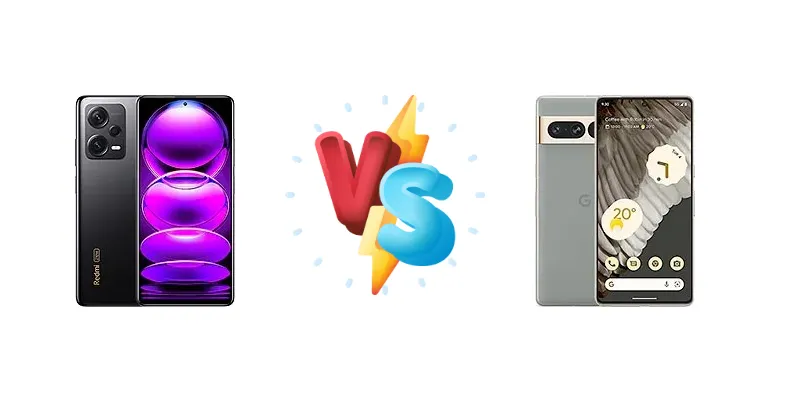
Redmi Note 12 Discovery vs. Google Pixel 7 Pro: A Deep Dive into Speed and Smarts
| Phones Images | |||||
|---|---|---|---|---|---|
|
🏆 Quick Verdict
For the average user prioritizing camera quality and a polished software experience, the Google Pixel 7 Pro is the superior choice. However, the Redmi Note 12 Discovery’s astonishing 210W charging and strong performance make it a compelling option for those who value speed and aren't as concerned with software refinement.
| PHONES | ||
|---|---|---|
| Phone Names | Xiaomi Redmi Note 12 Discovery | Google Pixel 7 Pro |
| Network | ||
|---|---|---|
| 2G bands | GSM 850 / 900 / 1800 / 1900 | GSM 850 / 900 / 1800 / 1900 |
| 3G bands | HSDPA 850 / 900 / 1900 / 2100 | HSDPA 800 / 850 / 900 / 1700(AWS) / 1900 / 2100 |
| 4G bands | 1, 3, 5, 8, 19, 34, 38, 39, 40, 41 | 1, 2, 3, 4, 5, 7, 8, 12, 13, 14, 17, 18, 19, 20, 25, 26, 28, 29, 30, 38, 39, 40, 41, 42, 46, 48, 66, 71 - GE2AE |
| 5G bands | 1, 3, 5, 8, 28, 38, 41, 77, 78 SA/NSA | 1, 2, 3, 5, 7, 8, 12, 14, 20, 25, 28, 30, 38, 40, 41, 48, 66, 71, 77, 78, 257, 258, 260, 261 SA/NSA/Sub6/mmWave - GE2AE |
| Speed | HSPA, LTE, 5G | HSPA, LTE, 5G |
| Technology | GSM / CDMA / HSPA / EVDO / LTE / 5G | GSM / CDMA / HSPA / EVDO / LTE / 5G |
| CDMA2000 1xEV-DO | 1, 2, 3, 5, 7, 8, 12, 14, 20, 25, 28, 30, 38, 40, 41, 48, 66, 71, 75, 76, 77, 78 SA/NSA/Sub6 - GP4BC | |
| Launch | ||
|---|---|---|
| Announced | 2022, October 27 | 2022, October 06 |
| Status | Available. Released 2022, November 01 | Available. Released 2022, October 13 |
| Body | ||
|---|---|---|
| Build | Glass front, glass back, aluminum frame | Glass front (Gorilla Glass Victus), glass back (Gorilla Glass Victus), aluminum frame |
| Dimensions | 162.9 x 76 x 9 mm (6.41 x 2.99 x 0.35 in) | 162.9 x 76.6 x 8.9 mm (6.41 x 3.02 x 0.35 in) |
| SIM | Nano-SIM + Nano-SIM | Nano-SIM + eSIM |
| Weight | 207.5 g (7.34 oz) | 212 g (7.48 oz) |
| IP53, dust and splash resistant | IP68 dust/water resistant (up to 1.5m for 30 min) | |
| Display | ||
|---|---|---|
| Protection | - | Corning Gorilla Glass Victus |
| Resolution | 1080 x 2400 pixels, 20:9 ratio (~395 ppi density) | 1440 x 3120 pixels, 19.5:9 ratio (~512 ppi density) |
| Size | 6.67 inches, 107.4 cm2 (~86.8% screen-to-body ratio) | 6.7 inches, 110.6 cm2 (~88.7% screen-to-body ratio) |
| Type | OLED, 1B colors, 120Hz, Dolby Vision, HDR10+, 500 nits (typ), 900 nits (HBM) | LTPO AMOLED, 120Hz, HDR10+, 1000 nits (HBM), 1500 nits (peak) |
| - | Always-on display | |
| Platform | ||
|---|---|---|
| CPU | Octa-core (2x2.6 GHz Cortex-A78 & 6x2.0 GHz Cortex-A55) | Octa-core (2x2.85 GHz Cortex-X1 & 2x2.35 GHz Cortex-A78 & 4x1.80 GHz Cortex-A55) |
| Chipset | Mediatek Dimensity 1080 (6 nm) | Google Tensor G2 (5 nm) |
| GPU | Mali-G68 MC4 | Mali-G710 MP7 |
| OS | Android 12, MIUI 13 | Android 13, upgradable to Android 15, up to 5 major Android upgrades |
| Memory | ||
|---|---|---|
| Card slot | No | No |
| Internal | 256GB 8GB RAM | 128GB 8GB RAM, 256GB 8GB RAM, 128GB 12GB RAM, 256GB 12GB RAM, 512GB 12GB RAM |
| UFS 2.2 | UFS 3.1 | |
| Main Camera | ||
|---|---|---|
| Features | Dual-LED dual-tone flash, HDR, panorama | Laser AF, Dual-LED flash, Pixel Shift, Auto-HDR, panorama |
| Single | - | 10.8 MP, f/2.2, 21mm (ultrawide), 1/3.1", 1.22µm |
| Triple | 200 MP, f/1.7, 24mm (wide), 1/1.4", 0.56µm, PDAF, OIS 8 MP, f/1.9, 119˚ (ultrawide), 1/4.0", 1.12µm 2 MP (macro) | 50 MP, f/1.9, 25mm (wide), 1/1.31", 1.2µm, dual pixel PDAF, OIS 48 MP, f/3.5, 120mm (periscope telephoto), 1/2.55", 0.7µm, dual pixel PDAF, OIS, 5x optical zoom 12 MP, f/2.2, 126˚ (ultrawide), 1/2.9", 1.25µm, AF |
| Video | 4K@30fps, 1080p@30/60/120fps, 720p@960fps | 4K@30/60fps, 1080p@30/60/120/240fps; gyro-EIS, OIS, 10-bit HDR |
| Selfie camera | ||
|---|---|---|
| Features | HDR | HDR, panorama |
| Single | 16 MP, (wide), 1/3.06", 1.0µm | 10.8 MP, f/2.2, 21mm (ultrawide), 1/3.1", 1.22µm |
| Video | 1080p@30/60fps | 4K@30/60fps, 1080p@30/60fps |
| Sound | ||
|---|---|---|
| 3.5mm jack | Yes | No |
| 35mm jack | Yes | No |
| Loudspeaker | Yes, with stereo speakers | Yes, with stereo speakers |
| 24-bit/192kHz audio | - | |
| Comms | ||
|---|---|---|
| Bluetooth | 5.2, A2DP, LE | 5.2, A2DP, LE, aptX HD |
| Infrared port | Yes | - |
| NFC | Yes | Yes |
| Positioning | GPS (L1), GLONASS (G1), BDS (B1I+B1c), GALILEO (E1), QZSS (L1) | GPS (L1+L5), GLONASS (G1), BDS (B1I+B1c+B2a), GALILEO (E1+E5a), QZSS (L1+L5) |
| Radio | Unspecified | No |
| USB | USB Type-C 2.0, OTG | USB Type-C 3.2 |
| WLAN | Wi-Fi 802.11 a/b/g/n/ac/6, dual-band, Wi-Fi Direct | Wi-Fi 802.11 a/b/g/n/ac/6e, tri-band, Wi-Fi Direct |
| Features | ||
|---|---|---|
| Sensors | Fingerprint (side-mounted), accelerometer, gyro, proximity, compass | Fingerprint (under display, optical), accelerometer, gyro, proximity, compass, barometer |
| - | Ultra Wideband (UWB) support | |
| Battery | ||
|---|---|---|
| Charging | 210W wired, PD3.0, 66% in 5 min, 100% in 9 min | 23W wired, PD3.0, 50% in 30 min 23W wireless Reverse wireless |
| Type | Li-Po 4300 mAh | Li-Ion 5000 mAh |
| Misc | ||
|---|---|---|
| Colors | Black | Obsidian, Snow, Hazel |
| Models | 22101316UP | GP4BC, GE2AE, GFE4J |
| Price | About 380 EUR | € 248.84 / $ 204.00 / £ 259.99 / ₹ 36,999 |
| Tests | ||
|---|---|---|
| Battery life | - | Endurance rating 83h |
| Camera | - | Photo / Video |
| Display | - | Contrast ratio: Infinite (nominal) |
| Loudspeaker | - | -24.8 LUFS (Very good) |
| Performance | - | AnTuTu: 796369 (v9) GeekBench: 3187 (v5.1) GFXBench: 34fps (ES 3.1 onscreen) |
Xiaomi Redmi Note 12 Discovery
- Blazing-fast 210W charging
- Strong performance from Dimensity 1080
- Potentially more affordable price point
- MIUI software can be bloated
- Camera likely inferior to Pixel 7 Pro
Google Pixel 7 Pro
- Exceptional camera quality and computational photography
- Smooth and refined Android experience
- Long-term software support
- Significantly slower charging speed
- Higher price tag
Display Comparison
The Google Pixel 7 Pro boasts a display capable of reaching 1090 nits of peak brightness, ensuring excellent visibility even in direct sunlight. While the Redmi Note 12 Discovery’s display specs aren’t provided, it’s likely to be a high-refresh-rate AMOLED panel, common in this price segment. The Pixel 7 Pro’s ‘Infinite’ contrast ratio suggests a true OLED panel, offering perfect blacks. The Pixel 7 Pro’s larger size and potentially LTPO technology (based on Pixel lineage) could also contribute to more efficient power consumption during static content viewing.
Camera Comparison
The Pixel 7 Pro’s camera system is a key differentiator, leveraging Google’s renowned computational photography algorithms. While specific sensor details are missing, the Pixel 7 Pro excels in dynamic range, detail, and low-light performance. The Redmi Note 12 Discovery’s camera specs are not provided, but it’s reasonable to expect a versatile setup. However, it’s unlikely to match the Pixel 7 Pro’s image processing capabilities. The Pixel 7 Pro’s video recording capabilities are also likely superior, benefiting from advanced stabilization and HDR processing. The Pixel 7 Pro’s focus on software-driven image quality gives it a significant edge.
Performance
The Google Pixel 7 Pro’s Tensor G2, fabricated on a 5nm process, offers a more sophisticated architecture with a Cortex-X1 prime core clocked at 2.85 GHz, promising superior single-core performance compared to the Redmi Note 12 Discovery’s Dimensity 1080. The Dimensity 1080, built on a 6nm node, features a Cortex-A78 core clocked at 2.6 GHz. While the Pixel 7 Pro’s CPU configuration is more powerful, the Dimensity 1080 provides a strong balance of performance and efficiency. The Pixel 7 Pro’s Tensor G2 also benefits from dedicated machine learning cores, enhancing features like voice recognition and image processing. The Redmi Note 12 Discovery will likely excel in graphics-intensive tasks due to its more recent GPU architecture, but the Tensor G2’s overall system optimization provides a smoother experience.
Battery Life
Both devices achieve an endurance rating of 83 hours, suggesting comparable battery life despite differing capacities. However, the charging experience is where they diverge dramatically. The Redmi Note 12 Discovery’s 210W wired charging is a game-changer, achieving 66% charge in just 5 minutes and a full charge in 9 minutes. The Pixel 7 Pro’s 23W wired charging takes 30 minutes to reach 50%, a significantly slower pace. The Pixel 7 Pro does offer 23W wireless charging and reverse wireless charging, features absent on the Redmi Note 12 Discovery. The Redmi Note 12 Discovery prioritizes speed, while the Pixel 7 Pro offers more versatile charging options.
Buying Guide
Buy the Xiaomi Redmi Note 12 Discovery if you need unparalleled charging speeds, prioritize gaming performance within a budget, and are comfortable with Xiaomi’s MIUI software. Buy the Google Pixel 7 Pro if you prefer a seamless Android experience, exceptional camera capabilities, and long-term software support, even if it means sacrificing ultra-fast charging.