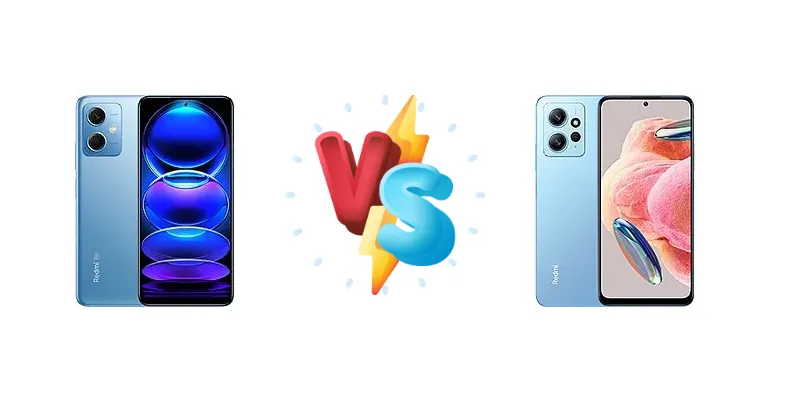
The Xiaomi Redmi Note 12 series offers compelling value, but navigating the different versions can be confusing. This review pits the Redmi Note 12 (China) against the Redmi Note 12 4G, dissecting their strengths and weaknesses to help you choose the right one for your needs.
🏆 Quick Verdict
The Redmi Note 12 4G boasts exceptional battery life and a bright display, making it ideal for power users. The Redmi Note 12 (China) offers a slightly more modern chipset, potentially providing a small performance edge for demanding tasks. Ultimately, battery life and display quality tip the scales towards the 4G model for most users.
| Network |
|---|
| 2G bands | GSM 850 / 900 / 1800 / 1900 | GSM 850 / 900 / 1800 / 1900 |
| 3G bands | HSDPA 850 / 900 / 1900 / 2100 | HSDPA 850 / 900 / 2100 |
| 4G bands | 1, 3, 5, 7, 8, 34, 38, 39, 40, 41 | 1, 3, 5, 7, 8, 20, 28, 38, 40, 41 |
| 5G bands | 1, 3, 5, 8, 41, 77, 78 SA/NSA | - |
| Speed | HSPA, LTE, 5G | HSPA, LTE, 5G |
| Technology | GSM / CDMA / HSPA / EVDO / LTE / 5G | GSM / HSPA / LTE |
| | CDMA2000 1xEV-DO | - |
| Launch |
|---|
| Announced | 2022, October 27 | 2023, March 23 |
| Status | Available. Released 2022, November 01 | Available. Released 2023, March 30 |
| Body |
|---|
| Build | - | Glass front (Gorilla Glass 3), plastic frame, plastic back |
| Dimensions | 165.9 x 76.2 x 8 mm (6.53 x 3.00 x 0.31 in) | 165.7 x 76 x 7.9 mm (6.52 x 2.99 x 0.31 in) |
| SIM | Nano-SIM + Nano-SIM | Nano-SIM + Nano-SIM |
| Weight | 188 g (6.63 oz) | 183.5 g (6.49 oz) |
| | IP53, dust and splash resistant | IP53, dust and splash resistant |
| Display |
|---|
| Protection | - | Corning Gorilla Glass 3 |
| Resolution | 1080 x 2400 pixels, 20:9 ratio (~395 ppi density) | 1080 x 2400 pixels, 20:9 ratio (~395 ppi density) |
| Size | 6.67 inches, 107.4 cm2 (~85.0% screen-to-body ratio) | 6.67 inches, 107.4 cm2 (~85.3% screen-to-body ratio) |
| Type | Samsung AMOLED, 120Hz, 1200 nits (peak) | AMOLED, 120Hz, 450 nits (typ), 700 nits (HBM), 1200 nits (peak) |
| Platform |
|---|
| CPU | Octa-core (2x2.0 GHz Cortex-A78 & 6x1.8 GHz Cortex-A55) | Octa-core (4x2.8 GHz Cortex-A73 & 4x1.9 GHz Cortex-A53) |
| Chipset | Qualcomm SM4375 Snapdragon 4 Gen 1 (6 nm) | Qualcomm SM6225 Snapdragon 685 (6 nm) |
| GPU | Adreno 619 | Adreno 610 |
| OS | Android 12, MIUI 13 | Android 13, upgradable to Android 14, HyperOS |
| Memory |
|---|
| Card slot | No | microSDXC (dedicated slot) |
| Internal | 128GB 4GB RAM, 128GB 6GB RAM, 128GB 8GB RAM, 256GB 8GB RAM, 256GB 12GB RAM | 64GB 4GB RAM, 64GB 6GB RAM, 128GB 4GB RAM, 128GB 6GB RAM, 128GB 8GB RAM, 256GB 8GB RAM |
| | UFS 2.2 | UFS 2.2 |
| Main Camera |
|---|
| Dual | 48 MP, (wide), 0.8µm, PDAF
Auxiliary lens | - |
| Features | LED flash, HDR, panorama | LED flash, HDR, panorama |
| Triple | - | 50 MP, f/1.8, (wide), 1/2.76", 0.64µm, PDAF
8 MP, f/2.2, 120˚ (ultrawide), 1/4.0", 1.12µm
2 MP (macro) |
| Video | 1080p@30/60fps | 1080p@30fps |
| Selfie camera |
|---|
| Features | HDR | HDR |
| Single | 8 MP, f/2.0, (wide), 1/4.0", 1.12µm | 13 MP, f/2.5, (wide), 1/3.0" |
| Video | 1080p@30fps | 1080p@30fps |
| Sound |
|---|
| 3.5mm jack | Yes | Yes |
| 35mm jack | Yes | Yes |
| Loudspeaker | Yes | Yes |
| | 24-bit/192kHz audio | - |
| Comms |
|---|
| Bluetooth | 5.1, A2DP, LE | 5.0, A2DP, LE |
| Infrared port | Yes | Yes |
| NFC | No | Yes (market/region dependent) |
| Positioning | GPS (L1), GLONASS (G1), BDS (B1), GALILEO (E1) | GPS, GLONASS, GALILEO |
| Radio | No | Unspecified |
| USB | USB Type-C 2.0 | USB Type-C 2.0, OTG |
| WLAN | Wi-Fi 802.11 a/b/g/n/ac, dual-band, Wi-Fi Direct | Wi-Fi 802.11 a/b/g/n/ac, dual-band |
| Features |
|---|
| Sensors | Fingerprint (side-mounted), accelerometer, gyro, proximity, compass | Fingerprint (side-mounted), accelerometer, gyro, proximity, compass |
| Battery |
|---|
| Charging | 33W wired | 33W wired |
| Type | Li-Po 5000 mAh | Li-Po 5000 mAh |
| Misc |
|---|
| Colors | Black, White, Blue | Onyx Gray, Mint Green, Ice Blue |
| Models | 22101317C | 23021RAAEG, 23021RAA2Y, 23027RAD4I, 23028RA60L |
| Price | About 190 EUR | £ 189.99 / € 107.98 / ₹ 9,998 |
| SAR | - | 1.09 W/kg (head) 0.89 W/kg (body) |
| SAR EU | - | 0.90 W/kg (head) 0.99 W/kg (body) |
| Tests |
|---|
| Battery life | - |
Endurance rating 117h
|
| Camera | - |
Photo / Video |
| Display | - |
Contrast ratio: Infinite (nominal) |
| Loudspeaker | - |
-27.9 LUFS (Good)
|
| Performance | - |
AnTuTu: 319219 (v9)
GeekBench: 1797 (v5.1), 1341 (v6)
GFXBench: 7.5fps (ES 3.1 onscreen) |
Xiaomi Redmi Note 12 (China)
- Slightly newer chipset (Snapdragon 4 Gen 1)
- Potentially better gaming performance
- Modern design (assumed)
- Likely shorter battery life
- Less powerful CPU cores overall
- Camera details are unclear
Xiaomi Redmi Note 12 4G
- Exceptional battery life (117h endurance rating)
- Bright display (744 nits)
- Reliable performance for everyday tasks
- Older chipset (Snapdragon 685)
- Potentially less smooth performance in demanding games
- Camera details are unclear
Display Comparison
Both phones feature a similar display, likely an AMOLED panel. The Redmi Note 12 4G's measured 744 nits max brightness is impressive for a budget phone, offering good visibility outdoors. The 'Infinite' contrast ratio mentioned for the 4G model is a nominal value, but suggests deep blacks and vibrant colors. The China version likely has similar display characteristics, though specific brightness measurements may vary.
Camera Comparison
Camera specifications are listed as 'Photo / Video' for both devices, indicating a lack of detailed information. Both likely feature a primary sensor, an ultrawide lens, and a macro lens. Image quality will depend heavily on software processing and sensor size, which are not specified. Expect similar camera performance overall, with potential differences in color science and dynamic range.
Performance
The Snapdragon 4 Gen 1 in the China version is a newer chipset built on a 6nm process, theoretically offering better efficiency and performance compared to the Snapdragon 685 in the 4G model. However, the Cortex-A78 cores in the 4 Gen 1 are paired with less powerful Cortex-A55 cores, and the 685's Cortex-A73 cores are generally more powerful than the A55s. Real-world performance differences will likely be noticeable in demanding games or multitasking, but for everyday use, they'll be minimal.
Battery Life
The Redmi Note 12 4G's endurance rating of 117 hours is exceptional, suggesting outstanding battery life. The China version likely has a similar battery capacity (around 5000mAh), but the less efficient chipset may result in shorter battery life. This is a significant advantage for the 4G model.
Buying Guide
The Xiaomi Redmi Note 12 (China) is best suited for users who prioritize a slightly faster processor and are willing to compromise on battery life. The Redmi Note 12 4G is the clear winner for those who need all-day (or multi-day) battery life and appreciate a vibrant display, even if it means sacrificing a bit of processing power.
Frequently Asked Questions
❓ Is the Snapdragon 4 Gen 1 significantly faster than the Snapdragon 685?
While the 4 Gen 1 is a newer chipset, the Snapdragon 685's Cortex-A73 cores offer strong performance. The real-world difference will be noticeable in demanding tasks, but minimal for everyday use.
❓ What is the battery capacity of these phones?
Both phones likely have a 5000mAh battery, although this is not explicitly stated in the provided specifications.