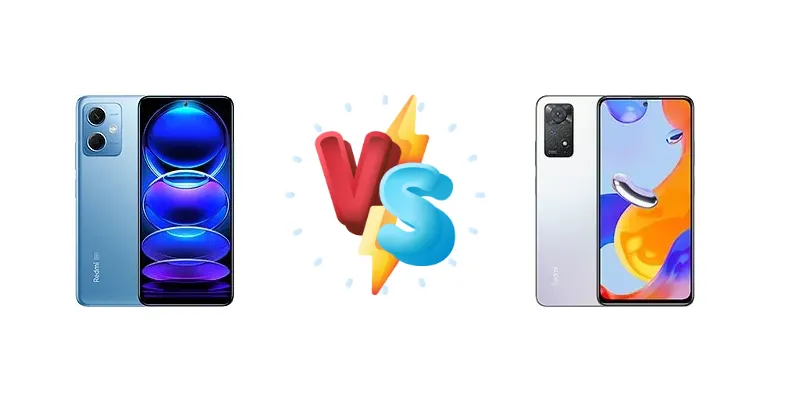
The Xiaomi Redmi Note series consistently delivers excellent value, but choosing between the latest Note 12 and the established Note 11 Pro can be tricky. Both offer compelling features for budget-conscious buyers, but significant differences exist. Let's dive into a comprehensive comparison to help you make the right choice.
🏆 Quick Verdict
The Redmi Note 11 Pro generally edges out the Note 12 (China) thanks to its faster charging, brighter display, and slightly more powerful chipset. However, the Note 12 offers a newer processor and potentially better efficiency, making it a strong contender depending on your priorities.
| Network |
|---|
| 2G bands | GSM 850 / 900 / 1800 / 1900 | GSM 850 / 900 / 1800 / 1900 |
| 3G bands | HSDPA 850 / 900 / 1900 / 2100 | HSDPA 850 / 900 / 1700(AWS) / 1900 / 2100 - International |
| 4G bands | 1, 3, 5, 7, 8, 34, 38, 39, 40, 41 | 1, 2, 3, 4, 5, 7, 8, 12, 13, 17, 20, 26, 28, 32, 38, 40, 41, 66 - International |
| 5G bands | 1, 3, 5, 8, 41, 77, 78 SA/NSA | - |
| Speed | HSPA, LTE, 5G | HSPA, LTE |
| Technology | GSM / CDMA / HSPA / EVDO / LTE / 5G | GSM / HSPA / LTE |
| | CDMA2000 1xEV-DO | 1, 3, 5, 8, 40, 41 - India |
| Launch |
|---|
| Announced | 2022, October 27 | 2022, January 26 |
| Status | Available. Released 2022, November 01 | Available. Released 2022, February 18 |
| Body |
|---|
| Build | - | Glass front (Gorilla Glass 5), glass back, plastic frame |
| Dimensions | 165.9 x 76.2 x 8 mm (6.53 x 3.00 x 0.31 in) | 164.2 x 76.1 x 8.1 mm (6.46 x 3.00 x 0.32 in) |
| SIM | Nano-SIM + Nano-SIM | Nano-SIM + Nano-SIM |
| Weight | 188 g (6.63 oz) | 202 g (7.13 oz) |
| | IP53, dust and splash resistant | IP53, dust and splash resistant |
| Display |
|---|
| Protection | - | Corning Gorilla Glass 5 |
| Resolution | 1080 x 2400 pixels, 20:9 ratio (~395 ppi density) | 1080 x 2400 pixels, 20:9 ratio (~395 ppi density) |
| Size | 6.67 inches, 107.4 cm2 (~85.0% screen-to-body ratio) | 6.67 inches, 107.4 cm2 (~86.0% screen-to-body ratio) |
| Type | Samsung AMOLED, 120Hz, 1200 nits (peak) | Super AMOLED, 120Hz, 700 nits, 1200 nits (peak) |
| Platform |
|---|
| CPU | Octa-core (2x2.0 GHz Cortex-A78 & 6x1.8 GHz Cortex-A55) | Octa-core (2x2.05 GHz Cortex-A76 & 6x2.0 GHz Cortex-A55) |
| Chipset | Qualcomm SM4375 Snapdragon 4 Gen 1 (6 nm) | Mediatek MT6781 Helio G96 (12 nm) |
| GPU | Adreno 619 | Mali-G57 MC2 |
| OS | Android 12, MIUI 13 | Android 11, MIUI 13 |
| Memory |
|---|
| Card slot | No | microSDXC (uses shared SIM slot) |
| Internal | 128GB 4GB RAM, 128GB 6GB RAM, 128GB 8GB RAM, 256GB 8GB RAM, 256GB 12GB RAM | 64GB 6GB RAM, 128GB 4GB RAM, 128GB 6GB RAM, 128GB 8GB RAM |
| | UFS 2.2 | UFS 2.2 |
| Main Camera |
|---|
| Dual | 48 MP, (wide), 0.8µm, PDAF
Auxiliary lens | - |
| Features | LED flash, HDR, panorama | LED flash, HDR, panorama |
| Quad | - | 108 MP, f/1.9, 26mm (wide), 1/1.52", 0.7µm, PDAF
8 MP, f/2.2, 118˚ (ultrawide)
2 MP (macro)
Auxiliary lens |
| Single | - | 16 MP, f/2.5, (wide), 1/3.06" 1.0µm |
| Video | 1080p@30/60fps | 1080p@30fps |
| Selfie camera |
|---|
| Features | HDR | - |
| Single | 8 MP, f/2.0, (wide), 1/4.0", 1.12µm | 16 MP, f/2.5, (wide), 1/3.06" 1.0µm |
| Video | 1080p@30fps | 1080p@30fps |
| Sound |
|---|
| 3.5mm jack | Yes | Yes |
| 35mm jack | Yes | Yes |
| Loudspeaker | Yes | Yes, with stereo speakers |
| | 24-bit/192kHz audio | 24-bit/192kHz audio |
| Comms |
|---|
| Bluetooth | 5.1, A2DP, LE | 5.1, A2DP, LE |
| Infrared port | Yes | Yes |
| NFC | No | Yes (market/region dependent) |
| Positioning | GPS (L1), GLONASS (G1), BDS (B1), GALILEO (E1) | GPS, GLONASS, BDS, GALILEO |
| Radio | No | Unspecified |
| USB | USB Type-C 2.0 | USB Type-C 2.0, OTG |
| WLAN | Wi-Fi 802.11 a/b/g/n/ac, dual-band, Wi-Fi Direct | Wi-Fi 802.11 b/g/n/ac, dual-band, Wi-Fi Direct |
| Features |
|---|
| Sensors | Fingerprint (side-mounted), accelerometer, gyro, proximity, compass | Fingerprint (side-mounted), accelerometer, gyro, compass |
| | - | Virtual proximity sensing |
| Battery |
|---|
| Charging | 33W wired | 67W wired, PD3.0, QC3, 51% in 15 min |
| Type | Li-Po 5000 mAh | Li-Po 5000 mAh |
| Misc |
|---|
| Colors | Black, White, Blue | Graphite Gray (Stealth Black), Polar White (Phantom White), Star Blue |
| Models | 22101317C | 2201116TG, 2201116TI |
| Price | About 190 EUR | € 121.46 / £ 169.57 |
| SAR | - | 1.08 W/kg (head) 1.08 W/kg (body) |
| SAR EU | - | 0.58 W/kg (head) 0.86 W/kg (body) |
| Tests |
|---|
| Battery life | - |
Endurance rating 100h
|
| Camera | - |
Photo / Video |
| Display | - |
Contrast ratio: Infinite (nominal) |
| Loudspeaker | - |
-24.4 LUFS (Very good)
|
| Performance | - |
AnTuTu: 261309 (v8), 319093 (v9)
GeekBench: 1729 (v5.1)
GFXBench: 12fps (ES 3.1 onscreen) |
Xiaomi Redmi Note 12 (China)
- Newer Snapdragon 4 Gen 1 processor
- Potentially better battery efficiency
- Modern design
- Slower charging (33W)
- Likely dimmer display
- Potentially less powerful than Note 11 Pro
Xiaomi Redmi Note 11 Pro
- Faster charging (67W)
- Brighter display (746 nits)
- Slightly more powerful chipset (Helio G96)
- Excellent battery life (100h endurance)
- Older chipset
- Larger 12nm process
- Design may feel dated
Display Comparison
The Redmi Note 11 Pro boasts a measured peak brightness of 746 nits, significantly brighter than the Note 12's likely output (estimated around 450-500 nits). While both feature AMOLED panels with vibrant colors and deep blacks, the Note 11 Pro's superior brightness makes it more usable in direct sunlight. The Note 11 Pro also advertises an 'infinite' contrast ratio, though this is a nominal value.
Camera Comparison
Both phones feature capable camera systems, but detailed camera comparisons require more in-depth testing. The Note 11 Pro likely has a slight advantage in low-light photography due to its potentially larger sensors and image processing algorithms. Both offer standard photo and video capabilities.
Performance
The Note 11 Pro's Helio G96 chipset, while on a 12nm process, offers a decent performance boost over the Note 12's Snapdragon 4 Gen 1 (6nm). The Cortex-A76 cores in the G96 provide better single-core performance. The 6nm Snapdragon 4 Gen 1 is more efficient, but the G96's raw power gives the Note 11 Pro a slight edge in demanding tasks. Both handle everyday use smoothly.
Battery Life
The Redmi Note 11 Pro shines here with an impressive endurance rating of 100 hours. The Note 12's battery life is expected to be good, but likely not as exceptional as the Note 11 Pro. The Note 11 Pro's 67W charging is a significant advantage, allowing for a 51% charge in just 15 minutes, while the Note 12 offers 33W charging.
Buying Guide
The Xiaomi Redmi Note 12 (China) is ideal for users prioritizing a modern processor and potentially better battery efficiency, even if it means sacrificing some charging speed. The Redmi Note 11 Pro is a better choice for those who value faster charging, a brighter display for outdoor use, and a slightly more robust overall performance.
Frequently Asked Questions
❓ Is the Snapdragon 4 Gen 1 processor good enough for everyday use?
Yes, the Snapdragon 4 Gen 1 is sufficient for everyday tasks like browsing, social media, and light gaming. However, it may struggle with more demanding games or applications.
❓ Which phone has better value for money?
It's a close call. The Redmi Note 11 Pro offers more features for the price, particularly the faster charging and brighter display. However, the Note 12's newer processor and potential efficiency gains make it a strong contender.