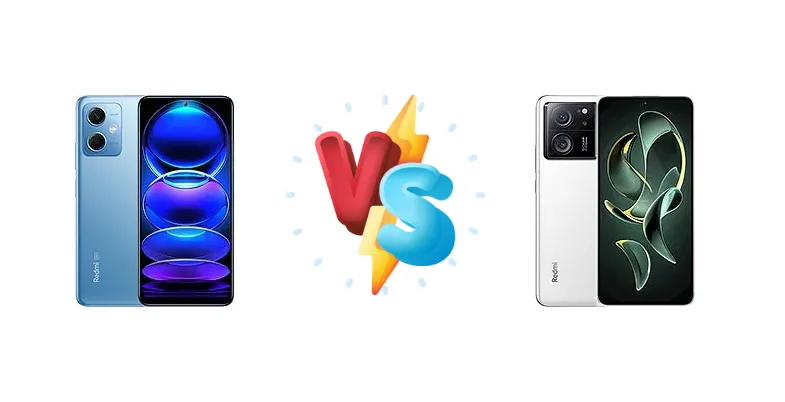
Xiaomi offers a diverse range of smartphones, and the Redmi Note 12 and K60 Ultra represent distinct approaches. The Note 12, available in China, focuses on affordability and everyday usability, while the K60 Ultra aims for near-flagship performance at a competitive price. This comparison dissects their key differences to help you choose the right Xiaomi for your needs.
🏆 Quick Verdict
For most users, the Xiaomi Redmi K60 Ultra is the superior choice. Its significantly more powerful Dimensity 9200+ chipset and blazing-fast 120W charging justify the price premium, offering a smoother, more responsive experience and drastically reduced downtime. However, the Note 12 remains a viable option for budget-conscious users prioritizing efficiency.
| Network |
|---|
| 2G bands | GSM 850 / 900 / 1800 / 1900 | GSM 850 / 900 / 1800 / 1900 |
| 3G bands | HSDPA 850 / 900 / 1900 / 2100 | HSDPA 800 / 850 / 900 / 1700(AWS) / 2100 |
| 4G bands | 1, 3, 5, 7, 8, 34, 38, 39, 40, 41 | 1, 3, 4, 5, 8, 18, 19, 26, 34, 38, 39, 40, 41, 42, 66 |
| 5G bands | 1, 3, 5, 8, 41, 77, 78 SA/NSA | 1, 3, 5, 8, 28, 38, 41, 66, 77, 78 SA/NSA |
| Speed | HSPA, LTE, 5G | HSPA, LTE, 5G |
| Technology | GSM / CDMA / HSPA / EVDO / LTE / 5G | GSM / CDMA / HSPA / CDMA2000 / LTE / 5G |
| | CDMA2000 1xEV-DO | - |
| Launch |
|---|
| Announced | 2022, October 27 | 2023, August 15 |
| Status | Available. Released 2022, November 01 | Available. Released 2023, August 15 |
| Body |
|---|
| Dimensions | 165.9 x 76.2 x 8 mm (6.53 x 3.00 x 0.31 in) | 162.2 x 75.7 x 8.5 mm (6.39 x 2.98 x 0.33 in) |
| SIM | Nano-SIM + Nano-SIM | Nano-SIM + Nano-SIM |
| Weight | 188 g (6.63 oz) | 204 g (7.20 oz) |
| | IP53, dust and splash resistant | - |
| Display |
|---|
| Protection | - | Unspecified |
| Resolution | 1080 x 2400 pixels, 20:9 ratio (~395 ppi density) | 1220 x 2712 pixels, 20:9 ratio (~446 ppi density) |
| Size | 6.67 inches, 107.4 cm2 (~85.0% screen-to-body ratio) | 6.67 inches, 107.4 cm2 (~87.5% screen-to-body ratio) |
| Type | Samsung AMOLED, 120Hz, 1200 nits (peak) | OLED, 68B colors, 144Hz, Dolby Vision, HDR10+, 2600 nits (peak) |
| Platform |
|---|
| CPU | Octa-core (2x2.0 GHz Cortex-A78 & 6x1.8 GHz Cortex-A55) | Octa-core (1x3.35 GHz Cortex-X3 & 3x3.0 GHz Cortex-A715 & 4x2.0 GHz Cortex-A510) |
| Chipset | Qualcomm SM4375 Snapdragon 4 Gen 1 (6 nm) | Mediatek Dimensity 9200+ (4 nm) |
| GPU | Adreno 619 | Immortalis-G715 MC11 |
| OS | Android 12, MIUI 13 | Android 13, MIUI 14 |
| Memory |
|---|
| Card slot | No | No |
| Internal | 128GB 4GB RAM, 128GB 6GB RAM, 128GB 8GB RAM, 256GB 8GB RAM, 256GB 12GB RAM | 256GB 12GB RAM, 256GB 16GB RAM, 512GB 16GB RAM, 1TB 16GB RAM, 1TB 24GB RAM |
| | UFS 2.2 | - |
| Main Camera |
|---|
| Dual | 48 MP, (wide), 0.8µm, PDAF
Auxiliary lens | - |
| Features | LED flash, HDR, panorama | Color spectrum sensor, Dual-LED dual-tone flash, HDR, panorama |
| Triple | - | 50 MP, f/1.7, (wide), 1/1.49", 1.0µm, PDAF, OIS
8 MP, 119˚ (ultrawide), 1/4.0", 1.12µm
2 MP (macro) |
| Video | 1080p@30/60fps | 8K@24fps, 4K@30/60fps, 1080p@30/60/120/240/960fps, gyro-EIS, HDR10+, 10-bit |
| Selfie camera |
|---|
| Features | HDR | HDR |
| Single | 8 MP, f/2.0, (wide), 1/4.0", 1.12µm | 20 MP, (wide), 1/2.0", 0.8µm |
| Video | 1080p@30fps | 1080p@30/120fps |
| Sound |
|---|
| 3.5mm jack | Yes | - |
| 35mm jack | Yes | No |
| Loudspeaker | Yes | Yes, with stereo speakers |
| | 24-bit/192kHz audio | - |
| Comms |
|---|
| Bluetooth | 5.1, A2DP, LE | 5.4, A2DP, LE |
| Infrared port | Yes | Yes |
| NFC | No | Yes |
| Positioning | GPS (L1), GLONASS (G1), BDS (B1), GALILEO (E1) | GPS (L1+L5), GLONASS (G1), BDS (B1I+B1C+B2a+B2b), GALILEO (E1+E5a), QZSS (L1+L5), NavIC |
| Radio | No | Unspecified |
| USB | USB Type-C 2.0 | USB Type-C, OTG |
| WLAN | Wi-Fi 802.11 a/b/g/n/ac, dual-band, Wi-Fi Direct | Wi-Fi 802.11 a/b/g/n/ac/6e, dual-band, Wi-Fi Direct |
| Features |
|---|
| Sensors | Fingerprint (side-mounted), accelerometer, gyro, proximity, compass | Fingerprint (under display, optical), accelerometer, gyro, proximity, compass |
| Battery |
|---|
| Charging | 33W wired | 120W wired, PD3.0, 100% in 19 min |
| Type | Li-Po 5000 mAh | Li-Po 5000 mAh |
| Misc |
|---|
| Colors | Black, White, Blue | Black, White, Green |
| Models | 22101317C | 23078RKD5C |
| Price | About 190 EUR | About 330 EUR |
Xiaomi Redmi Note 12 (China)
- More power-efficient chipset (Snapdragon 4 Gen 1)
- Lower price point
- Sufficient for basic smartphone tasks
- Significantly slower performance
- Slower charging speed (33W)
- Likely inferior camera system
Xiaomi Redmi K60 Ultra
- Flagship-level performance (Dimensity 9200+)
- Ultra-fast 120W charging
- Likely superior camera capabilities
- Higher price
- Potentially shorter battery life during heavy use
- More demanding on thermal management
Display Comparison
While both phones likely feature LCD panels (data unavailable for Note 12), the K60 Ultra’s focus on performance suggests a higher refresh rate and potentially better color accuracy. The Note 12, targeting a lower price point, likely prioritizes cost savings over display quality. Bezels are expected to be similar, but the K60 Ultra may benefit from a slightly more refined design. Without specific display specs for the Note 12, a direct comparison is limited, but the K60 Ultra is positioned as a more premium device, implying a superior visual experience.
Camera Comparison
Without detailed camera specifications, a precise comparison is difficult. However, the K60 Ultra, being a higher-tier device, likely features a larger main sensor and more sophisticated image processing algorithms. The Note 12, while potentially offering a decent camera for its price range, will likely fall short in low-light performance and dynamic range. The inclusion of Optical Image Stabilization (OIS) is more probable on the K60 Ultra, resulting in sharper images and smoother videos. We can expect the K60 Ultra to offer more versatile camera capabilities overall.
Performance
The performance gap between these devices is substantial. The Redmi K60 Ultra’s MediaTek Dimensity 9200+ (4nm) is a flagship-level chipset featuring a Cortex-X3 prime core clocked at 3.35 GHz, designed for peak performance. This contrasts sharply with the Redmi Note 12’s Qualcomm Snapdragon 4 Gen 1 (6nm), which utilizes a more power-efficient but less potent Cortex-A78 based CPU. The Dimensity 9200+’s advanced architecture and smaller node size translate to significantly faster processing speeds and improved graphics performance, making the K60 Ultra ideal for gaming and demanding applications. The K60 Ultra also benefits from faster RAM (likely LPDDR5X) compared to the Note 12, further enhancing responsiveness.
Battery Life
The Redmi K60 Ultra’s 120W wired charging is a game-changer, capable of fully charging the device in just 19 minutes. This is a massive advantage over the Redmi Note 12’s 33W charging, which will take considerably longer. While the K60 Ultra’s battery capacity is unknown, the faster charging speed mitigates concerns about a potentially smaller battery. The Snapdragon 4 Gen 1 in the Note 12 is more power-efficient, potentially offering longer battery life during light usage, but the K60 Ultra’s quick top-ups provide a more convenient experience for power users.
Buying Guide
Buy the Xiaomi Redmi Note 12 (China) if you need a reliable, affordable smartphone for basic tasks like calling, texting, social media, and light web browsing, and prioritize battery efficiency over raw power. Buy the Xiaomi Redmi K60 Ultra if you prefer a phone capable of demanding gaming, video editing, and multitasking, and value incredibly fast charging and a smoother overall user experience.
Frequently Asked Questions
❓ Is the Dimensity 9200+ in the K60 Ultra prone to overheating during extended gaming sessions?
The Dimensity 9200+ is a powerful chip, and while it can generate heat, Xiaomi typically implements effective cooling solutions in the K60 series. Reviews suggest the K60 Ultra manages thermals well, preventing significant throttling during prolonged gaming, though some warmth is expected.
❓ How does the 33W charging on the Redmi Note 12 compare to typical fast charging standards?
33W charging is considered relatively slow by today's standards. While it's still faster than standard 15W or 18W charging, it will take significantly longer to fully charge the Note 12 compared to the K60 Ultra's 120W charging. Expect a full charge to take well over an hour.
❓ Will the Redmi Note 12 struggle with graphically intensive games like Genshin Impact or PUBG?
The Snapdragon 4 Gen 1 is not designed for demanding games. While it can run less intensive titles, you'll likely need to lower graphics settings significantly and accept lower frame rates in games like Genshin Impact or PUBG to achieve a playable experience. The K60 Ultra is far better suited for these games.