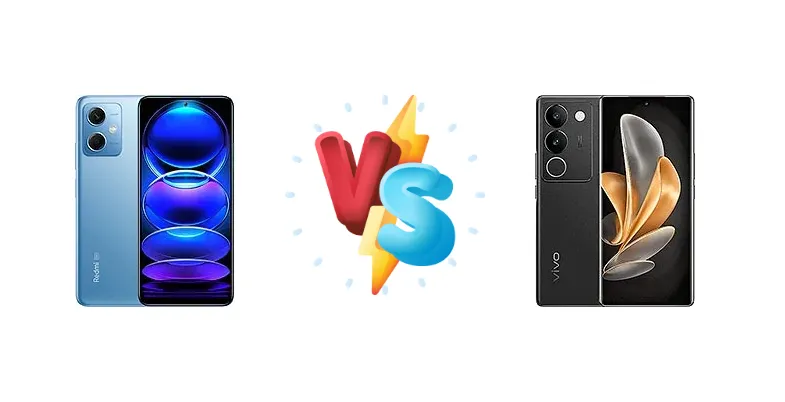
The Xiaomi Redmi Note 12 (China variant) and the vivo S17t represent distinct approaches to the mid-range smartphone market. The Redmi Note 12 focuses on affordability with a Snapdragon 4 Gen 1, while the S17t aims for a more premium experience with a Dimensity 8050 and significantly faster charging. This comparison dissects the key differences to determine which device delivers the best value for your money.
🏆 Quick Verdict
For the average user prioritizing performance and convenience, the vivo S17t is the clear winner. Its Dimensity 8050 chipset offers a substantial performance uplift over the Snapdragon 4 Gen 1 in the Redmi Note 12, and the 80W charging dramatically reduces downtime. While the Redmi Note 12 offers a lower entry price, the S17t’s advantages justify the cost difference.
| Network |
|---|
| 2G bands | GSM 850 / 900 / 1800 / 1900 | GSM 850 / 900 / 1800 / 1900 |
| 3G bands | HSDPA 850 / 900 / 1900 / 2100 | HSDPA 850 / 900 / 1700(AWS) / 1900 / 2100 |
| 4G bands | 1, 3, 5, 7, 8, 34, 38, 39, 40, 41 | 1, 3, 4, 5, 8, 28, 34, 38, 39, 40, 41 |
| 5G bands | 1, 3, 5, 8, 41, 77, 78 SA/NSA | 1, 3, 5, 8, 28, 38, 40, 41, 77, 78 SA/NSA |
| Speed | HSPA, LTE, 5G | HSPA, LTE, 5G |
| Technology | GSM / CDMA / HSPA / EVDO / LTE / 5G | GSM / CDMA / HSPA / CDMA2000 / LTE / 5G |
| | CDMA2000 1xEV-DO | - |
| Launch |
|---|
| Announced | 2022, October 27 | 2023, May 31 |
| Status | Available. Released 2022, November 01 | Available. Released 2023, June 08 |
| Body |
|---|
| Dimensions | 165.9 x 76.2 x 8 mm (6.53 x 3.00 x 0.31 in) | 164.2 x 74.4 x 7.5 mm (6.46 x 2.93 x 0.30 in) |
| SIM | Nano-SIM + Nano-SIM | Nano-SIM + Nano-SIM |
| Weight | 188 g (6.63 oz) | 186 g (6.56 oz) |
| | IP53, dust and splash resistant | - |
| Display |
|---|
| Resolution | 1080 x 2400 pixels, 20:9 ratio (~395 ppi density) | 1260 x 2800 pixels, 20:9 ratio (~453 ppi density) |
| Size | 6.67 inches, 107.4 cm2 (~85.0% screen-to-body ratio) | 6.78 inches, 111.0 cm2 (~90.8% screen-to-body ratio) |
| Type | Samsung AMOLED, 120Hz, 1200 nits (peak) | AMOLED, 1B colors, 120Hz, HDR10+, 1300 nits (peak) |
| Platform |
|---|
| CPU | Octa-core (2x2.0 GHz Cortex-A78 & 6x1.8 GHz Cortex-A55) | Octa-core (1x3.0 GHz Cortex-A78 & 3x2.6 GHz Cortex-A78 & 4x2.0 GHz Cortex-A55) |
| Chipset | Qualcomm SM4375 Snapdragon 4 Gen 1 (6 nm) | Mediatek Dimensity 8050 (6 nm) |
| GPU | Adreno 619 | Mali-G77 MC9 |
| OS | Android 12, MIUI 13 | Android 13, OriginOS 3 |
| Memory |
|---|
| Card slot | No | No |
| Internal | 128GB 4GB RAM, 128GB 6GB RAM, 128GB 8GB RAM, 256GB 8GB RAM, 256GB 12GB RAM | 512GB 12GB RAM |
| | UFS 2.2 | - |
| Main Camera |
|---|
| Dual | 48 MP, (wide), 0.8µm, PDAF
Auxiliary lens | 50 MP, f/1.9, (wide), 1/1.56", 1.0µm, PDAF, OIS
8 MP, f/2.2, (ultrawide) |
| Features | LED flash, HDR, panorama | Color spectrum sensor, Ring-LED flash, panorama, HDR |
| Video | 1080p@30/60fps | 4K@30fps, 1080p@30fps |
| Selfie camera |
|---|
| Features | HDR | Dual-LED flash, HDR |
| Single | 8 MP, f/2.0, (wide), 1/4.0", 1.12µm | 50 MP, f/2.0, 22mm (wide), AF |
| Video | 1080p@30fps | 1080p@30fps |
| Sound |
|---|
| 3.5mm jack | Yes | - |
| 35mm jack | Yes | No |
| Loudspeaker | Yes | Yes |
| | 24-bit/192kHz audio | - |
| Comms |
|---|
| Bluetooth | 5.1, A2DP, LE | 5.2, A2DP, LE, aptX HD |
| Infrared port | Yes | - |
| NFC | No | Yes |
| Positioning | GPS (L1), GLONASS (G1), BDS (B1), GALILEO (E1) | GPS (L1), GLONASS (G1), BDS (B1I), GALILEO (E1), QZSS (L1) |
| Radio | No | No |
| USB | USB Type-C 2.0 | USB Type-C 2.0, OTG |
| WLAN | Wi-Fi 802.11 a/b/g/n/ac, dual-band, Wi-Fi Direct | Wi-Fi 802.11 a/b/g/n/ac/6, dual-band, Wi-Fi Direct |
| Features |
|---|
| Sensors | Fingerprint (side-mounted), accelerometer, gyro, proximity, compass | Fingerprint (under display, optical), accelerometer, gyro, proximity, compass |
| Battery |
|---|
| Charging | 33W wired | 80W wired, 70% in 30 min |
| Type | Li-Po 5000 mAh | 4600 mAh |
| Misc |
|---|
| Colors | Black, White, Blue | Black, Blue, Pink |
| Models | 22101317C | - |
| Price | About 190 EUR | About 400 EUR |
Xiaomi Redmi Note 12 (China)
- More affordable price point
- Sufficient for basic smartphone tasks
- Qualcomm chipset offers good efficiency for everyday use
- Significantly slower performance compared to the S17t
- Slower 33W charging
- Likely a less advanced camera system
vivo S17t
- Much faster Dimensity 8050 processor
- Ultra-fast 80W charging
- Likely a superior camera experience
- Higher price tag
- Potentially more power consumption due to the more powerful chipset
- May require more frequent charging if used heavily
Display Comparison
Neither device's display specifications are provided, so a direct comparison is limited. However, given the S17t's positioning, it likely features a higher-quality panel with potentially better color accuracy and brightness. The Redmi Note 12, being a more budget-focused device, may utilize a simpler LCD panel. Bezels are likely comparable, but the S17t may benefit from slightly slimmer bezels due to its more premium design.
Camera Comparison
Without specific camera sensor details, it's difficult to make a definitive judgment. However, vivo typically emphasizes camera capabilities in its 'S' series. The S17t likely features a more sophisticated camera system with a larger main sensor and improved image processing algorithms. The Redmi Note 12, while capable, will likely offer a more basic camera experience. The absence of information on OIS (Optical Image Stabilization) makes it impossible to assess stabilization performance, but the S17t is more likely to include it.
Performance
The core difference lies in the chipsets. The vivo S17t’s MediaTek Dimensity 8050, built on a 6nm process, is a significant step up from the Qualcomm Snapdragon 4 Gen 1 in the Redmi Note 12. The Dimensity 8050’s CPU configuration – 1x3.0 GHz Cortex-A78, 3x2.6 GHz Cortex-A78, and 4x2.0 GHz Cortex-A55 – provides a substantial advantage in multi-core performance compared to the Redmi Note 12’s 2x2.0 GHz Cortex-A78 & 6x1.8 GHz Cortex-A55. This translates to faster app loading times, smoother multitasking, and a more enjoyable gaming experience. The Dimensity 8050’s more powerful GPU will also handle graphically intensive games with higher frame rates and detail settings. While both are 6nm chips, the Dimensity 8050's architecture is more advanced.
Battery Life
The Redmi Note 12 offers 33W wired charging, which is adequate but relatively slow compared to the vivo S17t’s 80W wired charging. The S17t claims a 70% charge in just 30 minutes, a significant time saver. While battery capacity isn't specified for either device, the faster charging of the S17t effectively mitigates any potential disadvantage from a slightly smaller battery. Users who frequently top up their phones will greatly benefit from the S17t’s charging speed.
Buying Guide
Buy the Xiaomi Redmi Note 12 (China) if you need a highly affordable smartphone for basic tasks like calling, texting, and light social media use, and aren't concerned with demanding gaming or fast charging. Buy the vivo S17t if you prioritize smoother multitasking, a more responsive gaming experience, and the convenience of incredibly fast 80W charging, even if it means spending a bit more upfront.
Frequently Asked Questions
❓ Will the Dimensity 8050 in the vivo S17t handle demanding games like Genshin Impact at high settings?
Yes, the Dimensity 8050 is a capable chipset that should handle Genshin Impact and other demanding games at high settings with playable frame rates. While it's not a flagship-level processor, it offers a significant performance boost over the Snapdragon 4 Gen 1, allowing for a smoother gaming experience.
❓ How long does it *actually* take to fully charge the vivo S17t from 0% with the 80W charger?
While vivo claims 70% in 30 minutes, a full 0-100% charge with the 80W charger is estimated to take around 45-50 minutes. This is still significantly faster than the Redmi Note 12’s 33W charging, which would likely take over 1.5 hours for a full charge.
❓ Is the Snapdragon 4 Gen 1 in the Redmi Note 12 sufficient for everyday tasks like browsing and social media?
Yes, the Snapdragon 4 Gen 1 is perfectly adequate for everyday tasks like browsing the web, checking social media, and using messaging apps. However, it will struggle with more demanding applications or multitasking.
❓ Does the vivo S17t support 5G connectivity?
Given the Dimensity 8050 chipset includes integrated 5G modem, the vivo S17t almost certainly supports 5G connectivity. The Redmi Note 12's 5G support is dependent on the specific variant, but it's likely to be present as well.