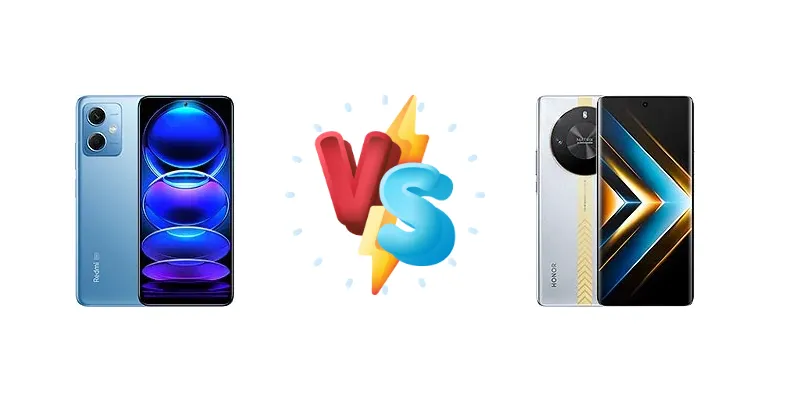
The Xiaomi Redmi Note 12 (China variant) and the Honor X50 GT represent distinct approaches to the mid-range smartphone market. The Redmi Note 12 focuses on affordability and efficiency with the Snapdragon 4 Gen 1, while the X50 GT aims for near-flagship performance with the older, but still potent, Snapdragon 8+ Gen 1. This comparison dissects the key differences to help you determine which device best suits your needs.
🏆 Quick Verdict
For the average user prioritizing smooth everyday tasks and battery life, the Xiaomi Redmi Note 12 offers a compelling value. However, the Honor X50 GT is the clear winner for gamers and power users who demand significantly higher processing power, despite potentially sacrificing some efficiency.
| Network |
|---|
| 2G bands | GSM 850 / 900 / 1800 / 1900 | GSM 850 / 900 / 1800 / 1900 |
| 3G bands | HSDPA 850 / 900 / 1900 / 2100 | HSDPA 850 / 900 / 1700(AWS) / 1900 / 2100 |
| 4G bands | 1, 3, 5, 7, 8, 34, 38, 39, 40, 41 | LTE |
| 5G bands | 1, 3, 5, 8, 41, 77, 78 SA/NSA | SA/NSA |
| Speed | HSPA, LTE, 5G | HSPA, LTE, 5G |
| Technology | GSM / CDMA / HSPA / EVDO / LTE / 5G | GSM / CDMA / HSPA / CDMA2000 / LTE / 5G |
| | CDMA2000 1xEV-DO | - |
| Launch |
|---|
| Announced | 2022, October 27 | 2024, January 04 |
| Status | Available. Released 2022, November 01 | Available. Released 2024, January 09 |
| Body |
|---|
| Dimensions | 165.9 x 76.2 x 8 mm (6.53 x 3.00 x 0.31 in) | 163.6 x 75.5 x 8 mm (6.44 x 2.97 x 0.31 in) |
| SIM | Nano-SIM + Nano-SIM | Nano-SIM + Nano-SIM |
| Weight | 188 g (6.63 oz) | 192 g (6.77 oz) |
| | IP53, dust and splash resistant | - |
| Display |
|---|
| Resolution | 1080 x 2400 pixels, 20:9 ratio (~395 ppi density) | 1220 x 2652 pixels, 19.5:9 ratio (~431 ppi density) |
| Size | 6.67 inches, 107.4 cm2 (~85.0% screen-to-body ratio) | 6.78 inches, 112.6 cm2 (~91.2% screen-to-body ratio) |
| Type | Samsung AMOLED, 120Hz, 1200 nits (peak) | AMOLED, 1B colors, 120Hz |
| Platform |
|---|
| CPU | Octa-core (2x2.0 GHz Cortex-A78 & 6x1.8 GHz Cortex-A55) | Octa-core (1x3.0 GHz Cortex-X2 & 3x2.5 GHz Cortex-A710 & 4x1.80 GHz Cortex-A510) |
| Chipset | Qualcomm SM4375 Snapdragon 4 Gen 1 (6 nm) | Qualcomm SM8475 Snapdragon 8+ Gen 1 (4 nm) |
| GPU | Adreno 619 | Adreno 730 |
| OS | Android 12, MIUI 13 | Android 13, MagicOS 7.2 |
| Memory |
|---|
| Card slot | No | No |
| Internal | 128GB 4GB RAM, 128GB 6GB RAM, 128GB 8GB RAM, 256GB 8GB RAM, 256GB 12GB RAM | 256GB 12GB RAM, 256GB 16GB RAM, 512GB 16GB RAM, 1TB 16GB RAM |
| | UFS 2.2 | - |
| Main Camera |
|---|
| Dual | 48 MP, (wide), 0.8µm, PDAF
Auxiliary lens | 108 MP, f/1.8, (wide), 1/1.67", PDAF
Auxiliary lens |
| Features | LED flash, HDR, panorama | LED flash, panorama, HDR |
| Video | 1080p@30/60fps | 4K@30fps, 1080p@30fps |
| Selfie camera |
|---|
| Features | HDR | - |
| Single | 8 MP, f/2.0, (wide), 1/4.0", 1.12µm | 8 MP, f/2.0, (wide) |
| Video | 1080p@30fps | 1080p@30fps |
| Sound |
|---|
| 3.5mm jack | Yes | - |
| 35mm jack | Yes | No |
| Loudspeaker | Yes | Yes |
| | 24-bit/192kHz audio | - |
| Comms |
|---|
| Bluetooth | 5.1, A2DP, LE | 5.2, A2DP, LE, aptX HD |
| Infrared port | Yes | - |
| NFC | No | Yes |
| Positioning | GPS (L1), GLONASS (G1), BDS (B1), GALILEO (E1) | GPS, GLONASS, GALILEO, BDS |
| Radio | No | No |
| USB | USB Type-C 2.0 | USB Type-C 2.0, OTG |
| WLAN | Wi-Fi 802.11 a/b/g/n/ac, dual-band, Wi-Fi Direct | Wi-Fi 802.11 a/b/g/n/ac/6, dual-band, Wi-Fi Direct |
| Features |
|---|
| Sensors | Fingerprint (side-mounted), accelerometer, gyro, proximity, compass | Fingerprint (under display, optical), accelerometer, gyro, ultrasound proximity, compass |
| Battery |
|---|
| Charging | 33W wired | 35W wired
7.5W reverse wired |
| Type | Li-Po 5000 mAh | Li-Po 5800 mAh |
| Misc |
|---|
| Colors | Black, White, Blue | Black, Silver |
| Models | 22101317C | ALP-AN00 |
| Price | About 190 EUR | About 260 EUR |
Xiaomi Redmi Note 12 (China)
- More power-efficient Snapdragon 4 Gen 1 chipset
- Likely longer battery life
- Potentially lower price point
- Significantly lower performance compared to the X50 GT
- Less capable camera system (likely)
- Slower charging speed
Honor X50 GT
- Flagship-level performance with Snapdragon 8+ Gen 1
- Faster 35W charging with reverse wired charging
- Likely superior camera system
- Higher power consumption and potentially shorter battery life
- Potentially higher price point
- May experience more thermal throttling under sustained load
Display Comparison
Neither device's display specifications are provided, so a direct comparison is limited. However, given the X50 GT's positioning, it likely features a higher quality panel with potentially a higher refresh rate. The Redmi Note 12, being a more budget-focused device, will likely prioritize cost-effectiveness over display features. Expect the X50 GT to have better color accuracy and potentially higher peak brightness.
Camera Comparison
Without specific camera specs, it's difficult to make a definitive comparison. However, the X50 GT, positioned as a more premium device, likely incorporates a more sophisticated camera system with a larger sensor and potentially optical image stabilization (OIS). The Redmi Note 12 will likely focus on providing adequate camera performance for everyday use, but will likely lack the advanced features found on the X50 GT. Image processing algorithms will also likely differ, with the X50 GT potentially offering more detailed and dynamic images.
Performance
The core difference lies in the chipsets. The Honor X50 GT’s Snapdragon 8+ Gen 1 (4nm) is a substantial upgrade over the Redmi Note 12’s Snapdragon 4 Gen 1 (6nm). The 8+ Gen 1 features a Cortex-X2 prime core clocked at 3.0 GHz, alongside three Cortex-A710 performance cores at 2.5 GHz, and four Cortex-A510 efficiency cores. This contrasts with the Redmi Note 12’s dual Cortex-A78 cores at 2.0 GHz and six Cortex-A55 cores at 1.8 GHz. The 4nm process of the 8+ Gen 1 also provides superior thermal efficiency, meaning sustained performance will be higher before throttling occurs. Gamers and users running demanding applications will see a dramatic performance increase with the X50 GT.
Battery Life
The Honor X50 GT boasts 35W wired charging, slightly faster than the Redmi Note 12’s 33W charging. The X50 GT also includes 7.5W reverse wired charging, a feature absent on the Redmi Note 12. While battery capacity isn't specified, the Snapdragon 8+ Gen 1 is more power-hungry than the Snapdragon 4 Gen 1. Therefore, despite potentially having a similar battery capacity, the Redmi Note 12 will likely offer longer battery life under typical usage scenarios. The faster charging on the X50 GT will mitigate this difference somewhat, allowing for quicker top-ups.
Buying Guide
Buy the Xiaomi Redmi Note 12 (China) if you need a reliable, efficient smartphone for daily tasks, social media, and light gaming, and prioritize long battery life and a lower price point. Buy the Honor X50 GT if you prefer a phone capable of handling demanding games, video editing, and multitasking with ease, and are willing to accept potentially shorter battery life and a higher price.
Frequently Asked Questions
❓ Will the Snapdragon 8+ Gen 1 in the Honor X50 GT get noticeably hot during extended gaming sessions?
The Snapdragon 8+ Gen 1 is a powerful chip, and while the 4nm process helps with efficiency, it can still generate significant heat under sustained load. The X50 GT may experience some thermal throttling during prolonged gaming, but the overall performance will still be significantly higher than the Redmi Note 12.
❓ Is the difference in performance between the Snapdragon 4 Gen 1 and Snapdragon 8+ Gen 1 noticeable for everyday tasks like browsing and social media?
For basic tasks like browsing, social media, and messaging, the difference will be minimal. Both phones will handle these tasks smoothly. However, when multitasking or opening multiple apps, the Snapdragon 8+ Gen 1 in the X50 GT will provide a noticeably snappier and more responsive experience.
❓ Does the Honor X50 GT support high refresh rate gaming, and if so, at what frame rates?
While the display specifications aren't provided, the Snapdragon 8+ Gen 1 is capable of driving high refresh rate displays. It's likely the X50 GT supports 120Hz or higher, and can achieve high frame rates in many popular games, potentially exceeding 60fps in titles like PUBG Mobile and Call of Duty Mobile, depending on graphics settings.