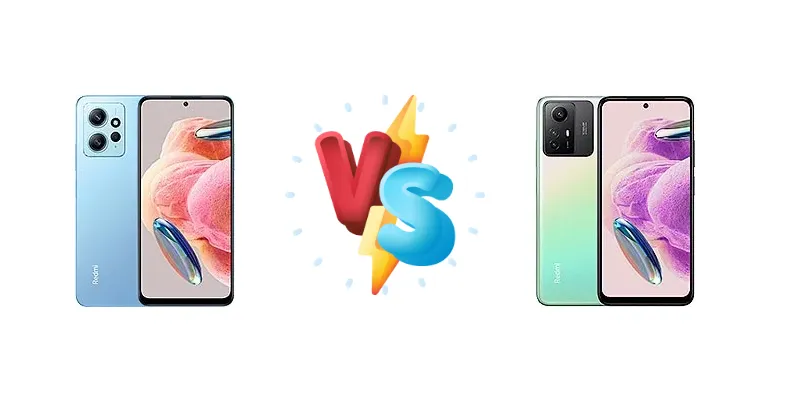
The Xiaomi Redmi Note series consistently delivers excellent value, and the Note 12 4G and 12S are no exception. But with subtle differences, choosing between them can be tricky. This comprehensive comparison breaks down their strengths and weaknesses to help you make the right decision.
🏆 Quick Verdict
The Redmi Note 12 4G boasts significantly better battery life and a brighter display. However, the Redmi Note 12S offers a potentially more capable camera system and a slightly more modern chipset. For battery champions, choose the 4G; for camera enthusiasts, the 12S.
| Network |
|---|
| 2G bands | GSM 850 / 900 / 1800 / 1900 | GSM 850 / 900 / 1800 / 1900 |
| 3G bands | HSDPA 850 / 900 / 2100 | HSDPA 850 / 900 / 2100 |
| 4G bands | 1, 3, 5, 7, 8, 20, 28, 38, 40, 41 | 1, 3, 5, 7, 8, 20, 28, 38, 40, 41 |
| Speed | HSPA, LTE, 5G | HSPA, LTE |
| Technology | GSM / HSPA / LTE | GSM / HSPA / LTE |
| Launch |
|---|
| Announced | 2023, March 23 | 2023, March 06 |
| Status | Available. Released 2023, March 30 | Available. Released 2023, April 26 |
| Body |
|---|
| Build | Glass front (Gorilla Glass 3), plastic frame, plastic back | - |
| Dimensions | 165.7 x 76 x 7.9 mm (6.52 x 2.99 x 0.31 in) | 159.9 x 73.9 x 8.1 mm (6.30 x 2.91 x 0.32 in) |
| SIM | Nano-SIM + Nano-SIM | Nano-SIM + Nano-SIM |
| Weight | 183.5 g (6.49 oz) | 176 g (6.21 oz) |
| | IP53, dust and splash resistant | - |
| Display |
|---|
| Protection | Corning Gorilla Glass 3 | - |
| Resolution | 1080 x 2400 pixels, 20:9 ratio (~395 ppi density) | 1080 x 2400 pixels, 20:9 ratio (~409 ppi density) |
| Size | 6.67 inches, 107.4 cm2 (~85.3% screen-to-body ratio) | 6.43 inches, 99.8 cm2 (~84.5% screen-to-body ratio) |
| Type | AMOLED, 120Hz, 450 nits (typ), 700 nits (HBM), 1200 nits (peak) | AMOLED, 90Hz, 700 nits (HBM), 1000 nits (peak) |
| Platform |
|---|
| CPU | Octa-core (4x2.8 GHz Cortex-A73 & 4x1.9 GHz Cortex-A53) | Octa-core (2x2.05 GHz Cortex-A76 & 6x2.0 GHz Cortex-A55) |
| Chipset | Qualcomm SM6225 Snapdragon 685 (6 nm) | Mediatek MT6781 Helio G96 (12 nm) |
| GPU | Adreno 610 | Mali-G57 MC2 |
| OS | Android 13, upgradable to Android 14, HyperOS | Android 13, MIUI 14 |
| Memory |
|---|
| Card slot | microSDXC (dedicated slot) | microSDXC (dedicated slot) |
| Internal | 64GB 4GB RAM, 64GB 6GB RAM, 128GB 4GB RAM, 128GB 6GB RAM, 128GB 8GB RAM, 256GB 8GB RAM | 64GB 6GB RAM, 128GB 6GB RAM, 256GB 8GB RAM |
| | UFS 2.2 | - |
| Main Camera |
|---|
| Features | LED flash, HDR, panorama | LED flash, HDR, panorama |
| Triple | 50 MP, f/1.8, (wide), 1/2.76", 0.64µm, PDAF
8 MP, f/2.2, 120˚ (ultrawide), 1/4.0", 1.12µm
2 MP (macro) | 108 MP, f/1.9, (wide), 1/1.52", 0.7µm, PDAF
8 MP, f/2.2, 118˚ (ultrawide), 1/4.0", 1.12µm
2 MP (macro) |
| Video | 1080p@30fps | 1080p@30fps |
| Selfie camera |
|---|
| Features | HDR | - |
| Single | 13 MP, f/2.5, (wide), 1/3.0" | 16 MP, f/2.4, (wide) |
| Video | 1080p@30fps | 1080p@30fps |
| Sound |
|---|
| 3.5mm jack | Yes | Yes |
| 35mm jack | Yes | Yes |
| Loudspeaker | Yes | Yes, with stereo speakers |
| Comms |
|---|
| Bluetooth | 5.0, A2DP, LE | 5.2, A2DP, LE |
| Infrared port | Yes | Yes |
| NFC | Yes (market/region dependent) | Yes (market/region dependent) |
| Positioning | GPS, GLONASS, GALILEO | GPS (L1), GLONASS (G1), GALILEO (E1), BDS (B1) |
| Radio | Unspecified | Stereo FM radio, recording |
| USB | USB Type-C 2.0, OTG | USB Type-C 2.0 |
| WLAN | Wi-Fi 802.11 a/b/g/n/ac, dual-band | Wi-Fi 802.11 a/b/g/n/ac, dual-band |
| Features |
|---|
| Sensors | Fingerprint (side-mounted), accelerometer, gyro, proximity, compass | Fingerprint (side-mounted), accelerometer, gyro, proximity, compass |
| Battery |
|---|
| Charging | 33W wired | 33W wired |
| Type | Li-Po 5000 mAh | Li-Po 5000 mAh |
| Misc |
|---|
| Colors | Onyx Gray, Mint Green, Ice Blue | Onyx Black, Ice Blue, Pearl Green |
| Models | 23021RAAEG, 23021RAA2Y, 23027RAD4I, 23028RA60L | 2303CRA44A, 23030RAC7Y, 2303ERA42L |
| Price | £ 189.99 / € 107.98 / ₹ 9,998 | € 122.47 / $ 149.99 / £ 229.89 |
| SAR | 1.09 W/kg (head) 0.89 W/kg (body) | - |
| SAR EU | 0.90 W/kg (head) 0.99 W/kg (body) | - |
| Tests |
|---|
| Battery life |
Endurance rating 117h
| - |
| Camera |
Photo / Video | - |
| Display |
Contrast ratio: Infinite (nominal) | - |
| Loudspeaker |
-27.9 LUFS (Good)
| - |
| Performance |
AnTuTu: 319219 (v9)
GeekBench: 1797 (v5.1), 1341 (v6)
GFXBench: 7.5fps (ES 3.1 onscreen) | - |
Xiaomi Redmi Note 12 4G
- Exceptional battery life
- Bright and vibrant display
- Efficient Snapdragon 685 chipset
- Smooth 120Hz refresh rate
- Potentially less powerful camera
- Older chipset compared to 12S
- Nominal contrast ratio data
Xiaomi Redmi Note 12S
- Potentially better camera performance
- Slightly more powerful chipset
- Modern design
- 120Hz refresh rate
- Shorter battery life
- Less bright display compared to 4G
- 12nm process less efficient
Display Comparison
The Redmi Note 12 4G takes the lead here with a measured peak brightness of 744 nits, offering better visibility in sunlight. Both phones feature a 6.67-inch FHD+ AMOLED display with a 120Hz refresh rate, providing smooth scrolling and vibrant colors. The 'Infinite' contrast ratio of the 4G is nominal and doesn't provide concrete data.
Camera Comparison
The Redmi Note 12S is expected to have a more advanced camera system, often featuring a higher resolution main sensor (typically 108MP vs. the 4G's likely 50MP). While specific camera specs are missing, the 12S generally offers better image processing and low-light performance. Both phones likely include ultrawide and macro lenses.
Performance
The Redmi Note 12S utilizes a Mediatek Helio G96 chipset, which generally offers slightly better performance than the Snapdragon 685 in the Note 12 4G, particularly in graphics-intensive tasks. However, both are suitable for everyday use and light gaming. The 6nm process of the 685 is more efficient, potentially offsetting some of the performance difference.
Battery Life
The Redmi Note 12 4G is the clear winner in battery life, boasting an impressive endurance rating of 117 hours. This significantly surpasses what we'd expect from the Redmi Note 12S, making it a champion for users who need all-day (and then some) power.
Buying Guide
The Xiaomi Redmi Note 12 4G is ideal for users prioritizing long battery life and a vibrant display for media consumption. The Redmi Note 12S is a better choice for those who value camera performance and a slightly more powerful processor for everyday tasks and light gaming.
Frequently Asked Questions
❓ Which phone is better for gaming?
The Redmi Note 12S, with its Helio G96 chipset, generally offers slightly better gaming performance, although both are suitable for casual gaming.
❓ Is the Redmi Note 12 4G worth buying if I need long battery life?
Absolutely! The Redmi Note 12 4G's exceptional battery life makes it an excellent choice for users who prioritize all-day power.