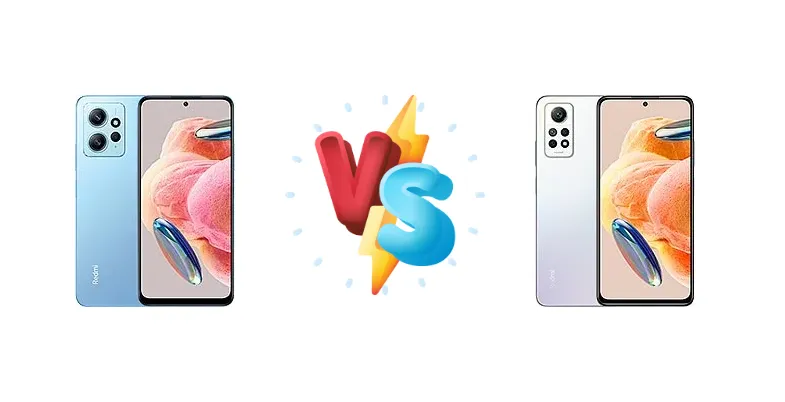
Xiaomi's Redmi Note series consistently delivers excellent value, but choosing between models can be tricky. The Redmi Note 12 4G and 12 Pro 4G offer compelling features at accessible prices. This comprehensive comparison will break down their differences to help you pick the perfect phone for your needs.
🏆 Quick Verdict
The Redmi Note 12 Pro 4G is the clear winner, offering a more powerful chipset, faster charging, and likely a better camera experience. However, the Note 12 4G remains a strong contender for budget-conscious buyers prioritizing exceptional battery life.
| Network |
|---|
| 2G bands | GSM 850 / 900 / 1800 / 1900 | GSM 850 / 900 / 1800 / 1900 |
| 3G bands | HSDPA 850 / 900 / 2100 | HSDPA 850 / 900 / 1700(AWS) / 1900 / 2100 |
| 4G bands | 1, 3, 5, 7, 8, 20, 28, 38, 40, 41 | 1, 2, 3, 4, 5, 7, 8, 20, 28, 38, 40, 41, 66 |
| Speed | HSPA, LTE, 5G | HSPA, LTE |
| Technology | GSM / HSPA / LTE | GSM / HSPA / LTE |
| Launch |
|---|
| Announced | 2023, March 23 | 2023, March 03 |
| Status | Available. Released 2023, March 30 | Available. Released 2023, April 11 |
| Body |
|---|
| Build | Glass front (Gorilla Glass 3), plastic frame, plastic back | - |
| Dimensions | 165.7 x 76 x 7.9 mm (6.52 x 2.99 x 0.31 in) | 164.2 x 76.1 x 8.1 mm (6.46 x 3.00 x 0.32 in) |
| SIM | Nano-SIM + Nano-SIM | Nano-SIM + Nano-SIM |
| Weight | 183.5 g (6.49 oz) | 201.8 g (7.13 oz) |
| | IP53, dust and splash resistant | - |
| Display |
|---|
| Protection | Corning Gorilla Glass 3 | - |
| Resolution | 1080 x 2400 pixels, 20:9 ratio (~395 ppi density) | 1080 x 2400 pixels, 20:9 ratio (~395 ppi density) |
| Size | 6.67 inches, 107.4 cm2 (~85.3% screen-to-body ratio) | 6.67 inches, 107.4 cm2 (~86.0% screen-to-body ratio) |
| Type | AMOLED, 120Hz, 450 nits (typ), 700 nits (HBM), 1200 nits (peak) | AMOLED, 120Hz, Dolby Vision, 700 nits (HBM), 1100 nits (peak) |
| Platform |
|---|
| CPU | Octa-core (4x2.8 GHz Cortex-A73 & 4x1.9 GHz Cortex-A53) | Octa-core (2x2.2 GHz Kryo 470 Gold & 6x1.8 GHz Kryo 470 Silver) |
| Chipset | Qualcomm SM6225 Snapdragon 685 (6 nm) | Qualcomm SM7150 Snapdragon 732G (8 nm) |
| GPU | Adreno 610 | Adreno 618 |
| OS | Android 13, upgradable to Android 14, HyperOS | Android 11, MIUI 13 |
| Memory |
|---|
| Card slot | microSDXC (dedicated slot) | microSDXC (uses shared SIM slot) |
| Internal | 64GB 4GB RAM, 64GB 6GB RAM, 128GB 4GB RAM, 128GB 6GB RAM, 128GB 8GB RAM, 256GB 8GB RAM | 128GB 6GB RAM, 128GB 8GB RAM, 256GB 8GB RAM |
| | UFS 2.2 | UFS 2.2 |
| Main Camera |
|---|
| Features | LED flash, HDR, panorama | LED flash, HDR, panorama |
| Quad | - | 108 MP, f/1.9, (wide), 1/1.52", 0.7µm, PDAF
8 MP, 120˚, (ultrawide)
2 MP (macro)
Auxiliary lens |
| Triple | 50 MP, f/1.8, (wide), 1/2.76", 0.64µm, PDAF
8 MP, f/2.2, 120˚ (ultrawide), 1/4.0", 1.12µm
2 MP (macro) | - |
| Video | 1080p@30fps | 4K@30fps, 1080p@30/60fps |
| Selfie camera |
|---|
| Features | HDR | - |
| Single | 13 MP, f/2.5, (wide), 1/3.0" | 16 MP, f/2.4, (wide) |
| Video | 1080p@30fps | 1080p@30fps |
| Sound |
|---|
| 3.5mm jack | Yes | Yes |
| 35mm jack | Yes | Yes |
| Loudspeaker | Yes | Yes, with stereo speakers |
| Comms |
|---|
| Bluetooth | 5.0, A2DP, LE | 5.0, A2DP, LE |
| Infrared port | Yes | Yes |
| NFC | Yes (market/region dependent) | Yes (market/region dependent) |
| Positioning | GPS, GLONASS, GALILEO | GPS, GLONASS, GALILEO, BDS |
| Radio | Unspecified | Unspecified |
| USB | USB Type-C 2.0, OTG | USB Type-C 2.0, OTG |
| WLAN | Wi-Fi 802.11 a/b/g/n/ac, dual-band | Wi-Fi 802.11 a/b/g/n/ac, dual-band |
| Features |
|---|
| Sensors | Fingerprint (side-mounted), accelerometer, gyro, proximity, compass | Fingerprint (side-mounted), accelerometer, gyro, compass |
| Battery |
|---|
| Charging | 33W wired | 67W wired |
| Type | Li-Po 5000 mAh | Li-Po 5000 mAh |
| Misc |
|---|
| Colors | Onyx Gray, Mint Green, Ice Blue | Star Blue, Graphite Gray, Polar White, Ice blue |
| Models | 23021RAAEG, 23021RAA2Y, 23027RAD4I, 23028RA60L | 2209116AG, 2209116AG |
| Price | £ 189.99 / € 107.98 / ₹ 9,998 | About 150 EUR |
| SAR | 1.09 W/kg (head) 0.89 W/kg (body) | - |
| SAR EU | 0.90 W/kg (head) 0.99 W/kg (body) | - |
| Tests |
|---|
| Battery life |
Endurance rating 117h
| - |
| Camera |
Photo / Video | - |
| Display |
Contrast ratio: Infinite (nominal) | - |
| Loudspeaker |
-27.9 LUFS (Good)
| - |
| Performance |
AnTuTu: 319219 (v9)
GeekBench: 1797 (v5.1), 1341 (v6)
GFXBench: 7.5fps (ES 3.1 onscreen) | - |
Xiaomi Redmi Note 12 4G
- Exceptional battery life
- Smooth 120Hz display
- Good value for money
- Less powerful chipset
- Potentially inferior camera
- Slower charging
Xiaomi Redmi Note 12 Pro 4G
- Faster performance
- Faster charging (67W)
- Likely better camera
- More efficient chipset (8nm)
- Slightly shorter battery life (potentially)
- Higher price point
Display Comparison
Both phones likely feature a similar 6.67-inch FHD+ AMOLED display with a 120Hz refresh rate. While the Note 12 4G boasts a measured peak brightness of 744 nits, the Pro model may offer slightly better color accuracy and HDR support, though this isn't explicitly stated in the provided specs. Contrast ratio is likely excellent on both due to the AMOLED panel.
Camera Comparison
While both phones offer Photo/Video capabilities, the Redmi Note 12 Pro 4G is expected to have a superior camera system. It likely features a higher resolution main sensor (potentially 108MP vs. a lower resolution on the 4G model) and improved image processing. The Pro model may also include additional features like optical image stabilization (OIS).
Performance
The Snapdragon 732G in the Redmi Note 12 Pro 4G provides a significant performance boost over the Snapdragon 685 in the Note 12 4G. Expect smoother multitasking, faster app loading times, and better gaming performance on the Pro model. The 8nm process of the 732G also contributes to improved efficiency.
Battery Life
The Redmi Note 12 4G shines with its exceptional endurance rating of 117 hours. While the Note 12 Pro 4G's battery capacity is likely similar, the more powerful chipset might slightly impact battery life. However, the 67W wired charging on the Pro model significantly reduces charging times.
Buying Guide
The Xiaomi Redmi Note 12 4G is ideal for users who prioritize long battery life and a smooth, basic experience for everyday tasks. The Redmi Note 12 Pro 4G is better suited for those who want improved performance for gaming, photography, and faster charging speeds.
Frequently Asked Questions
❓ Is the Redmi Note 12 Pro 4G worth the extra money?
If you value performance, faster charging, and a better camera, then yes, the Pro model is worth the upgrade. However, if battery life is your top priority and you're on a tight budget, the 4G model remains a solid choice.
❓ What processor do these phones use?
The Redmi Note 12 4G uses a Qualcomm Snapdragon 685, while the Redmi Note 12 Pro 4G uses a Qualcomm Snapdragon 732G. The 732G is significantly more powerful.