
Xiaomi Redmi Note 11T Pro+ vs Samsung Galaxy A53 5G: A Deep Dive into Mid-Range Power
| Phones Images | |||||
|---|---|---|---|---|---|
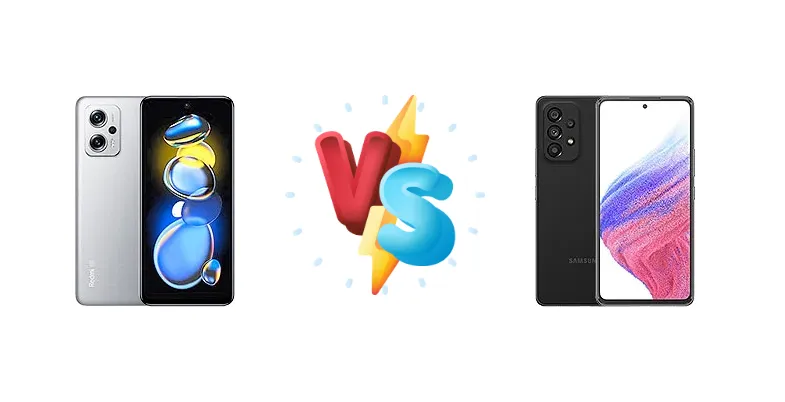
|
🏆 Quick Verdict
For users prioritizing performance and rapid charging, the Xiaomi Redmi Note 11T Pro+ is the clear winner. Its Dimensity 8100 chipset significantly outperforms the Exynos 1280, and the 120W charging is a game-changer. However, the Galaxy A53 5G remains a solid choice for those valuing Samsung’s ecosystem and software support.
| PHONES | ||
|---|---|---|
| Phone Names | Xiaomi Redmi Note 11T Pro+ | Samsung Galaxy A53 5G |
| Network | ||
|---|---|---|
| 2G bands | GSM 850 / 900 / 1800 / 1900 | GSM 850 / 900 / 1800 / 1900 |
| 3G bands | HSDPA 800 / 850 / 900 / 2100 | HSDPA 850 / 900 / 1700(AWS) / 1900 / 2100 |
| 4G bands | 1, 3, 5, 8, 19, 34, 38, 39, 40, 41, 42 | 1, 2, 3, 4, 5, 7, 12, 14, 20, 29, 30, 38, 39, 40, 41, 46, 48, 66 - SM-A536U |
| 5G bands | 1, 3, 5, 8, 28, 38, 41, 77, 78 SA/NSA | 2, 5, 41, 66, 77, 78 SA/NSA/Sub6/mmWave - SM-A536U |
| Speed | HSPA, LTE, 5G | HSPA, LTE, 5G |
| Technology | GSM / CDMA / HSPA / EVDO / LTE / 5G | GSM / HSPA / LTE / 5G |
| - | 2, 5, 48, 66, 77, 78, 260, 261 SA/NSA/Sub6/mmWave - SM-A536V | |
| Launch | ||
|---|---|---|
| Announced | 2022, May 24 | 2022, March 17 |
| Status | Available. Released 2022, May 31 | Available. Released 2022, March 24 |
| Body | ||
|---|---|---|
| Build | - | Glass front (Gorilla Glass 5), plastic frame, plastic back |
| Dimensions | 163.6 x 74.3 x 8.9 mm (6.44 x 2.93 x 0.35 in) | 159.6 x 74.8 x 8.1 mm (6.28 x 2.94 x 0.32 in) |
| SIM | Nano-SIM + Nano-SIM | · Nano-SIM· Nano-SIM + Nano-SIM |
| Weight | 198 g (6.98 oz) | 189 g (6.67 oz) |
| - | IP67 dust/water resistant (up to 1m for 30 min) | |
| Display | ||
|---|---|---|
| Protection | - | Corning Gorilla Glass 5 |
| Resolution | 1080 x 2460 pixels (~407 ppi density) | 1080 x 2400 pixels, 20:9 ratio (~405 ppi density) |
| Size | 6.6 inches, 103.4 cm2 (~85.1% screen-to-body ratio) | 6.5 inches, 102.0 cm2 (~85.4% screen-to-body ratio) |
| Type | IPS LCD, 144Hz, HDR10, Dolby Vision, 650 nits (typ) | Super AMOLED, 120Hz, 800 nits (HBM) |
| Platform | ||
|---|---|---|
| CPU | Octa-core (4x2.85 GHz Cortex-A78 & 4x2.0 GHz Cortex-A55) | Octa-core (2x2.4 GHz Cortex-A78 & 6x2.0 GHz Cortex-A55) |
| Chipset | Mediatek Dimensity 8100 (5 nm) | Exynos 1280 (5 nm) |
| GPU | Mali-G610 MC6 | Mali-G68 |
| OS | Android 12, MIUI 13 | Android 12, up to 4 major Android upgrades, One UI 8 |
| Memory | ||
|---|---|---|
| Card slot | No | microSDXC (uses shared SIM slot) |
| Internal | 128GB 8GB RAM, 256GB 8GB RAM, 512GB 8GB RAM | 128GB 4GB RAM, 128GB 6GB RAM, 128GB 8GB RAM, 256GB 6GB RAM, 256GB 8GB RAM |
| Main Camera | ||
|---|---|---|
| Features | Color spectrum sensor, LED flash, HDR, panorama | LED flash, panorama, HDR |
| Quad | - | 64 MP, f/1.8, 26mm (wide), 1/1.7X", 0.8µm, PDAF, OIS 12 MP, f/2.2, 123˚ (ultrawide), 1.12µm 5 MP (macro) Auxiliary lens |
| Single | - | 32 MP, f/2.2, 26mm (wide), 1/2.8", 0.8µm |
| Triple | 64 MP, (wide), 1/1.72", 0.8µm, PDAF 8 MP, 120˚, (ultrawide) 2 MP (macro) | - |
| Video | 4K@30fps, 1080p@30/60/120fps, 720p@960fps | 4K@30fps, 1080p@30/60fps; gyro-EIS |
| Selfie camera | ||
|---|---|---|
| Features | - | HDR |
| Single | 16 MP, (wide) | 32 MP, f/2.2, 26mm (wide), 1/2.8", 0.8µm |
| Video | 1080p@30/60fps | 4K@30fps, 1080p@30fps |
| Sound | ||
|---|---|---|
| 3.5mm jack | - | No |
| 35mm jack | Yes | No |
| Loudspeaker | Yes, with stereo speakers | Yes, with stereo speakers |
| Comms | ||
|---|---|---|
| Bluetooth | 5.3, A2DP, LE | 5.1, A2DP, LE |
| Infrared port | Yes | - |
| NFC | Yes | Yes (market/region dependent) |
| Positioning | GPS (L1), GLONASS (G1), BDS (B1I+B1c), GALILEO (E1), QZSS (L1) | GPS, GLONASS, GALILEO, BDS |
| Radio | No | No |
| USB | USB Type-C 2.0, OTG | USB Type-C 2.0, OTG |
| WLAN | Wi-Fi 802.11 a/b/g/n/ac/6, dual-band, Wi-Fi Direct | Wi-Fi 802.11 a/b/g/n/ac, dual-band, Wi-Fi Direct |
| Features | ||
|---|---|---|
| Sensors | Fingerprint (side-mounted), accelerometer, gyro, compass | Fingerprint (under display, optical), accelerometer, gyro, compass, barometer (market/region dependent) |
| - | Virtual proximity sensing | |
| Battery | ||
|---|---|---|
| Charging | 120W wired, PD3.0, 50% in 10 min, 100% in 19 min | 25W wired |
| Type | Li-Po 4400 mAh | Li-Po 5000 mAh |
| Misc | ||
|---|---|---|
| Colors | Blue, Silver, Black | Black, White, Blue, Peach |
| Models | 22041216UC | SM-A536B, SM-A536B/DS, SM-A536U, SM-A536U1, SM-A5360, SM-A536E, SM-A536E/DS, SM-A536V, SM-A536W, SM-A536N, SM-S536DL |
| Price | About 300 EUR | $ 151.42 / £ 185.00 / € 169.14 |
| SAR | - | 0.75 W/kg (head) 1.58 W/kg (body) |
| SAR EU | - | 0.89 W/kg (head) 1.60 W/kg (body) |
| Tests | ||
|---|---|---|
| Battery life | - | Endurance rating 113h |
| Camera | - | Photo / Video |
| Display | - | Contrast ratio: Infinite (nominal) |
| Loudspeaker | - | -26.5 LUFS (Good) |
| Performance | - | AnTuTu: 329802 (v8), 379313 (v9) GeekBench: 1891 (v5.1) GFXBench: 19fps (ES 3.1 onscreen) |
Xiaomi Redmi Note 11T Pro+
- Significantly faster charging (120W)
- More powerful processor (Dimensity 8100)
- Potentially better gaming performance
- Camera specs are unknown
- Software support may be shorter than Samsung
Samsung Galaxy A53 5G
- Strong brand reputation and software support
- Bright and vibrant display (830 nits)
- Balanced overall experience
- Slower processor (Exynos 1280)
- Significantly slower charging (25W)
Display Comparison
The Samsung Galaxy A53 5G boasts a measured peak brightness of 830 nits, providing excellent visibility outdoors. While the Redmi Note 11T Pro+’s display specs aren’t provided, Samsung’s panel benefits from an 'Infinite' contrast ratio, suggesting deep blacks. However, without knowing the Redmi’s peak brightness, it’s difficult to definitively declare a winner. Both likely utilize AMOLED technology, common in this price bracket, but the A53’s brightness gives it an edge in direct sunlight.
Camera Comparison
Both phones offer photo and video capabilities, but detailed sensor information is lacking for the Redmi Note 11T Pro+. The Galaxy A53 5G’s camera performance is generally good, but it’s not a standout in its class. Without knowing the main sensor resolution or aperture of the Redmi, it’s hard to compare directly. It’s safe to assume the A53’s image processing will lean towards Samsung’s signature vibrant colors, while the Redmi’s might offer a more natural look. The presence of OIS on either device would be a significant advantage, but this information isn’t provided.
Performance
The core difference lies in the chipsets. The Redmi Note 11T Pro+’s Mediatek Dimensity 8100 (5nm) features a more powerful CPU configuration – four Cortex-A78 cores clocked at 2.85 GHz versus the Galaxy A53 5G’s Exynos 1280’s two Cortex-A78 cores at 2.4 GHz. This translates to a noticeable performance advantage for the Redmi, particularly in CPU-intensive tasks. The 5nm fabrication process of both chips is efficient, but the Dimensity 8100’s superior core count and clock speeds provide a significant edge. The Redmi Note 11T Pro+ is the better choice for gamers and power users.
Battery Life
Both devices achieve an endurance rating of 113 hours, suggesting similar overall battery life despite the Redmi Note 11T Pro+'s charging advantage. However, the charging speeds are drastically different. The Redmi Note 11T Pro+’s 120W wired charging can take the battery from 0-100% in just 19 minutes, a massive advantage over the Galaxy A53 5G’s 25W charging. This means less time tethered to a wall and more time using the phone. While the A53’s endurance rating is respectable, the Redmi’s charging speed is a game-changer for users who value convenience.
Buying Guide
Buy the Xiaomi Redmi Note 11T Pro+ if you need a phone for demanding tasks like gaming, video editing, or frequent multitasking, and if minimizing charging downtime is crucial. Buy the Samsung Galaxy A53 5G if you prefer a more refined software experience, a well-established brand reputation, and a phone that’s likely to receive longer software support, even if it means sacrificing some raw power.