
Redmi Note 11T Pro+ vs Google Pixel 6a: Which Mid-Range Champion Reigns Supreme?
| Phones Images | |||||
|---|---|---|---|---|---|
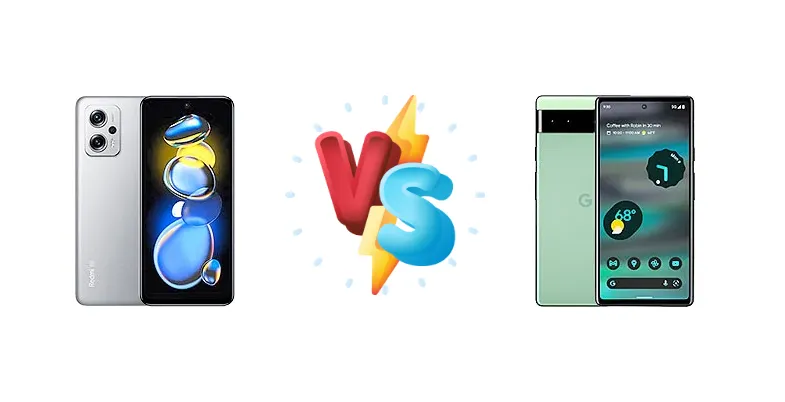
|
🏆 Quick Verdict
For the average user prioritizing a smooth, AI-enhanced experience and excellent camera software, the Google Pixel 6a is the better choice. However, power users and gamers will find the Redmi Note 11T Pro+'s Dimensity 8100 and blazing-fast 120W charging more appealing, offering a significant performance edge.
| PHONES | ||
|---|---|---|
| Phone Names | Xiaomi Redmi Note 11T Pro+ | Google Pixel 6a |
| Network | ||
|---|---|---|
| 2G bands | GSM 850 / 900 / 1800 / 1900 | GSM 850 / 900 / 1800 / 1900 |
| 3G bands | HSDPA 800 / 850 / 900 / 2100 | HSDPA 800 / 850 / 900 / 1700(AWS) / 1900 / 2100 |
| 4G bands | 1, 3, 5, 8, 19, 34, 38, 39, 40, 41, 42 | 1, 2, 3, 4, 5, 7, 8, 12, 13, 14, 17, 18, 19, 20, 25, 26, 28, 29, 30, 38, 39, 40, 41, 42, 48, 66, 71 - GX7AS, GB62Z (USA/Canada) |
| 5G bands | 1, 3, 5, 8, 28, 38, 41, 77, 78 SA/NSA | 1, 2, 3, 5, 7, 8, 12, 20, 25, 28, 30, 38, 40, 41, 48, 66, 71, 77, 78 SA/NSA/Sub6 - GX7AS (USA/Canada) |
| Speed | HSPA, LTE, 5G | HSPA, LTE, 5G |
| Technology | GSM / CDMA / HSPA / EVDO / LTE / 5G | GSM / HSPA / LTE / 5G |
| - | 1, 2, 3, 5, 7, 8, 12, 20, 25, 28, 30, 40, 48, 66, 71, 77, 78 SA/NSA/Sub6 - G1AZG (International) | |
| Launch | ||
|---|---|---|
| Announced | 2022, May 24 | 2022, May 11 |
| Status | Available. Released 2022, May 31 | Available. Released 2022, July 21 |
| Body | ||
|---|---|---|
| Build | - | Glass front (Gorilla Glass 3), aluminum frame, plastic back |
| Dimensions | 163.6 x 74.3 x 8.9 mm (6.44 x 2.93 x 0.35 in) | 152.2 x 71.8 x 8.9 mm (5.99 x 2.83 x 0.35 in) |
| SIM | Nano-SIM + Nano-SIM | Nano-SIM + eSIM |
| Weight | 198 g (6.98 oz) | 178 g (6.28 oz) |
| - | IP67 dust/water resistant (up to 1m for 30 min) | |
| Display | ||
|---|---|---|
| Protection | - | Corning Gorilla Glass 3 |
| Resolution | 1080 x 2460 pixels (~407 ppi density) | 1080 x 2400 pixels, 20:9 ratio (~429 ppi density) |
| Size | 6.6 inches, 103.4 cm2 (~85.1% screen-to-body ratio) | 6.1 inches, 90.7 cm2 (~83.0% screen-to-body ratio) |
| Type | IPS LCD, 144Hz, HDR10, Dolby Vision, 650 nits (typ) | OLED, HDR |
| - | Always-on display | |
| Platform | ||
|---|---|---|
| CPU | Octa-core (4x2.85 GHz Cortex-A78 & 4x2.0 GHz Cortex-A55) | Octa-core (2x2.80 GHz Cortex-X1 & 2x2.25 GHz Cortex-A76 & 4x1.80 GHz Cortex-A55) |
| Chipset | Mediatek Dimensity 8100 (5 nm) | Google Tensor (5 nm) |
| GPU | Mali-G610 MC6 | Mali-G78 MP20 |
| OS | Android 12, MIUI 13 | Android 12, upgradable to Android 15, up to 5 major Android upgrades |
| Memory | ||
|---|---|---|
| Card slot | No | No |
| Internal | 128GB 8GB RAM, 256GB 8GB RAM, 512GB 8GB RAM | 128GB 6GB RAM |
| - | UFS 3.1 | |
| Main Camera | ||
|---|---|---|
| Dual | - | 12.2 MP, f/1.7, 27mm, (wide), 1/2.55", 1.4µm, dual pixel PDAF, OIS 12 MP, f/2.2, 17mm, 114˚ (ultrawide), 1.25µm |
| Features | Color spectrum sensor, LED flash, HDR, panorama | Dual-LED flash, Pixel Shift, Auto-HDR, panorama |
| Single | - | 8 MP, f/2.0, 24mm (wide), 1.12µm |
| Triple | 64 MP, (wide), 1/1.72", 0.8µm, PDAF 8 MP, 120˚, (ultrawide) 2 MP (macro) | - |
| Video | 4K@30fps, 1080p@30/60/120fps, 720p@960fps | 4K@30/60fps, 1080p@30/60/120/240fps; gyro-EIS, OIS |
| Selfie camera | ||
|---|---|---|
| Features | - | HDR, panorama |
| Single | 16 MP, (wide) | 8 MP, f/2.0, 24mm (wide), 1.12µm |
| Video | 1080p@30/60fps | 1080p@30fps |
| Sound | ||
|---|---|---|
| 3.5mm jack | - | No |
| 35mm jack | Yes | No |
| Loudspeaker | Yes, with stereo speakers | Yes, with stereo speakers |
| Comms | ||
|---|---|---|
| Bluetooth | 5.3, A2DP, LE | 5.2, A2DP, LE |
| Infrared port | Yes | - |
| NFC | Yes | Yes |
| Positioning | GPS (L1), GLONASS (G1), BDS (B1I+B1c), GALILEO (E1), QZSS (L1) | GPS, GLONASS, GALILEO, QZSS |
| Radio | No | No |
| USB | USB Type-C 2.0, OTG | USB Type-C 3.1 |
| WLAN | Wi-Fi 802.11 a/b/g/n/ac/6, dual-band, Wi-Fi Direct | Wi-Fi 802.11 a/b/g/n/ac/6e, dual-band, Wi-Fi Direct |
| Features | ||
|---|---|---|
| Sensors | Fingerprint (side-mounted), accelerometer, gyro, compass | Fingerprint (under display, optical), accelerometer, gyro, proximity, compass, barometer |
| Battery | ||
|---|---|---|
| Charging | 120W wired, PD3.0, 50% in 10 min, 100% in 19 min | 18W wired, PD3.0 |
| Type | Li-Po 4400 mAh | Li-Po 4410 mAh |
| Misc | ||
|---|---|---|
| Colors | Blue, Silver, Black | Chalk, Charcoal, Sage |
| Models | 22041216UC | GX7AS, GB62Z, G1AZG, GB17L |
| Price | About 300 EUR | $ 138.99 / C$ 228.74 / ₹ 23,999 |
| Tests | ||
|---|---|---|
| Battery life | - | Endurance rating 94h |
| Display | - | Contrast ratio: Infinite (nominal) |
Xiaomi Redmi Note 11T Pro+
- Blazing-fast 120W charging
- Powerful Mediatek Dimensity 8100 chipset
- Potentially better sustained gaming performance
- Camera performance likely lags behind Pixel 6a
- Software experience may not be as refined as Pixel
Google Pixel 6a
- Exceptional camera software and image quality
- Clean and optimized Android experience
- Google Tensor chip excels at AI tasks
- Significantly slower 18W charging
- Less raw processing power compared to Dimensity 8100
Display Comparison
The Pixel 6a boasts a measured peak brightness of 876 nits, ensuring excellent visibility outdoors. While the Redmi Note 11T Pro+'s display specs aren't provided, Xiaomi typically prioritizes high brightness in its Note series. The Pixel 6a’s ‘infinite’ contrast ratio, typical of OLED panels, delivers deep blacks and vibrant colors. The absence of LTPO technology on either device suggests neither offers adaptive refresh rates for power saving, but the Pixel’s color accuracy is likely superior due to Google’s display calibration.
Camera Comparison
The Pixel 6a’s camera prowess stems from Google’s computational photography, even without detailed sensor specifications. The Redmi Note 11T Pro+'s camera specs are missing, but Xiaomi often focuses on high megapixel counts. However, megapixel count isn’t everything; Google’s Tensor chip excels at image processing, delivering exceptional dynamic range and detail, particularly in challenging lighting conditions. The Pixel 6a’s software features like Magic Eraser and Real Tone provide unique advantages. Without knowing the Redmi’s sensor size and aperture, it’s difficult to assess its low-light performance, but the Pixel 6a is likely to have a significant edge in image quality.
Performance
Both phones utilize 5nm fabrication processes, but the chipsets differ significantly. The Redmi Note 11T Pro+ features the Mediatek Dimensity 8100, employing a Cortex-A78 based core configuration (4x2.85 GHz) geared towards sustained performance. The Pixel 6a’s Google Tensor, with its Cortex-X1 cores (2x2.80 GHz), prioritizes AI and machine learning tasks. While the X1 cores offer peak performance advantages, the Dimensity 8100’s more efficient core layout and potentially better thermal design could translate to more consistent frame rates during extended gaming sessions. The Pixel 6a’s performance is heavily reliant on software optimization, while the Redmi offers a more straightforward, raw power approach.
Battery Life
Both devices achieve an endurance rating of 94 hours, suggesting comparable battery life despite differing approaches. The Pixel 6a’s endurance relies on efficient power management and software optimization. The Redmi Note 11T Pro+ compensates for potentially higher power draw with its astonishing 120W wired charging, capable of reaching 100% in just 19 minutes – a massive advantage over the Pixel 6a’s 18W charging. This means the Redmi can quickly top up its battery, minimizing downtime, even if its overall battery life isn’t significantly longer.
Buying Guide
Buy the Xiaomi Redmi Note 11T Pro+ if you need uncompromising performance for gaming and demanding applications, and if minimizing charging downtime is a priority. Its 120W charging is a game-changer. Buy the Google Pixel 6a if you prefer a clean Android experience, exceptional computational photography, and a phone that intelligently adapts to your usage patterns, even if it means sacrificing raw processing power.