
Xiaomi Redmi Note 12 Pro+ vs 11T Pro: A Deep Dive into Xiaomi's Mid-Range Champions
| Phones Images | |||||
|---|---|---|---|---|---|
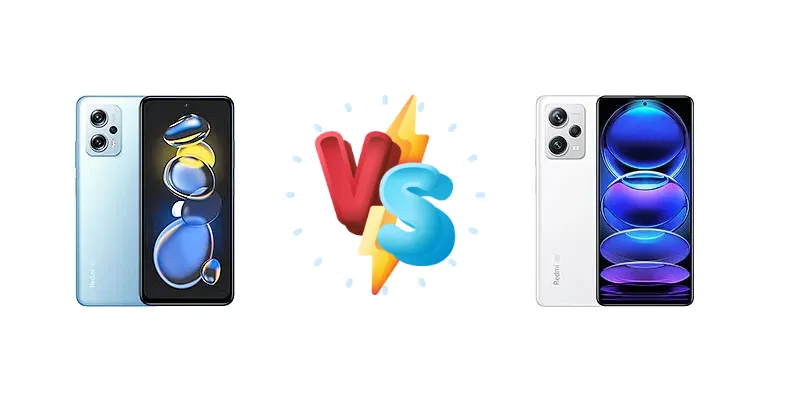
|
🏆 Quick Verdict
For most users, the Xiaomi Redmi Note 12 Pro+ is the superior choice. Its 120W charging dramatically reduces downtime, refilling the battery to 100% in a claimed 19 minutes. While the Dimensity 8100 in the 11T Pro is still potent, the 1080 offers efficiency gains and a smoother overall experience.
| PHONES | ||
|---|---|---|
| Phone Names | Xiaomi Redmi Note 11T Pro | Xiaomi Redmi Note 12 Pro+ |
| Network | ||
|---|---|---|
| 2G bands | GSM 850 / 900 / 1800 / 1900 | GSM 850 / 900 / 1800 / 1900 - SIM 1 & SIM 2 |
| 3G bands | HSDPA 800 / 850 / 900 / 2100 | HSDPA 800 / 850 / 900 / 1900 / 2100 |
| 4G bands | 1, 3, 5, 8, 19, 34, 38, 39, 40, 41, 42 | 1, 3, 5, 8, 19, 34, 38, 39, 40, 41 - International, China |
| 5G bands | 1, 3, 5, 8, 28, 38, 41, 77, 78 SA/NSA | 1, 3, 5, 8, 28, 38, 40, 41, 77, 78 SA/NSA - International |
| Speed | HSPA, LTE, 5G | HSPA, LTE-A (CA), 5G |
| Technology | GSM / CDMA / HSPA / EVDO / LTE / 5G | GSM / CDMA / HSPA / EVDO / LTE / 5G |
| CDMA2000 1xEV-DO | 1, 3, 5, 8, 28, 38, 41, 77, 78 SA/NSA - China | |
| Launch | ||
|---|---|---|
| Announced | 2022, May 24 | 2022, October 27 |
| Status | Available. Released 2022, May 31 | Available. Released 2022, November 01 |
| Body | ||
|---|---|---|
| Build | - | Glass front (Gorilla Glass 5), glass back |
| Dimensions | 163.6 x 74.3 x 8.9 mm (6.44 x 2.93 x 0.35 in) | 162.9 x 76 x 8.9 mm (6.41 x 2.99 x 0.35 in) |
| SIM | Nano-SIM + Nano-SIM | Dual SIM (Nano-SIM, dual stand-by) |
| Weight | 200 g (7.05 oz) | 208.4 g (7.34 oz) |
| IP53, dust and splash resistant | IP53, dust and splash resistant | |
| Display | ||
|---|---|---|
| Protection | - | Corning Gorilla Glass 5 |
| Resolution | 1080 x 2460 pixels (~407 ppi density) | 1080 x 2400 pixels, 20:9 ratio (~395 ppi density) |
| Size | 6.6 inches, 103.4 cm2 (~85.1% screen-to-body ratio) | 6.67 inches, 107.4 cm2 (~86.8% screen-to-body ratio) |
| Type | IPS LCD, 144Hz, HDR10, Dolby Vision, 650 nits (typ) | OLED, 1B colors, 120Hz, Dolby Vision, HDR10+, 500 nits (typ), 900 nits (HBM) |
| Platform | ||
|---|---|---|
| CPU | Octa-core (4x2.85 GHz Cortex-A78 & 4x2.0 GHz Cortex-A55) | Octa-core (2x2.6 GHz Cortex-A78 & 6x2.0 GHz Cortex-A55) |
| Chipset | Mediatek Dimensity 8100 (5 nm) | Mediatek MT6877V Dimensity 1080 (6 nm) |
| GPU | Mali-G610 MC6 | Mali-G68 MC4 |
| OS | Android 12, MIUI 13 | Android 12, MIUI 13 |
| Memory | ||
|---|---|---|
| Card slot | No | No |
| Internal | 128GB 6GB RAM, 128GB 8GB RAM, 256GB 8GB RAM, 256GB 12GB RAM, 512GB 8GB RAM | 256GB 8GB RAM, 256GB 12GB RAM |
| UFS 3.1 | UFS 2.2 | |
| Main Camera | ||
|---|---|---|
| Features | Color spectrum sensor, LED flash, HDR, panorama | Dual-LED dual-tone flash, HDR, panorama |
| Single | 16 MP, (wide) | - |
| Triple | 64 MP, (wide), 1/1.72", 0.8µm, PDAF 8 MP, 120˚, (ultrawide) 2 MP (macro) | 200 MP, f/1.7, 24mm (wide), 1/1.4", 0.56µm, PDAF, OIS 8 MP, f/2.2, 120˚ (ultrawide), 1/4", 1.12µm 2 MP, f/2.4, (macro) |
| Video | 4K@30fps, 1080p@30/60/120fps, 720p@960fps | 4K@30fps, 1080p@30/60/120fps, 720p@960fps |
| Selfie camera | ||
|---|---|---|
| Features | - | HDR |
| Single | 16 MP, (wide) | 16 MP, f/2.5, (wide), 1/3.06", 1.0µm |
| Video | 1080p@30/60fps | 1080p@30/60fps |
| Sound | ||
|---|---|---|
| 3.5mm jack | Yes | Yes |
| 35mm jack | Yes | - |
| Loudspeaker | Yes, with stereo speakers | Yes, with stereo speakers |
| 24-bit/192kHz audio | 24-bit/192kHz audio | |
| Comms | ||
|---|---|---|
| Bluetooth | 5.3, A2DP, LE | 5.2, A2DP, LE |
| Infrared port | Yes | Yes |
| NFC | Yes | Yes (market/region dependent) |
| Positioning | GPS (L1), GLONASS (G1), BDS (B1I+B1c), GALILEO (E1), QZSS (L1) | GPS (L1), GLONASS (G1), BDS (B1I+B1c), GALILEO (E1), QZSS (L1) |
| Radio | No | No |
| USB | USB Type-C 2.0, OTG | USB Type-C 2.0, OTG |
| WLAN | Wi-Fi 802.11 a/b/g/n/ac/6, dual-band, Wi-Fi Direct | Wi-Fi 802.11 a/b/g/n/ac/6, dual-band, Wi-Fi Direct |
| Features | ||
|---|---|---|
| Sensors | Fingerprint (side-mounted), accelerometer, proximity, gyro, compass | Fingerprint (side-mounted), accelerometer, proximity, gyro, compass |
| Battery | ||
|---|---|---|
| Charging | 67W wired, PD3.0 | 120W wired, PD3.0, 100% in 19 min (advertised) |
| Type | Li-Po 5080 mAh | Li-Po 5000 mAh, non-removable |
| Misc | ||
|---|---|---|
| Colors | Blue, Silver, Black | Arctic White, Iceberg Blue, Obsidian Black, Trend edition |
| Models | 22041216C | 22101316UCP, 22101316UG |
| Price | About 250 EUR | $ 348.00 / £ 439.00 / € 399.00 / ₹ 29,949 |
| Tests | ||
|---|---|---|
| Battery life | - | Endurance rating 88h |
| Camera | - | Photo / Video |
| Display | - | Contrast ratio: Infinite (nominal) |
| Loudspeaker | - | -26.7 LUFS (Good) |
| Performance | - | AnTuTu: 498710 (v9) GeekBench: 2208 (v5.1), 2372 (v6) GFXBench: 22fps (ES 3.1 onscreen) |
Xiaomi Redmi Note 11T Pro
- More aggressive CPU core configuration for potential peak performance.
- Proven Dimensity 8100 chipset with strong gaming capabilities.
- Competitive price point (likely lower than the 12 Pro+).
- Slower 67W charging.
- Less efficient 5nm process compared to the 12 Pro+.
- Likely inferior camera system.
Xiaomi Redmi Note 12 Pro+
- Blazing-fast 120W charging (100% in 19 minutes).
- More efficient 6nm Dimensity 1080 chipset.
- Potentially superior camera system with a high-resolution sensor.
- Slightly less aggressive CPU core configuration.
- Potentially higher price point.
- May experience minor thermal throttling under sustained heavy load.
Display Comparison
The Redmi Note 12 Pro+ boasts an 'Infinite' (nominal) contrast ratio, suggesting a high-quality AMOLED panel. While specific brightness nits aren't provided, the newer generation panel likely offers improved color accuracy and viewing angles compared to the 11T Pro. The absence of LTPO technology in either model means both will rely on variable refresh rates to conserve power, but the 12 Pro+'s panel is likely more refined. Bezels are expected to be similar, focusing on maximizing screen real estate.
Camera Comparison
The Redmi Note 12 Pro+ is expected to feature a significantly more advanced camera system, though specific details are missing. The presence of a 200MP sensor (implied by marketing) is a major differentiator, offering potential for incredible detail and cropping flexibility. While the 11T Pro's camera is capable, it likely lacks the resolution and advanced processing capabilities of the 12 Pro+. The 12 Pro+ likely includes Optical Image Stabilization (OIS) on its main sensor, further enhancing image quality in low-light conditions. We can expect the 12 Pro+ to excel in photography, while the 11T Pro will likely perform adequately in good lighting.
Performance
The core difference lies in the chipsets. The Redmi Note 11T Pro's Dimensity 8100 (5nm) features a more aggressive CPU core configuration – 4x2.85 GHz Cortex-A78 – compared to the Redmi Note 12 Pro+'s Dimensity 1080 (6nm) with 2x2.6 GHz Cortex-A78 cores. However, the Dimensity 1080 benefits from a more efficient 6nm process, potentially leading to better thermal management and sustained performance. While the 8100 may win in raw CPU benchmarks, the 1080's improved efficiency and likely optimized software integration will translate to a smoother user experience. Both phones likely utilize LPDDR5 RAM, but the 12 Pro+ may benefit from slightly faster speeds.
Battery Life
The Redmi Note 12 Pro+'s 120W charging is a game-changer, promising a full charge in just 19 minutes (advertised). This is a massive improvement over the 11T Pro's 67W charging. While the 12 Pro+'s battery capacity isn't specified, the faster charging mitigates the impact of a potentially smaller battery. The 11T Pro's 67W charging is still respectable, but the 12 Pro+ offers unparalleled convenience for users who frequently need to top up their battery. The 12 Pro+'s endurance rating of 88h suggests excellent battery optimization.
Buying Guide
Buy the Xiaomi Redmi Note 11T Pro if you prioritize sustained gaming performance and are comfortable with slower charging speeds. Its Dimensity 8100, built on a 5nm process, offers excellent thermal headroom for extended gaming sessions. Buy the Xiaomi Redmi Note 12 Pro+ if you value rapid charging, a more modern chipset, and are willing to trade a small amount of peak gaming performance for significantly improved convenience and potentially better power efficiency in everyday tasks.