
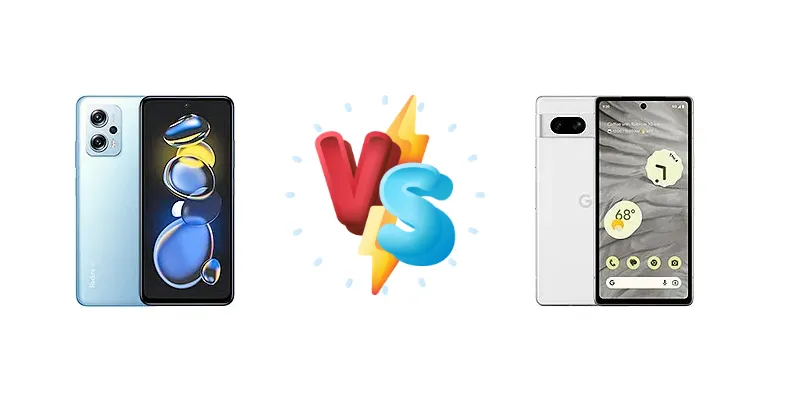
Xiaomi Redmi Note 11T Pro vs Google Pixel 7a: Which Mid-Range Champion Reigns Supreme?
| Phones Images | |||||
|---|---|---|---|---|---|
|
🏆 Quick Verdict
For users prioritizing raw processing power and faster charging, the Xiaomi Redmi Note 11T Pro is the clear winner. However, the Google Pixel 7a excels in camera quality and software support, making it the better choice for photography enthusiasts and those deeply integrated into the Google ecosystem.
| PHONES | ||
|---|---|---|
| Phone Names | Xiaomi Redmi Note 11T Pro | Google Pixel 7a |
| Network | ||
|---|---|---|
| 2G bands | GSM 850 / 900 / 1800 / 1900 | GSM 850 / 900 / 1800 / 1900 |
| 3G bands | HSDPA 800 / 850 / 900 / 2100 | HSDPA 800 / 850 / 900 / 1700(AWS) / 1900 / 2100 |
| 4G bands | 1, 3, 5, 8, 19, 34, 38, 39, 40, 41, 42 | 1, 2, 3, 4, 5, 7, 8, 12, 13, 14, 17, 20, 25, 26, 28, 29, 30, 38, 40, 41, 48, 66, 71 - GWKK3, G0DZQ |
| 5G bands | 1, 3, 5, 8, 28, 38, 41, 77, 78 SA/NSA | 1, 2, 3, 5, 7, 8, 12, 14, 20, 25, 28, 30, 38, 41, 48, 66, 71, 77, 78 SA/NSA/Sub6 - GWKK3 |
| Speed | HSPA, LTE, 5G | HSPA, LTE, 5G |
| Technology | GSM / CDMA / HSPA / EVDO / LTE / 5G | GSM / HSPA / LTE / 5G |
| CDMA2000 1xEV-DO | 1, 2, 3, 5, 7, 8, 12, 20, 25, 28, 38, 40, 41, 66, 75, 76, 77, 78, 79 SA/NSA/Sub6 - GHL1X, G82U8 | |
| Launch | ||
|---|---|---|
| Announced | 2022, May 24 | 2023, May 10 |
| Status | Available. Released 2022, May 31 | Available. Released 2023, May 10 |
| Body | ||
|---|---|---|
| Build | - | Glass front (Gorilla Glass 3), aluminum frame, plastic back |
| Dimensions | 163.6 x 74.3 x 8.9 mm (6.44 x 2.93 x 0.35 in) | 152 x 72.9 x 9 mm (5.98 x 2.87 x 0.35 in) |
| SIM | Nano-SIM + Nano-SIM | Nano-SIM + eSIM |
| Weight | 200 g (7.05 oz) | 193.5 g (6.84 oz) |
| IP53, dust and splash resistant | IP67 dust/water resistant (up to 1m for 30 min) | |
| Display | ||
|---|---|---|
| Protection | - | Corning Gorilla Glass 3 |
| Resolution | 1080 x 2460 pixels (~407 ppi density) | 1080 x 2400 pixels, 20:9 ratio (~429 ppi density) |
| Size | 6.6 inches, 103.4 cm2 (~85.1% screen-to-body ratio) | 6.1 inches, 90.7 cm2 (~81.8% screen-to-body ratio) |
| Type | IPS LCD, 144Hz, HDR10, Dolby Vision, 650 nits (typ) | OLED, HDR, 90Hz |
| - | Always-on display | |
| Platform | ||
|---|---|---|
| CPU | Octa-core (4x2.85 GHz Cortex-A78 & 4x2.0 GHz Cortex-A55) | Octa-core (2x2.85 GHz Cortex-X1 & 2x2.35 GHz Cortex-A78 & 4x1.80 GHz Cortex-A55) |
| Chipset | Mediatek Dimensity 8100 (5 nm) | Google Tensor G2 (5 nm) |
| GPU | Mali-G610 MC6 | Mali-G710 MP7 |
| OS | Android 12, MIUI 13 | Android 13, upgradable to Android 15, up to 5 major Android upgrades |
| Memory | ||
|---|---|---|
| Card slot | No | No |
| Internal | 128GB 6GB RAM, 128GB 8GB RAM, 256GB 8GB RAM, 256GB 12GB RAM, 512GB 8GB RAM | 128GB 8GB RAM |
| UFS 3.1 | UFS 3.1 | |
| Main Camera | ||
|---|---|---|
| Dual | - | 64 MP, f/1.9, 26mm (wide), 1/1.73", 0.8µm, dual pixel PDAF, OIS 13 MP, f/2.2, 120˚ (ultrawide), 1.12µm |
| Features | Color spectrum sensor, LED flash, HDR, panorama | Dual-LED flash, Pixel Shift, Auto-HDR, panorama |
| Single | 16 MP, (wide) | - |
| Triple | 64 MP, (wide), 1/1.72", 0.8µm, PDAF 8 MP, 120˚, (ultrawide) 2 MP (macro) | - |
| Video | 4K@30fps, 1080p@30/60/120fps, 720p@960fps | 4K@30/60fps, 1080p@30/60/120/240fps, OIS |
| Selfie camera | ||
|---|---|---|
| Features | - | HDR, panorama |
| Single | 16 MP, (wide) | 13 MP, f/2.2, 20mm (ultrawide), 1.12µm |
| Video | 1080p@30/60fps | 4K@30fps, 1080p@30fps |
| Sound | ||
|---|---|---|
| 3.5mm jack | Yes | No |
| 35mm jack | Yes | No |
| Loudspeaker | Yes, with stereo speakers | Yes, with stereo speakers |
| 24-bit/192kHz audio | - | |
| Comms | ||
|---|---|---|
| Bluetooth | 5.3, A2DP, LE | 5.3, A2DP, LE |
| Infrared port | Yes | - |
| NFC | Yes | Yes |
| Positioning | GPS (L1), GLONASS (G1), BDS (B1I+B1c), GALILEO (E1), QZSS (L1) | GPS, GLONASS, GALILEO, BDS, QZSS, NavIC |
| Radio | No | No |
| USB | USB Type-C 2.0, OTG | USB Type-C 3.2 |
| WLAN | Wi-Fi 802.11 a/b/g/n/ac/6, dual-band, Wi-Fi Direct | Wi-Fi 802.11 a/b/g/n/ac/6e, tri-band |
| Features | ||
|---|---|---|
| Sensors | Fingerprint (side-mounted), accelerometer, proximity, gyro, compass | Fingerprint (under display, optical), accelerometer, gyro, proximity, compass, barometer |
| Battery | ||
|---|---|---|
| Charging | 67W wired, PD3.0 | 18W wired, PD3.0 7.5W wireless |
| Type | Li-Po 5080 mAh | Li-Po 4385 mAh |
| Misc | ||
|---|---|---|
| Colors | Blue, Silver, Black | Charcoal, Snow, Sea, Coral |
| Models | 22041216C | GWKK3, GHL1X, G0DZQ, G82U8 |
| Price | About 250 EUR | € 179.90 / $ 150.00 / £ 170.00 / ₹ 25,980 |
Xiaomi Redmi Note 11T Pro
- Faster 67W charging for quick top-ups
- Potentially stronger multi-core performance with Dimensity 8100
- Likely more affordable price point
- Inferior camera performance compared to Pixel 7a
- Slower software updates and less consistent support
Google Pixel 7a
- Superior camera quality and computational photography
- Clean Android experience with guaranteed updates
- Google Tensor G2’s AI capabilities enhance various features
- Significantly slower 18W charging
- Potentially higher price compared to Redmi Note 11T Pro
Display Comparison
The Pixel 7a boasts a brighter display, reaching a measured peak of 1070 nits, which translates to better visibility under direct sunlight compared to the Redmi Note 11T Pro (brightness unspecified). While the Redmi Note 11T Pro’s panel technology isn’t detailed, the Pixel 7a’s OLED panel delivers vibrant colors and deep blacks. The Pixel 7a’s smaller size (6.1” vs likely 6.6” on the Redmi) also contributes to a higher pixel density, potentially resulting in a sharper image. Bezels are likely comparable, but the Pixel 7a’s overall display quality is a clear advantage.
Camera Comparison
The Google Pixel 7a’s camera system is its standout feature. While sensor sizes aren’t provided, Google’s computational photography prowess, powered by the Tensor G2, elevates image quality significantly. The Pixel 7a excels in dynamic range, low-light performance, and portrait mode. The Redmi Note 11T Pro’s camera specifications are not detailed enough to make a direct comparison, but Xiaomi typically focuses on high megapixel counts rather than advanced image processing. The Pixel 7a’s video capabilities are also likely superior, benefiting from the Tensor G2’s image stabilization and processing algorithms. The Redmi Note 11T Pro likely offers a more versatile camera setup with potentially more zoom options, but the Pixel 7a delivers consistently better image quality.
Performance
Both phones utilize octa-core CPUs built on a 5nm process, but their architectures differ significantly. The Redmi Note 11T Pro’s Dimensity 8100 features four Cortex-A78 cores clocked at 2.85 GHz, while the Pixel 7a’s Tensor G2 employs two Cortex-X1 cores at the same speed, alongside two A78 cores at 2.35 GHz. The X1 cores in the Tensor G2 are designed for peak performance, giving the Pixel an edge in single-core tasks and AI processing. However, the Dimensity 8100’s four A78 cores provide strong multi-core performance. The Pixel 7a’s Tensor G2 is also heavily optimized for Google’s machine learning algorithms, enhancing features like voice recognition and image processing. RAM speed is not specified, but the Tensor G2’s integrated AI capabilities are a key differentiator.
Battery Life
The Google Pixel 7a has an endurance rating of 76 hours, suggesting good battery life despite its smaller capacity (unspecified). The Redmi Note 11T Pro compensates for a potentially smaller battery with significantly faster 67W wired charging, utilizing PD3.0, allowing for a full charge in under 40 minutes. The Pixel 7a’s 18W charging is considerably slower, taking well over an hour for a full charge. The Pixel 7a also supports 7.5W wireless charging, a feature absent on the Redmi Note 11T Pro. The Redmi Note 11T Pro’s faster charging is a major convenience factor, while the Pixel 7a prioritizes overall battery endurance and wireless charging flexibility.
Buying Guide
Buy the Xiaomi Redmi Note 11T Pro if you need a phone for demanding tasks like gaming or video editing, and value rapid 67W charging. Buy the Google Pixel 7a if you prefer a superior camera experience, a clean and consistently updated Android interface, and benefit from Google’s AI-powered features.