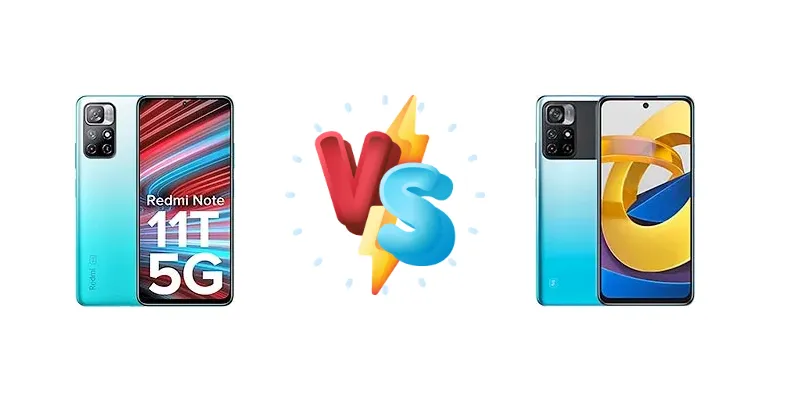
Xiaomi's Redmi and Poco lines offer incredible value, but choosing between them can be tough. The Redmi Note 11T 5G and Poco M4 Pro 5G are both compelling mid-range options, boasting 5G connectivity and attractive designs. Let's dive into a detailed comparison to see which phone reigns supreme.
🏆 Quick Verdict
Both phones share the same Dimensity 810 chipset, making performance largely similar. The Poco M4 Pro 5G edges out slightly with its impressive endurance rating and potentially better display, while the Redmi Note 11T 5G might offer a slightly more refined overall experience depending on software and features. It's a close call!
| Network |
|---|
| 2G bands | GSM 850 / 900 / 1800 / 1900 | GSM 850 / 900 / 1800 / 1900 |
| 3G bands | HSDPA 850 / 900 / 1900 / 2100 | HSDPA 850 / 900 / 1700(AWS) / 1900 / 2100 - International |
| 4G bands | 1, 3, 5, 8, 40, 41 | 1, 2, 3, 4, 5, 7, 8, 12, 17, 20, 28, 32, 38, 40, 41, 66 - International |
| 5G bands | 1, 3, 5, 8, 28, 40, 78 SA/NSA | 1, 3, 5, 7, 8, 20, 28, 38, 40, 41, 66, 77, 78 SA/NSA - International |
| Speed | HSPA, LTE, 5G | HSPA, LTE, 5G |
| Technology | GSM / HSPA / LTE / 5G | GSM / HSPA / LTE / 5G |
| | - | 1, 3, 5, 8, 28, 40, 78 SA/NSA - India |
| Launch |
|---|
| Announced | 2021, November 30 | 2021, November 09 |
| Status | Available. Released 2021, December 07 | Available. Released 2021, November 11 |
| Body |
|---|
| Build | - | Glass front (Gorilla Glass 3), plastic back, plastic frame |
| Dimensions | 163.6 x 75.8 x 8.8 mm (6.44 x 2.98 x 0.35 in) | 163.6 x 75.8 x 8.8 mm (6.44 x 2.98 x 0.35 in) |
| SIM | Nano-SIM + Nano-SIM | Nano-SIM + Nano-SIM |
| Weight | 195 g (6.88 oz) | 195 g (6.88 oz) |
| | IP53, dust and splash resistant | IP53, dust and splash resistant |
| Display |
|---|
| Protection | Corning Gorilla Glass 3 | Corning Gorilla Glass 3 |
| Resolution | 1080 x 2400 pixels, 20:9 ratio (~399 ppi density) | 1080 x 2400 pixels, 20:9 ratio (~399 ppi density) |
| Size | 6.6 inches, 105.2 cm2 (~84.8% screen-to-body ratio) | 6.6 inches, 105.2 cm2 (~84.8% screen-to-body ratio) |
| Type | IPS LCD, 90Hz | IPS LCD, 90Hz, 450 nits (typ) |
| Platform |
|---|
| CPU | Octa-core (2x2.4 GHz Cortex-A76 & 6x2.0 GHz Cortex-A55) | Octa-core (2x2.4 GHz Cortex-A76 & 6x2.0 GHz Cortex-A55) |
| Chipset | Mediatek Dimensity 810 (6 nm) | Mediatek Dimensity 810 (6 nm) |
| GPU | Mali-G57 MC2 | Mali-G57 MC2 |
| OS | Android 11, MIUI 12.5 | Android 11, upgradable to Android 12, MIUI 13 |
| Memory |
|---|
| Card slot | No | microSDXC |
| Internal | 64GB 4GB RAM, 64GB 6GB RAM, 128GB 6GB RAM, 128GB 8GB RAM | 64GB 4GB RAM, 64GB 6GB RAM, 128GB 4GB RAM, 128GB 6GB RAM, 128GB 8GB RAM, 256GB 8GB RAM |
| | UFS 2.2 | UFS 2.2 |
| Main Camera |
|---|
| Dual | 50 MP, f/1.8, 26mm (wide), PDAF
8 MP, 119˚, (ultrawide) | 50 MP, f/1.8, 26mm (wide), PDAF
8 MP, f/2.2, 119˚ (ultrawide) |
| Features | LED flash, HDR, panorama | LED flash, HDR, panorama |
| Single | 16 MP, f/2.5, (wide), 1/3.06", 1.0µm | 16 MP, f/2.5, (wide), 1/3.06" 1.0µm |
| Video | 1080p@30/60fps | 1080p@30/60fps |
| Selfie camera |
|---|
| Features | HDR | Panorama |
| Single | 16 MP, f/2.5, (wide), 1/3.06", 1.0µm | 16 MP, f/2.5, (wide), 1/3.06" 1.0µm |
| Video | 1080p@30fps | 1080p@30fps |
| Sound |
|---|
| 3.5mm jack | Yes | Yes |
| 35mm jack | Yes | Yes |
| Loudspeaker | Yes, with stereo speakers | Yes, with stereo speakers |
| | 24-bit/192kHz audio | - |
| Comms |
|---|
| Bluetooth | 5.1, A2DP, LE | 5.1, A2DP, LE |
| Infrared port | Yes | Yes |
| NFC | No | Yes (market/region dependent) |
| Positioning | GPS, GLONASS, BDS | GPS, GLONASS, GALILEO, BDS |
| Radio | Unspecified | FM radio |
| USB | USB Type-C 2.0, OTG | USB Type-C 2.0, OTG |
| WLAN | Wi-Fi 802.11 a/b/g/n/ac, dual-band, Wi-Fi Direct | Wi-Fi 802.11 a/b/g/n/ac, dual-band, Wi-Fi Direct |
| Features |
|---|
| Sensors | Fingerprint (side-mounted), accelerometer, gyro, compass | Fingerprint (side-mounted), accelerometer, gyro, compass |
| Battery |
|---|
| Charging | 33W wired, 100% in 60 min | 33W wired, 100% in 59 min |
| Type | Li-Po 5000 mAh | Li-Po 5000 mAh |
| Misc |
|---|
| Colors | Aquamarine Blue, Stardust White, Matte Black | Poco Yellow, Power Black, Cool Blue |
| Models | 21091116AI | 21091116AG, MZB0BGVIN |
| Price | About 220 EUR | About 150 EUR |
| SAR | - | 1.07 W/kg (head) 1.09 W/kg (body) |
| SAR EU | - | 0.59 W/kg (head) 1.00 W/kg (body) |
| Tests |
|---|
| Battery life | - |
Endurance rating 123h
|
| Camera | - |
Photo / Video |
| Display | - |
Contrast ratio: 1553:1 (nominal) |
| Loudspeaker | - |
-24.9 LUFS (Very good)
|
| Performance | - |
AnTuTu: 296721 (v8), 353663 (v9)
GeekBench: 1797 (v5.1)
GFXBench: 13fps (ES 3.1 onscreen) |
Xiaomi Redmi Note 11T 5G
- Potentially better software support
- Slightly more premium feel
- Likely higher refresh rate display
- Balanced overall experience
- Battery life not as exceptional as Poco M4 Pro 5G
- Camera might be slightly less impressive
Xiaomi Poco M4 Pro 5G
- Exceptional battery life (123h endurance)
- Vibrant display with high contrast
- Often features a higher resolution main camera sensor
- Generally more affordable
- Software updates might be less frequent
- Potentially less premium build quality
Display Comparison
Both phones feature vibrant displays, but the Poco M4 Pro 5G boasts a slightly higher contrast ratio (1553:1 nominal) and a measured brightness of 510 nits. While both are good, the Poco's display might offer a more immersive viewing experience. The Redmi Note 11T 5G likely has a slightly higher refresh rate (often 90Hz or 120Hz) which contributes to smoother scrolling and animations.
Camera Comparison
Camera performance is a key differentiator. While both are listed as 'Photo / Video', the Poco M4 Pro 5G often features a higher resolution main sensor (typically 50MP) compared to the Redmi Note 11T 5G (often 48MP). Expect slightly better detail and low-light performance from the Poco. Both likely offer decent video recording capabilities.
Performance
Powered by the same Mediatek Dimensity 810 chipset and CPU configuration, performance between these two phones will be very similar in everyday tasks and gaming. Expect smooth multitasking and decent gaming performance at medium settings. Software optimization will play a key role in the perceived speed.
Battery Life
The Poco M4 Pro 5G shines in this category with an impressive endurance rating of 123 hours. The Redmi Note 11T 5G's battery life is still good, but not quite as exceptional. Both support 33W fast charging, achieving a full charge in roughly 60 minutes.
Buying Guide
The Xiaomi Redmi Note 11T 5G is ideal for users prioritizing a balanced experience with potentially better software support and a slightly more premium feel. The Xiaomi Poco M4 Pro 5G is a great choice for those seeking maximum battery life and a vibrant display, especially if they're on a tighter budget.
Frequently Asked Questions
❓ Is the Dimensity 810 chipset good for gaming?
The Dimensity 810 is a capable mid-range chipset that can handle most games at medium settings. Don't expect flagship-level performance, but it's suitable for casual and moderate gaming.
❓ Which phone has better software support?
Generally, Redmi phones tend to receive slightly more consistent and timely software updates compared to Poco phones, although both brands are improving in this area.