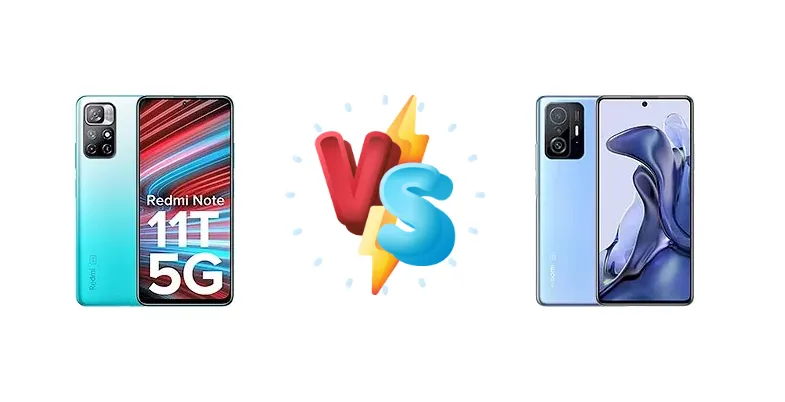
Xiaomi offers a range of compelling mid-range smartphones, and the Redmi Note 11T 5G and Xiaomi 11T are two popular contenders. Both offer excellent value, but cater to slightly different needs. This comprehensive comparison will break down their strengths and weaknesses to help you make the right choice.
🏆 Quick Verdict
The Xiaomi 11T emerges as the overall winner thanks to its significantly faster chipset, superior charging speed, and brighter display. However, the Redmi Note 11T 5G provides a more budget-friendly option with 5G connectivity, making it a solid choice for those prioritizing affordability.
| Network |
|---|
| 2G bands | GSM 850 / 900 / 1800 / 1900 | GSM 850 / 900 / 1800 / 1900 |
| 3G bands | HSDPA 850 / 900 / 1900 / 2100 | HSDPA 850 / 900 / 1700(AWS) / 1900 / 2100 |
| 4G bands | 1, 3, 5, 8, 40, 41 | 1, 2, 3, 4, 5, 7, 8, 12, 13, 17, 18, 19, 20, 26, 28, 32, 38, 40, 41, 42, 66 |
| 5G bands | 1, 3, 5, 8, 28, 40, 78 SA/NSA | 1, 3, 5, 7, 8, 20, 28, 38, 40, 41, 66, 77, 78 SA/NSA |
| Speed | HSPA, LTE, 5G | HSPA, LTE, 5G |
| Technology | GSM / HSPA / LTE / 5G | GSM / HSPA / LTE / 5G |
| Launch |
|---|
| Announced | 2021, November 30 | 2021, September 15 |
| Status | Available. Released 2021, December 07 | Available. Released 2021, October 05 |
| Body |
|---|
| Build | - | Glass front (Gorilla Glass Victus), aluminum frame, glass back |
| Dimensions | 163.6 x 75.8 x 8.8 mm (6.44 x 2.98 x 0.35 in) | 164.1 x 76.9 x 8.8 mm (6.46 x 3.03 x 0.35 in) |
| SIM | Nano-SIM + Nano-SIM | Nano-SIM + Nano-SIM |
| Weight | 195 g (6.88 oz) | 203 g (7.16 oz) |
| | IP53, dust and splash resistant | IP53, dust and splash resistant |
| Display |
|---|
| Protection | Corning Gorilla Glass 3 | Corning Gorilla Glass Victus |
| Resolution | 1080 x 2400 pixels, 20:9 ratio (~399 ppi density) | 1080 x 2400 pixels, 20:9 ratio (~395 ppi density) |
| Size | 6.6 inches, 105.2 cm2 (~84.8% screen-to-body ratio) | 6.67 inches, 107.4 cm2 (~85.1% screen-to-body ratio) |
| Type | IPS LCD, 90Hz | AMOLED, 1B colors, 120Hz, HDR10+, 800 nits (typ), 1000 nits (peak) |
| Platform |
|---|
| CPU | Octa-core (2x2.4 GHz Cortex-A76 & 6x2.0 GHz Cortex-A55) | Octa-core (1x3.0 GHz Cortex-A78 & 3x2.6 GHz Cortex-A78 & 4x2.0 GHz Cortex-A55) |
| Chipset | Mediatek Dimensity 810 (6 nm) | Mediatek Dimensity 1200 (6 nm) |
| GPU | Mali-G57 MC2 | Mali-G77 MC9 |
| OS | Android 11, MIUI 12.5 | Android 11, upgradable to Android 13, MIUI 14 |
| Memory |
|---|
| Card slot | No | No |
| Internal | 64GB 4GB RAM, 64GB 6GB RAM, 128GB 6GB RAM, 128GB 8GB RAM | 128GB 8GB RAM, 256GB 8GB RAM |
| | UFS 2.2 | UFS 3.1 |
| Main Camera |
|---|
| Dual | 50 MP, f/1.8, 26mm (wide), PDAF
8 MP, 119˚, (ultrawide) | - |
| Features | LED flash, HDR, panorama | Dual-LED dual-tone flash, HDR, panorama |
| Single | 16 MP, f/2.5, (wide), 1/3.06", 1.0µm | 16 MP, f/2.5, (wide), 1/3.06", 1.0µm |
| Triple | - | 108 MP, f/1.8, 26mm (wide), 1/1.52", 0.7µm, PDAF
8 MP, f/2.2, 120˚ (ultrawide), 1/4.0", 1.12µm
5 MP, f/2.4, 50mm (telephoto macro), 1/5.0", 1.12µm, AF |
| Video | 1080p@30/60fps | 4K@30fps, 1080p@30/60/120, gyro-EIS |
| Selfie camera |
|---|
| Features | HDR | - |
| Single | 16 MP, f/2.5, (wide), 1/3.06", 1.0µm | 16 MP, f/2.5, (wide), 1/3.06", 1.0µm |
| Video | 1080p@30fps | 1080p@30fps |
| Sound |
|---|
| 3.5mm jack | Yes | No |
| 35mm jack | Yes | No |
| Loudspeaker | Yes, with stereo speakers | Yes, with stereo speakers |
| | 24-bit/192kHz audio | - |
| Comms |
|---|
| Bluetooth | 5.1, A2DP, LE | 5.2, A2DP, LE, aptX HD, aptX Adaptive |
| Infrared port | Yes | Yes |
| NFC | No | Yes |
| Positioning | GPS, GLONASS, BDS | GPS (L1+L5), GLONASS (G1), BDS (B1), GALILEO (E1+E5a), QZSS (L1+L5) |
| Radio | Unspecified | No |
| USB | USB Type-C 2.0, OTG | USB Type-C 2.0, OTG |
| WLAN | Wi-Fi 802.11 a/b/g/n/ac, dual-band, Wi-Fi Direct | Wi-Fi 802.11 a/b/g/n/ac/6, dual-band, Wi-Fi Direct |
| Features |
|---|
| Sensors | Fingerprint (side-mounted), accelerometer, gyro, compass | Fingerprint (side-mounted), accelerometer, gyro, proximity, compass |
| Battery |
|---|
| Charging | 33W wired, 100% in 60 min | 67W wired, 100% in 36 min |
| Type | Li-Po 5000 mAh | Li-Po 5000 mAh |
| Misc |
|---|
| Colors | Aquamarine Blue, Stardust White, Matte Black | Meteorite Gray, Moonlight White, Celestial Blue |
| Models | 21091116AI | 21081111RG |
| Price | About 220 EUR | € 119.00 / £ 275.00 |
| SAR | - | 1.09 W/kg (head) 0.83 W/kg (body) |
| SAR EU | - | 0.55 W/kg (head) 0.95 W/kg (body) |
| Tests |
|---|
| Battery life | - |
Endurance rating 98h
|
| Camera | - |
Photo / Video |
| Display | - |
Contrast ratio: Infinite (nominal) |
| Loudspeaker | - |
-27.6 LUFS (Good)
|
| Performance | - |
AnTuTu: 590837 (v9)
GeekBench: 2834 (v5.1)
GFXBench: 40fps (ES 3.1 onscreen) |
Xiaomi Redmi Note 11T 5G
- More affordable
- 5G connectivity
- Decent battery life
- Reliable performance for everyday tasks
- Slower chipset
- Less bright display
- Slower charging speed
- Lower camera performance compared to 11T
Xiaomi 11T
- Faster chipset (Dimensity 1200)
- Brighter display
- Significantly faster charging (67W)
- Excellent battery life (98h endurance)
- Potentially better camera quality
- More expensive
- May lack 5G in some regions (depending on variant)
Display Comparison
The Xiaomi 11T boasts a significantly brighter display, measured at 798 nits peak brightness, offering better visibility in sunlight. While the Redmi Note 11T 5G's display is perfectly adequate, it lacks the same level of vibrancy and outdoor usability. The 11T's 'Infinite' contrast ratio (nominal) suggests excellent blacks and a more immersive viewing experience.
Camera Comparison
Both phones offer capable camera systems, but the Xiaomi 11T likely holds an edge in image quality, particularly in challenging lighting conditions. While specific camera specs are not detailed, the Dimensity 1200 generally supports more advanced camera features and processing capabilities. Both offer Photo/Video capabilities.
Performance
The Xiaomi 11T's Dimensity 1200 chipset is a clear winner here. It offers considerably more processing power than the Redmi Note 11T 5G's Dimensity 810, resulting in smoother multitasking, faster app loading times, and better gaming performance. The 11T's CPU architecture is also more advanced, with Cortex-A78 cores providing a significant performance boost.
Battery Life
The Xiaomi 11T's endurance rating of 98 hours is exceptional, suggesting outstanding battery life. While the Redmi Note 11T 5G offers decent battery performance, it doesn't quite match the longevity of the 11T. Furthermore, the 11T's 67W charging is significantly faster, fully charging the phone in just 36 minutes compared to the Note 11T 5G's 60 minutes with 33W charging.
Buying Guide
The Xiaomi Redmi Note 11T 5G is ideal for budget-conscious users who want 5G connectivity and a reliable all-around experience. The Xiaomi 11T is better suited for users who prioritize performance, faster charging, and a brighter, more vibrant display, even if it means spending a bit more.
Frequently Asked Questions
❓ Is the Redmi Note 11T 5G good for gaming?
It's adequate for casual gaming, but demanding titles may experience lag or reduced frame rates due to the less powerful chipset.
❓ Which phone has better software support?
Both Xiaomi phones typically receive regular software updates, but the Xiaomi 11T, being a slightly newer model, might have a longer support lifespan.