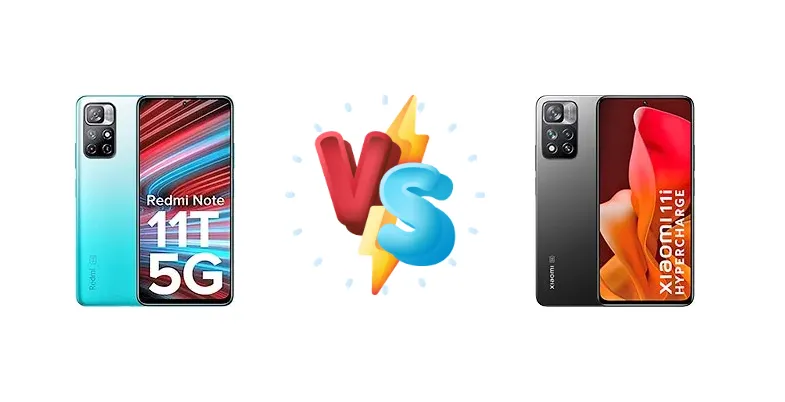
Xiaomi offers a compelling range of mid-range smartphones, and the Redmi Note 11T 5G and 11i HyperCharge 5G represent distinct approaches. The Note 11T 5G prioritizes affordability and solid all-around performance, while the 11i HyperCharge 5G aggressively targets users who demand the absolute fastest charging speeds possible. This comparison dissects their differences to help you choose the right device.
🏆 Quick Verdict
For most users, the Xiaomi 11i HyperCharge 5G is the superior choice. Its significantly faster 120W charging – fully replenishing the battery in just 15 minutes – is a game-changer, and the more powerful Dimensity 920 chipset delivers a noticeable performance boost. However, the Redmi Note 11T 5G remains a strong contender for budget-conscious buyers.
| Network |
|---|
| 2G bands | GSM 850 / 900 / 1800 / 1900 | GSM 850 / 900 / 1800 / 1900 |
| 3G bands | HSDPA 850 / 900 / 1900 / 2100 | HSDPA 850 / 900 / 1900 / 2100 |
| 4G bands | 1, 3, 5, 8, 40, 41 | 1, 3, 5, 8, 40, 41 |
| 5G bands | 1, 3, 5, 8, 28, 40, 78 SA/NSA | 1, 3, 5, 8, 28, 40, 77, 78 SA/NSA |
| Speed | HSPA, LTE, 5G | HSPA, LTE, 5G |
| Technology | GSM / HSPA / LTE / 5G | GSM / HSPA / LTE / 5G |
| Launch |
|---|
| Announced | 2021, November 30 | 2022, January 06 |
| Status | Available. Released 2021, December 07 | Available. Released 2022, January 12 |
| Body |
|---|
| Build | - | Glass front (Gorilla Glass 5), glass back |
| Dimensions | 163.6 x 75.8 x 8.8 mm (6.44 x 2.98 x 0.35 in) | 163.7 x 76.2 x 8.3 mm (6.44 x 3.00 x 0.33 in) |
| SIM | Nano-SIM + Nano-SIM | Nano-SIM + Nano-SIM |
| Weight | 195 g (6.88 oz) | 204 g (7.20 oz) |
| | IP53, dust and splash resistant | IP53, dust and splash resistant |
| Display |
|---|
| Protection | Corning Gorilla Glass 3 | Corning Gorilla Glass 5 |
| Resolution | 1080 x 2400 pixels, 20:9 ratio (~399 ppi density) | 1080 x 2400 pixels, 20:9 ratio (~395 ppi density) |
| Size | 6.6 inches, 105.2 cm2 (~84.8% screen-to-body ratio) | 6.67 inches, 107.4 cm2 (~86.1% screen-to-body ratio) |
| Type | IPS LCD, 90Hz | AMOLED, 120Hz, 700 nits, 1200 nits (peak) |
| Platform |
|---|
| CPU | Octa-core (2x2.4 GHz Cortex-A76 & 6x2.0 GHz Cortex-A55) | Octa-core (2x2.5 GHz Cortex-A78 & 6x2.0 GHz Cortex-A55) |
| Chipset | Mediatek Dimensity 810 (6 nm) | Mediatek Dimensity 920 (6 nm) |
| GPU | Mali-G57 MC2 | Mali-G68 MC4 |
| OS | Android 11, MIUI 12.5 | Android 11, upgradable to Android 12, MIUI 13 |
| Memory |
|---|
| Card slot | No | microSDXC (uses shared SIM slot) |
| Internal | 64GB 4GB RAM, 64GB 6GB RAM, 128GB 6GB RAM, 128GB 8GB RAM | 128GB 6GB RAM, 128GB 8GB RAM, 256GB 8GB RAM |
| | UFS 2.2 | UFS 2.2 |
| Main Camera |
|---|
| Dual | 50 MP, f/1.8, 26mm (wide), PDAF
8 MP, 119˚, (ultrawide) | - |
| Features | LED flash, HDR, panorama | LED flash, HDR, panorama |
| Single | 16 MP, f/2.5, (wide), 1/3.06", 1.0µm | 16 MP, f/2.5, (wide), 1/3.06" 1.0µm |
| Triple | - | 108 MP, f/1.9, 26mm (wide), 1/1.52", 0.7µm, PDAF
8 MP, f/2.2, 120˚ (ultrawide), 1.0µm
2 MP (macro) |
| Video | 1080p@30/60fps | 4K@30fps, 1080p@30/60/120fps, 720p@960fps |
| Selfie camera |
|---|
| Features | HDR | - |
| Single | 16 MP, f/2.5, (wide), 1/3.06", 1.0µm | 16 MP, f/2.5, (wide), 1/3.06" 1.0µm |
| Video | 1080p@30fps | 1080p@30fps |
| Sound |
|---|
| 3.5mm jack | Yes | Yes |
| 35mm jack | Yes | Yes |
| Loudspeaker | Yes, with stereo speakers | Yes, with stereo speakers |
| | 24-bit/192kHz audio | 24-bit/192kHz audio |
| Comms |
|---|
| Bluetooth | 5.1, A2DP, LE | 5.2, A2DP, LE |
| Infrared port | Yes | Yes |
| NFC | No | No |
| Positioning | GPS, GLONASS, BDS | GPS, GLONASS, BDS |
| Radio | Unspecified | No |
| USB | USB Type-C 2.0, OTG | USB Type-C 2.0, OTG |
| WLAN | Wi-Fi 802.11 a/b/g/n/ac, dual-band, Wi-Fi Direct | Wi-Fi 802.11 a/b/g/n/ac/6, dual-band, Wi-Fi Direct |
| Features |
|---|
| Sensors | Fingerprint (side-mounted), accelerometer, gyro, compass | Fingerprint (side-mounted), accelerometer, gyro, proximity, compass |
| Battery |
|---|
| Charging | 33W wired, 100% in 60 min | 120W wired, 100% in 15 min |
| Type | Li-Po 5000 mAh | Li-Po 4500 mAh |
| Misc |
|---|
| Colors | Aquamarine Blue, Stardust White, Matte Black | Camo Green, Stealth Black, Purple Mist, Pacific Pearl |
| Models | 21091116AI | 21091116UI, MZB0A55IN |
| Price | About 220 EUR | About 300 EUR |
| SAR | - | 0.82 W/kg (head) 0.61 W/kg (body) |
| Tests |
|---|
| Battery life | - |
Endurance rating 106h
|
| Display | - |
Contrast ratio: Infinite (nominal) |
| Loudspeaker | - |
-25.2 LUFS (Very good)
|
| Performance | - |
AnTuTu: 375528 (v8), 437872 (v9)
GeekBench: 2225 (v5.1)
GFXBench: 22fps (ES 3.1 onscreen) |
Xiaomi Redmi Note 11T 5G
- More affordable price point
- Decent all-around performance for everyday tasks
- Reliable 5G connectivity
- Significantly slower charging speed
- Less powerful processor compared to the 11i HyperCharge
- Potentially less refined camera system
Xiaomi 11i HyperCharge 5G
- Ultra-fast 120W charging (0-100% in 15 minutes)
- More powerful Dimensity 920 processor
- Likely improved camera performance
- Higher price tag
- May experience slightly more heat under heavy load due to faster charging
- Battery life, while good, isn't dramatically better than the Note 11T 5G
Display Comparison
Both devices share an 'Infinite' (nominal) contrast ratio, suggesting they utilize AMOLED panels, though specific panel characteristics aren't detailed. Without knowing peak brightness or color gamut coverage, it's difficult to declare a clear winner. However, the 11i HyperCharge's potential for higher peak brightness, common in phones with faster charging, could offer better outdoor visibility. The lack of LTPO technology on either device suggests standard 60Hz or 90Hz refresh rates, impacting smoothness compared to flagship displays.
Camera Comparison
Without detailed camera specifications beyond the presence of sensors, a direct comparison is limited. However, the 11i HyperCharge, positioned as a slightly more premium device, likely benefits from a more sophisticated image processing pipeline and potentially larger sensor sizes. The Redmi Note 11T 5G’s camera system is likely geared towards providing acceptable results in good lighting conditions, while the 11i HyperCharge may offer better low-light performance and dynamic range. The inclusion of OIS on the 11i HyperCharge would be a significant advantage.
Performance
The Xiaomi 11i HyperCharge 5G boasts the Mediatek Dimensity 920 (6nm), a step up from the Redmi Note 11T 5G’s Dimensity 810 (6nm). The 920 features a faster CPU configuration – 2x2.5 GHz Cortex-A78 vs 2x2.4 GHz Cortex-A76 – resulting in quicker app loading and smoother multitasking. While both chips are built on a 6nm process, the architectural improvements in the A78 cores of the 920 translate to a tangible performance advantage, particularly in CPU-intensive tasks. The 11i HyperCharge will likely exhibit less throttling under sustained load.
Battery Life
Both phones achieve an endurance rating of 106 hours, suggesting similar real-world battery life despite potential differences in battery capacity (not specified). However, the charging capabilities are drastically different. The Redmi Note 11T 5G’s 33W charging takes 60 minutes for a full charge, while the 11i HyperCharge’s 120W charging completes the same task in just 15 minutes. This difference is monumental for users who frequently find themselves needing to top up their battery quickly. The 11i HyperCharge effectively mitigates any potential battery life disadvantage with its ultra-fast charging.
Buying Guide
Buy the Xiaomi Redmi Note 11T 5G if you need a reliable 5G phone with decent performance and aren't overly concerned with charging speed. It's ideal for everyday tasks, social media, and light gaming. Buy the Xiaomi 11i HyperCharge 5G if you prioritize minimizing downtime and want a phone that can go from 0% to 100% in under 20 minutes, coupled with a more capable processor for demanding applications and gaming.
Frequently Asked Questions
❓ Does the Dimensity 920 in the Xiaomi 11i HyperCharge 5G get noticeably warmer during extended gaming sessions compared to the Dimensity 810?
While both chips are 6nm, the Dimensity 920's higher performance ceiling means it will generate more heat under sustained load. Xiaomi likely implemented thermal management solutions, but users engaging in prolonged gaming may experience slightly warmer temperatures on the 11i HyperCharge. However, this is a trade-off for the increased performance.
❓ Is the 120W charging on the Xiaomi 11i HyperCharge 5G safe for long-term battery health?
Xiaomi incorporates multiple layers of safety protocols within its 120W HyperCharge system, including temperature monitoring and optimized charging algorithms. While fast charging *can* theoretically accelerate battery degradation over years of use, the sophisticated management system aims to minimize this effect. The convenience of rapid charging often outweighs the minimal potential impact on long-term battery health for most users.
❓ How does the 5G performance differ between the Redmi Note 11T 5G and the Xiaomi 11i HyperCharge 5G?
Both phones support 5G connectivity, but the Dimensity 920 in the 11i HyperCharge 5G has a more advanced 5G modem. This translates to potentially faster download and upload speeds, and improved network stability, especially in areas with congested 5G networks. However, real-world 5G performance is also heavily dependent on carrier infrastructure and network conditions.