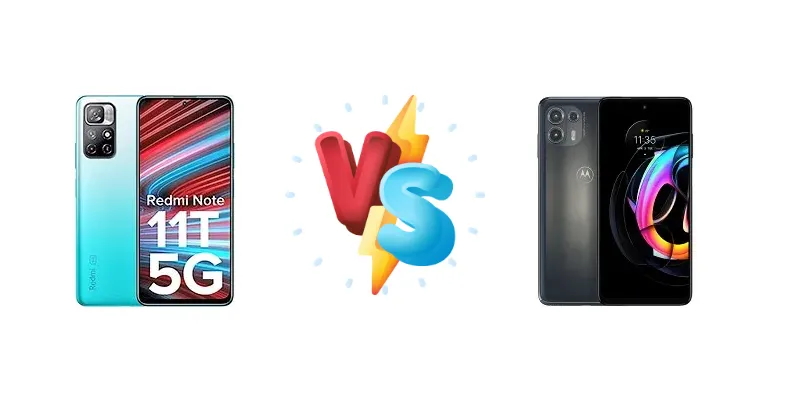
The Xiaomi Redmi Note 11T 5G and Motorola Edge 20 Fusion represent compelling options in the increasingly competitive mid-range 5G smartphone market. Both leverage Mediatek's Dimensity series, but subtle differences in chipset generation and implementation create distinct user experiences. This comparison dissects those differences, focusing on performance, charging, and overall value.
🏆 Quick Verdict
For the average user prioritizing consistent performance and faster charging, the Xiaomi Redmi Note 11T 5G emerges as the better choice. Its Dimensity 810, built on a more efficient 6nm process, offers a slight edge in efficiency and potentially sustained performance, while the 33W charging is noticeably quicker than the Edge 20 Fusion's 30W.
| Network |
|---|
| 2G bands | GSM 850 / 900 / 1800 / 1900 | GSM 850 / 900 / 1800 / 1900 |
| 3G bands | HSDPA 850 / 900 / 1900 / 2100 | HSDPA 850 / 900 / 1700(AWS) / 1900 / 2100 |
| 4G bands | 1, 3, 5, 8, 40, 41 | 1, 2, 3, 4, 5, 7, 8, 12, 13, 17, 18, 19, 20, 26, 28, 32, 34, 38, 39, 40, 41, 42, 43, 66 |
| 5G bands | 1, 3, 5, 8, 28, 40, 78 SA/NSA | 1, 3, 5, 7, 8, 20, 28, 38, 40, 41, 77, 78, 66 SA/NSA/Sub6 |
| Speed | HSPA, LTE, 5G | HSPA 42.2/5.76 Mbps, LTE Cat18 1200/150 Mbps, 5G |
| Technology | GSM / HSPA / LTE / 5G | GSM / HSPA / LTE / 5G |
| Launch |
|---|
| Announced | 2021, November 30 | 2021, August 17 |
| Status | Available. Released 2021, December 07 | Available. Released 2021, August 27 |
| Body |
|---|
| Build | - | Glass front |
| Dimensions | 163.6 x 75.8 x 8.8 mm (6.44 x 2.98 x 0.35 in) | 166 x 76 x 8.3 mm (6.54 x 2.99 x 0.33 in) |
| SIM | Nano-SIM + Nano-SIM | Nano-SIM + Nano-SIM |
| Weight | 195 g (6.88 oz) | 185 g (6.53 oz) |
| | IP53, dust and splash resistant | Water-repellent design |
| Display |
|---|
| Protection | Corning Gorilla Glass 3 | - |
| Resolution | 1080 x 2400 pixels, 20:9 ratio (~399 ppi density) | 1080 x 2400 pixels, 20:9 ratio (~393 ppi density) |
| Size | 6.6 inches, 105.2 cm2 (~84.8% screen-to-body ratio) | 6.7 inches, 108.4 cm2 (~85.9% screen-to-body ratio) |
| Type | IPS LCD, 90Hz | OLED, 1B colors, 90Hz, HDR10+ |
| Platform |
|---|
| CPU | Octa-core (2x2.4 GHz Cortex-A76 & 6x2.0 GHz Cortex-A55) | Octa-core (2x2.4 GHz Cortex-A76 & 6x2.0 GHz Cortex-A55) |
| Chipset | Mediatek Dimensity 810 (6 nm) | Mediatek Dimensity 800U (7 nm) |
| GPU | Mali-G57 MC2 | Mali-G57 MC3 |
| OS | Android 11, MIUI 12.5 | Android 11 |
| Memory |
|---|
| Card slot | No | microSDXC |
| Internal | 64GB 4GB RAM, 64GB 6GB RAM, 128GB 6GB RAM, 128GB 8GB RAM | 128GB 6GB RAM, 128GB 8GB RAM |
| | UFS 2.2 | - |
| Main Camera |
|---|
| Dual | 50 MP, f/1.8, 26mm (wide), PDAF
8 MP, 119˚, (ultrawide) | - |
| Features | LED flash, HDR, panorama | LED flash, HDR, panorama |
| Single | 16 MP, f/2.5, (wide), 1/3.06", 1.0µm | - |
| Triple | - | 108 MP, f/1.9, (wide), 1/1.52", 0.7µm, PDAF
8 MP, f/2.2, 118˚ (ultrawide)
Auxiliary lens |
| Video | 1080p@30/60fps | 4K@30fps, 1080p@30/60/120fps, gyro-EIS |
| Selfie camera |
|---|
| Features | HDR | HDR |
| Single | 16 MP, f/2.5, (wide), 1/3.06", 1.0µm | 32 MP, f/2.3, (wide), 0.7µm |
| Video | 1080p@30fps | 1080p@30fps |
| Sound |
|---|
| 3.5mm jack | Yes | Yes |
| 35mm jack | Yes | Yes |
| Loudspeaker | Yes, with stereo speakers | Yes |
| | 24-bit/192kHz audio | - |
| Comms |
|---|
| Bluetooth | 5.1, A2DP, LE | 5.0, A2DP, LE |
| Infrared port | Yes | - |
| NFC | No | Yes |
| Positioning | GPS, GLONASS, BDS | GPS, GLONASS, GALILEO |
| Radio | Unspecified | FM radio |
| USB | USB Type-C 2.0, OTG | USB Type-C 2.0 |
| WLAN | Wi-Fi 802.11 a/b/g/n/ac, dual-band, Wi-Fi Direct | Wi-Fi 802.11 a/b/g/n/ac, dual-band, Wi-Fi Direct |
| Features |
|---|
| Sensors | Fingerprint (side-mounted), accelerometer, gyro, compass | Fingerprint (side-mounted), accelerometer, gyro, proximity, compass |
| Battery |
|---|
| Charging | 33W wired, 100% in 60 min | 30W wired |
| Type | Li-Po 5000 mAh | Li-Po 5000 mAh |
| Misc |
|---|
| Colors | Aquamarine Blue, Stardust White, Matte Black | Electric Graphite, Cyber Teal |
| Models | 21091116AI | - |
| Price | About 220 EUR | About 250 EUR |
Xiaomi Redmi Note 11T 5G
- Faster 33W charging for quicker top-ups.
- More efficient 6nm Dimensity 810 chipset.
- Potentially better sustained performance due to improved thermal efficiency.
- Software experience may be less refined than Motorola's.
- Display specifications are unknown, potentially lacking features found on competitors.
Motorola Edge 20 Fusion
- Potentially cleaner software experience (depending on Motorola's skin).
- Reliable performance from the Dimensity 800U chipset.
- Generally good value for the price.
- Slower 30W charging.
- Less efficient 7nm Dimensity 800U chipset compared to the 810.
Display Comparison
Neither device boasts a standout display. Both likely utilize IPS LCD panels, a common choice in this price bracket. The key difference lies under the hood: the Redmi Note 11T 5G's Dimensity 810 allows for potentially higher refresh rate support (though not specified in the provided data), while the Edge 20 Fusion's Dimensity 800U is adequate for smooth scrolling and video playback. Without specific display specs like peak brightness or color gamut coverage, it's difficult to declare a clear winner; however, the newer chipset suggests a slight advantage for the Redmi Note 11T 5G in display capabilities.
Camera Comparison
Without detailed camera specifications, a direct comparison is challenging. Both phones likely feature a multi-camera setup, but the quality will depend heavily on sensor size, lens aperture, and image processing algorithms. Given the market positioning, it's reasonable to assume both will prioritize computational photography over raw sensor capabilities. The absence of information regarding OIS (Optical Image Stabilization) suggests neither phone will excel in low-light photography without significant software intervention. We can assume both will include standard features like portrait mode and night mode, but the quality will vary.
Performance
The core of the comparison rests on the chipsets. While both the Mediatek Dimensity 810 and 800U feature the same CPU core configuration – a 2x2.4 GHz Cortex-A76 and 6x2.0 GHz Cortex-A55 setup – the Dimensity 810 benefits from a more advanced 6nm manufacturing process compared to the 800U’s 7nm process. This smaller node generally translates to improved power efficiency and potentially higher sustained performance under load, reducing thermal throttling. The GPU performance is likely similar, but the 810’s efficiency gains could allow for longer gaming sessions without significant frame drops. The Redmi Note 11T 5G will likely exhibit a slight edge in demanding tasks.
Battery Life
The Redmi Note 11T 5G’s 33W wired charging is a clear advantage over the Edge 20 Fusion’s 30W. While the difference may not seem substantial, it translates to a faster 0-100% charge time – Xiaomi claims 60 minutes, while the Motorola will likely take longer. The battery capacity isn't specified for either device, but the more efficient Dimensity 810 in the Redmi Note 11T 5G could offset a potentially smaller battery size, resulting in comparable real-world battery life. The faster charging speed, however, provides a tangible benefit for users who frequently need to top up their phones.
Buying Guide
Buy the Xiaomi Redmi Note 11T 5G if you need a phone that can handle demanding apps and games with a bit more headroom, and if minimizing charging time is a priority. Buy the Motorola Edge 20 Fusion if you prefer a potentially more refined software experience (depending on Motorola's skin) and are less concerned with pushing the absolute limits of performance or achieving the fastest possible charge times.
Frequently Asked Questions
❓ Will the Redmi Note 11T 5G overheat during prolonged gaming sessions?
The Dimensity 810's 6nm process is designed for improved thermal efficiency compared to the 7nm Dimensity 800U in the Edge 20 Fusion. While overheating can still occur, the Redmi Note 11T 5G is likely to maintain higher sustained performance for longer periods before throttling kicks in.
❓ Does the Motorola Edge 20 Fusion support VoLTE/VoWiFi on all carriers?
Motorola's carrier support can be inconsistent. It's crucial to check compatibility with your specific carrier before purchasing the Edge 20 Fusion, as VoLTE and VoWiFi functionality may be limited on certain networks. Xiaomi generally offers broader carrier support.
❓ Is the difference in charging speed between 30W and 33W noticeable in everyday use?
Yes, the 3W difference, combined with potential optimizations in Xiaomi's charging circuitry, translates to a roughly 10-15 minute faster full charge with the Redmi Note 11T 5G. This is particularly beneficial for users who frequently need to quickly top up their battery.