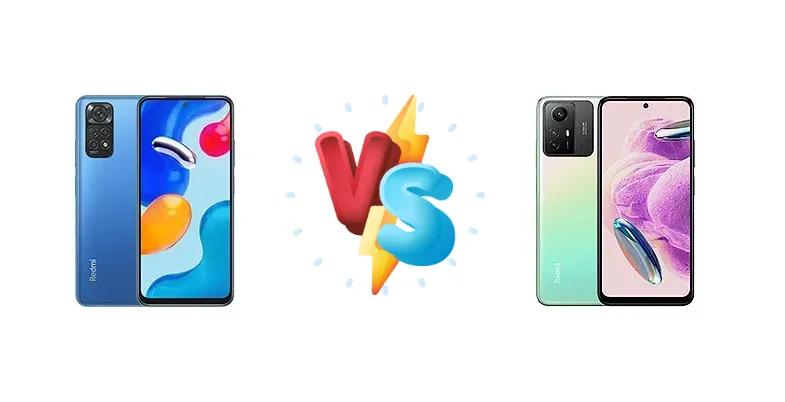
The Xiaomi Redmi Note series consistently delivers excellent value for money. The Note 11S and Note 12S are two popular contenders, but what are the key differences? This comprehensive comparison will help you determine which phone best suits your needs and budget.
🏆 Quick Verdict
The Redmi Note 12S offers a slightly improved camera and potentially a newer design, but the Note 11S retains a significant advantage with its faster charging and impressive endurance rating. Ultimately, the choice depends on your priorities: camera or battery life and charging speed.
| Network |
|---|
| 2G bands | GSM 850 / 900 / 1800 / 1900 | GSM 850 / 900 / 1800 / 1900 |
| 3G bands | HSDPA 850 / 900 / 1700(AWS) / 1900 / 2100 | HSDPA 850 / 900 / 2100 |
| 4G bands | 1, 2, 3, 4, 5, 7, 8, 20, 28, 38, 40, 41 | 1, 3, 5, 7, 8, 20, 28, 38, 40, 41 |
| Speed | HSPA, LTE | HSPA, LTE |
| Technology | GSM / HSPA / LTE | GSM / HSPA / LTE |
| Launch |
|---|
| Announced | 2022, January 26 | 2023, March 06 |
| Status | Available. Released 2022, February 09 | Available. Released 2023, April 26 |
| Body |
|---|
| Build | Glass front (Gorilla Glass 3), plastic frame, glass back | - |
| Dimensions | 159.9 x 73.9 x 8.1 mm (6.30 x 2.91 x 0.32 in) | 159.9 x 73.9 x 8.1 mm (6.30 x 2.91 x 0.32 in) |
| SIM | Nano-SIM + Nano-SIM | Nano-SIM + Nano-SIM |
| Weight | 179 g (6.31 oz) | 176 g (6.21 oz) |
| | IP53, dust and splash resistant | - |
| Display |
|---|
| Protection | Corning Gorilla Glass 3 | - |
| Resolution | 1080 x 2400 pixels, 20:9 ratio (~409 ppi density) | 1080 x 2400 pixels, 20:9 ratio (~409 ppi density) |
| Size | 6.43 inches, 99.8 cm2 (~84.5% screen-to-body ratio) | 6.43 inches, 99.8 cm2 (~84.5% screen-to-body ratio) |
| Type | AMOLED, 90Hz, 700 nits, 1000 nits (peak) | AMOLED, 90Hz, 700 nits (HBM), 1000 nits (peak) |
| Platform |
|---|
| CPU | Octa-core (2x2.05 GHz Cortex-A76 & 6x2.0 GHz Cortex-A55) | Octa-core (2x2.05 GHz Cortex-A76 & 6x2.0 GHz Cortex-A55) |
| Chipset | Mediatek MT6781 Helio G96 (12 nm) | Mediatek MT6781 Helio G96 (12 nm) |
| GPU | Mali-G57 MC2 | Mali-G57 MC2 |
| OS | Android 11, MIUI 13 | Android 13, MIUI 14 |
| Memory |
|---|
| Card slot | microSDXC (dedicated slot) | microSDXC (dedicated slot) |
| Internal | 64GB 6GB RAM, 128GB 6GB RAM, 128GB 8GB RAM | 64GB 6GB RAM, 128GB 6GB RAM, 256GB 8GB RAM |
| | UFS 2.2 | - |
| Main Camera |
|---|
| Features | LED flash, HDR, panorama | LED flash, HDR, panorama |
| Quad | 108 MP, f/1.9, 26mm (wide), 1/1.52", 0.7µm, PDAF
8 MP, f/2.2, 118˚ (ultrawide)
2 MP (macro)
Auxiliary lens | - |
| Triple | - | 108 MP, f/1.9, (wide), 1/1.52", 0.7µm, PDAF
8 MP, f/2.2, 118˚ (ultrawide), 1/4.0", 1.12µm
2 MP (macro) |
| Video | 1080p@30fps | 1080p@30fps |
| Selfie camera |
|---|
| Single | 16 MP, f/2.5, (wide), 1/3.06" 1.0µm | 16 MP, f/2.4, (wide) |
| Video | 1080p@30fps | 1080p@30fps |
| Sound |
|---|
| 3.5mm jack | Yes | Yes |
| 35mm jack | Yes | Yes |
| Loudspeaker | Yes, with stereo speakers | Yes, with stereo speakers |
| | 24-bit/192kHz audio | - |
| Comms |
|---|
| Bluetooth | 5.0, A2DP, LE | 5.2, A2DP, LE |
| Infrared port | Yes | Yes |
| NFC | Yes (market/region dependent) | Yes (market/region dependent) |
| Positioning | GPS, GLONASS, BDS, GALILEO | GPS (L1), GLONASS (G1), GALILEO (E1), BDS (B1) |
| Radio | FM radio | Stereo FM radio, recording |
| USB | USB Type-C 2.0, OTG | USB Type-C 2.0 |
| WLAN | Wi-Fi 802.11 a/b/g/n/ac, dual-band, Wi-Fi Direct | Wi-Fi 802.11 a/b/g/n/ac, dual-band |
| Features |
|---|
| Sensors | Fingerprint (side-mounted), accelerometer, gyro, compass | Fingerprint (side-mounted), accelerometer, gyro, proximity, compass |
| | Virtual proximity sensing | - |
| Battery |
|---|
| Charging | 33W wired, PD3.0, QC3, 100% in 58 min | 33W wired |
| Type | Li-Po 5000 mAh | Li-Po 5000 mAh |
| Misc |
|---|
| Colors | Graphite Gray, Pearl White, Twilight Blue | Onyx Black, Ice Blue, Pearl Green |
| Models | 2201117SG, 2201117SI, 2201117SY, 2201117SL | 2303CRA44A, 23030RAC7Y, 2303ERA42L |
| Price | € 136.99 | € 122.47 / $ 149.99 / £ 229.89 |
| SAR | 1.09 W/kg (head) 1.05 W/kg (body) | - |
| SAR EU | 0.59 W/kg (head) 0.88 W/kg (body) | - |
| Tests |
|---|
| Battery life |
Endurance rating 133h
| - |
| Camera |
Photo / Video | - |
| Display |
Contrast ratio: Infinite (nominal) | - |
| Loudspeaker |
-25.4 LUFS (Very good)
| - |
| Performance |
AnTuTu: 251201 (v8), 308741 (v9)
GeekBench: 1873 (v5.1)
GFXBench: 12fps (ES 3.1 onscreen) | - |
Xiaomi Redmi Note 11S
- Excellent battery life (133h endurance)
- Fast 33W charging (PD3.0, QC3)
- Bright 744 nits display
- Versatile quad-camera system
- Chipset is not the latest generation
- Design may feel slightly dated
Xiaomi Redmi Note 12S
- Potentially improved camera system
- Possibly newer design
- Good value for money
- Shorter battery life compared to 11S
- Charging speed details unclear (no PD3.0/QC3 mention)
- Same chipset as the 11S
Display Comparison
Both phones feature a 6.43-inch AMOLED display with a 90Hz refresh rate, offering vibrant colors and smooth scrolling. However, the Note 11S boasts a measured peak brightness of 744 nits, potentially offering better visibility in direct sunlight. The Note 12S may have a slightly different panel, but detailed brightness measurements are needed for a definitive comparison.
Camera Comparison
The Note 12S is expected to have a slightly improved camera system, potentially with a higher resolution main sensor (likely 108MP vs. the 11S's 108MP). While both offer a versatile quad-camera setup, the Note 12S's image processing algorithms might be more refined. Low-light performance and video recording quality are key areas to watch.
Performance
Both devices are powered by the Mediatek Helio G96 chipset, meaning performance will be largely similar for everyday tasks and moderate gaming. Don't expect flagship-level performance from either phone, but they are capable for their price range. Software optimization could be a differentiating factor, with the Note 12S potentially benefiting from newer MIUI versions.
Battery Life
The Redmi Note 11S shines in this category. Its endurance rating of 133 hours is exceptional. The Note 12S, while having a similar battery capacity (5000mAh), lacks the same level of optimization, resulting in potentially shorter battery life. The Note 11S also has 33W wired charging, while the Note 12S only lists 33W wired charging without mentioning PD3.0 or QC3 support, potentially impacting charging speed.
Buying Guide
Who should buy the Xiaomi Redmi Note 11S? Users prioritizing long battery life and fast charging will appreciate the 11S. Who should buy the Xiaomi Redmi Note 12S? Those seeking a slightly improved camera experience and potentially a more modern design might prefer the 12S.
Frequently Asked Questions
❓ Is the Redmi Note 12S worth upgrading from the Note 11S?
It depends on your priorities. If camera improvements are crucial, the 12S might be worth it. However, if battery life and fast charging are more important, sticking with the 11S is a good choice.
❓ What is the difference in performance between the two phones?
The performance is largely similar due to the same chipset. Software optimization and MIUI version could be the differentiating factors.