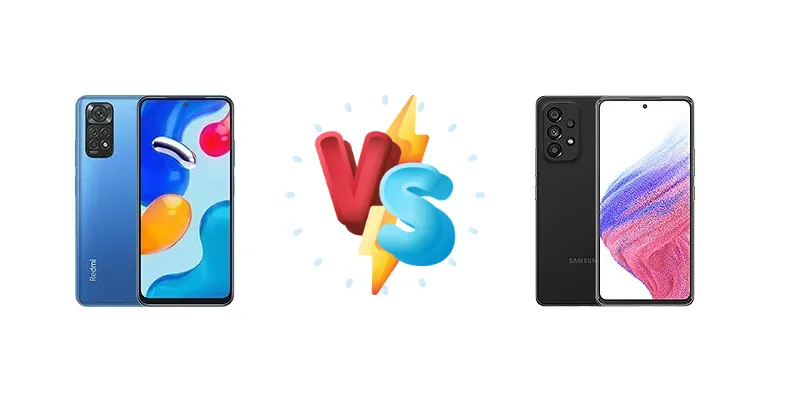
The Xiaomi Redmi Note 11S and Samsung Galaxy A53 5G represent compelling options in the crowded mid-range smartphone market. While both aim to deliver a balanced experience, they take different approaches to achieving it. The Note 11S prioritizes display brightness and endurance, while the A53 5G focuses on a more efficient chipset and Samsung’s software ecosystem. This comparison dissects their strengths and weaknesses to determine which device offers the best value.
🏆 Quick Verdict
For the average user prioritizing battery life and a brighter display, the Xiaomi Redmi Note 11S emerges as the winner. Its significantly longer endurance rating (133h vs 113h) and higher peak brightness (744 nits vs 830 nits) provide a tangible advantage in everyday use, despite the A53's more efficient processor.
| Network |
|---|
| 2G bands | GSM 850 / 900 / 1800 / 1900 | GSM 850 / 900 / 1800 / 1900 |
| 3G bands | HSDPA 850 / 900 / 1700(AWS) / 1900 / 2100 | HSDPA 850 / 900 / 1700(AWS) / 1900 / 2100 |
| 4G bands | 1, 2, 3, 4, 5, 7, 8, 20, 28, 38, 40, 41 | 1, 2, 3, 4, 5, 7, 12, 14, 20, 29, 30, 38, 39, 40, 41, 46, 48, 66 - SM-A536U |
| 5G bands | - | 2, 5, 41, 66, 77, 78 SA/NSA/Sub6/mmWave - SM-A536U |
| Speed | HSPA, LTE | HSPA, LTE, 5G |
| Technology | GSM / HSPA / LTE | GSM / HSPA / LTE / 5G |
| | - | 2, 5, 48, 66, 77, 78, 260, 261 SA/NSA/Sub6/mmWave - SM-A536V |
| Launch |
|---|
| Announced | 2022, January 26 | 2022, March 17 |
| Status | Available. Released 2022, February 09 | Available. Released 2022, March 24 |
| Body |
|---|
| Build | Glass front (Gorilla Glass 3), plastic frame, glass back | Glass front (Gorilla Glass 5), plastic frame, plastic back |
| Dimensions | 159.9 x 73.9 x 8.1 mm (6.30 x 2.91 x 0.32 in) | 159.6 x 74.8 x 8.1 mm (6.28 x 2.94 x 0.32 in) |
| SIM | Nano-SIM + Nano-SIM | · Nano-SIM· Nano-SIM + Nano-SIM |
| Weight | 179 g (6.31 oz) | 189 g (6.67 oz) |
| | IP53, dust and splash resistant | IP67 dust/water resistant (up to 1m for 30 min) |
| Display |
|---|
| Protection | Corning Gorilla Glass 3 | Corning Gorilla Glass 5 |
| Resolution | 1080 x 2400 pixels, 20:9 ratio (~409 ppi density) | 1080 x 2400 pixels, 20:9 ratio (~405 ppi density) |
| Size | 6.43 inches, 99.8 cm2 (~84.5% screen-to-body ratio) | 6.5 inches, 102.0 cm2 (~85.4% screen-to-body ratio) |
| Type | AMOLED, 90Hz, 700 nits, 1000 nits (peak) | Super AMOLED, 120Hz, 800 nits (HBM) |
| Platform |
|---|
| CPU | Octa-core (2x2.05 GHz Cortex-A76 & 6x2.0 GHz Cortex-A55) | Octa-core (2x2.4 GHz Cortex-A78 & 6x2.0 GHz Cortex-A55) |
| Chipset | Mediatek MT6781 Helio G96 (12 nm) | Exynos 1280 (5 nm) |
| GPU | Mali-G57 MC2 | Mali-G68 |
| OS | Android 11, MIUI 13 | Android 12, up to 4 major Android upgrades, One UI 8 |
| Memory |
|---|
| Card slot | microSDXC (dedicated slot) | microSDXC (uses shared SIM slot) |
| Internal | 64GB 6GB RAM, 128GB 6GB RAM, 128GB 8GB RAM | 128GB 4GB RAM, 128GB 6GB RAM, 128GB 8GB RAM, 256GB 6GB RAM, 256GB 8GB RAM |
| | UFS 2.2 | - |
| Main Camera |
|---|
| Features | LED flash, HDR, panorama | LED flash, panorama, HDR |
| Quad | 108 MP, f/1.9, 26mm (wide), 1/1.52", 0.7µm, PDAF
8 MP, f/2.2, 118˚ (ultrawide)
2 MP (macro)
Auxiliary lens | 64 MP, f/1.8, 26mm (wide), 1/1.7X", 0.8µm, PDAF, OIS
12 MP, f/2.2, 123˚ (ultrawide), 1.12µm
5 MP (macro)
Auxiliary lens |
| Single | - | 32 MP, f/2.2, 26mm (wide), 1/2.8", 0.8µm |
| Video | 1080p@30fps | 4K@30fps, 1080p@30/60fps; gyro-EIS |
| Selfie camera |
|---|
| Features | - | HDR |
| Single | 16 MP, f/2.5, (wide), 1/3.06" 1.0µm | 32 MP, f/2.2, 26mm (wide), 1/2.8", 0.8µm |
| Video | 1080p@30fps | 4K@30fps, 1080p@30fps |
| Sound |
|---|
| 3.5mm jack | Yes | No |
| 35mm jack | Yes | No |
| Loudspeaker | Yes, with stereo speakers | Yes, with stereo speakers |
| | 24-bit/192kHz audio | - |
| Comms |
|---|
| Bluetooth | 5.0, A2DP, LE | 5.1, A2DP, LE |
| Infrared port | Yes | - |
| NFC | Yes (market/region dependent) | Yes (market/region dependent) |
| Positioning | GPS, GLONASS, BDS, GALILEO | GPS, GLONASS, GALILEO, BDS |
| Radio | FM radio | No |
| USB | USB Type-C 2.0, OTG | USB Type-C 2.0, OTG |
| WLAN | Wi-Fi 802.11 a/b/g/n/ac, dual-band, Wi-Fi Direct | Wi-Fi 802.11 a/b/g/n/ac, dual-band, Wi-Fi Direct |
| Features |
|---|
| Sensors | Fingerprint (side-mounted), accelerometer, gyro, compass | Fingerprint (under display, optical), accelerometer, gyro, compass, barometer (market/region dependent) |
| | Virtual proximity sensing | Virtual proximity sensing |
| Battery |
|---|
| Charging | 33W wired, PD3.0, QC3, 100% in 58 min | 25W wired |
| Type | Li-Po 5000 mAh | Li-Po 5000 mAh |
| Misc |
|---|
| Colors | Graphite Gray, Pearl White, Twilight Blue | Black, White, Blue, Peach |
| Models | 2201117SG, 2201117SI, 2201117SY, 2201117SL | SM-A536B, SM-A536B/DS, SM-A536U, SM-A536U1, SM-A5360, SM-A536E, SM-A536E/DS, SM-A536V, SM-A536W, SM-A536N, SM-S536DL |
| Price | € 136.99 | $ 151.42 / £ 185.00 / € 169.14 |
| SAR | 1.09 W/kg (head) 1.05 W/kg (body) | 0.75 W/kg (head) 1.58 W/kg (body) |
| SAR EU | 0.59 W/kg (head) 0.88 W/kg (body) | 0.89 W/kg (head) 1.60 W/kg (body) |
| Tests |
|---|
| Battery life |
Endurance rating 133h
|
Endurance rating 113h
|
| Camera |
Photo / Video |
Photo / Video |
| Display |
Contrast ratio: Infinite (nominal) |
Contrast ratio: Infinite (nominal) |
| Loudspeaker |
-25.4 LUFS (Very good)
|
-26.5 LUFS (Good)
|
| Performance |
AnTuTu: 251201 (v8), 308741 (v9)
GeekBench: 1873 (v5.1)
GFXBench: 12fps (ES 3.1 onscreen) |
AnTuTu: 329802 (v8), 379313 (v9)
GeekBench: 1891 (v5.1)
GFXBench: 19fps (ES 3.1 onscreen) |
Xiaomi Redmi Note 11S
- Significantly longer battery life (133h endurance)
- Faster 33W charging with PD3.0/QC3 support
- Brighter display for outdoor visibility
- Less efficient chipset (Helio G96)
- Potentially lower image processing quality
Samsung Galaxy A53 5G
- More efficient chipset (Exynos 1280)
- Likely superior image processing
- Samsung’s software ecosystem and updates
- Shorter battery life (113h endurance)
- Slower 25W charging
Display Comparison
The Samsung Galaxy A53 5G boasts a slightly brighter display at 830 nits compared to the Redmi Note 11S’s 744 nits, but the difference isn’t massive. Both displays share an 'Infinite' (nominal) contrast ratio, suggesting deep blacks. However, the Note 11S’s higher brightness is more noticeable outdoors. While neither specification details refresh rate, the A53 is known to have a 120Hz panel, offering smoother scrolling and animations, a feature absent in the Note 11S. This impacts the user experience significantly for those sensitive to motion blur.
Camera Comparison
Both phones feature 'Photo / Video' capabilities, but detailed sensor information is lacking. However, given the market positioning, it’s likely the A53 5G benefits from Samsung’s superior image processing algorithms. The Exynos 1280’s ISP (Image Signal Processor) is more advanced than the Helio G96’s, resulting in better dynamic range and noise reduction. While both likely include standard features like HDR, the A53’s processing power allows for more sophisticated computational photography techniques. The presence of OIS (Optical Image Stabilization) on the A53, a common feature in Samsung’s A-series, would further enhance image quality, particularly in low-light conditions.
Performance
The Galaxy A53 5G’s Exynos 1280 (5nm) chipset offers a clear architectural advantage over the Redmi Note 11S’s MediaTek Helio G96 (12nm). The 5nm process node translates to improved power efficiency and thermal management, meaning the A53 is less likely to throttle under sustained load. The A53’s CPU configuration – 2x2.4 GHz Cortex-A78 & 6x2.0 GHz Cortex-A55 – also provides a performance edge over the Note 11S’s 2x2.05 GHz Cortex-A76 & 6x2.0 GHz Cortex-A55. This difference will be most apparent in demanding games and multitasking scenarios.
Battery Life
The Redmi Note 11S shines in battery endurance, achieving a measured 133 hours compared to the Galaxy A53 5G’s 113 hours. This 20-hour difference is substantial and reflects the efficiency gains of the Helio G96 combined with a potentially larger battery capacity (though not specified). While the A53 5G supports 25W charging, the Note 11S boasts 33W charging with support for PD3.0 and QC3, enabling a full charge in just 58 minutes. This faster charging speed mitigates the impact of a potentially larger battery size on the A53.
Buying Guide
Buy the Xiaomi Redmi Note 11S if you need exceptional battery life for all-day use, a display that remains visible in direct sunlight, and prioritize value for money. Buy the Samsung Galaxy A53 5G if you prefer a more refined software experience, a slightly more powerful processor for demanding tasks, and the broader ecosystem benefits of the Samsung brand.
Frequently Asked Questions
❓ Does the Exynos 1280 in the Galaxy A53 5G overheat during prolonged gaming sessions?
While the Exynos 1280 is more efficient than the Helio G96, it has been known to exhibit some thermal throttling under sustained heavy load. However, the 5nm process node helps mitigate this, and the A53 generally manages heat better than the Note 11S, offering a more consistent gaming experience over longer periods.
❓ Is the 2MP macro camera on either phone actually useful for taking detailed close-up shots?
Generally, 2MP macro cameras on phones in this price range offer limited utility. Image quality is often soft and lacks detail. They are more of a marketing feature than a genuinely useful photographic tool. You're better off using the main sensor and cropping for close-up shots.
❓ Can the Redmi Note 11S handle demanding games like PUBG Mobile at high frame rates?
The Redmi Note 11S can run PUBG Mobile, but achieving consistently high frame rates (60fps or higher) on maximum settings may be challenging. The Helio G96 is capable, but the phone may experience some frame drops during intense action sequences. Lowering the graphics settings will improve performance.
❓ How does Samsung's software update policy compare to Xiaomi's for these devices?
Samsung generally provides longer and more consistent software update support than Xiaomi. The Galaxy A53 5G is likely to receive several years of Android OS updates and security patches, while the Redmi Note 11S may have a shorter support lifespan. This is a significant consideration for long-term usability and security.