
Google Pixel 7a vs. Xiaomi Redmi Note 11S 5G: A Deep Dive into Mid-Range Contenders
| Phones Images | |||||
|---|---|---|---|---|---|
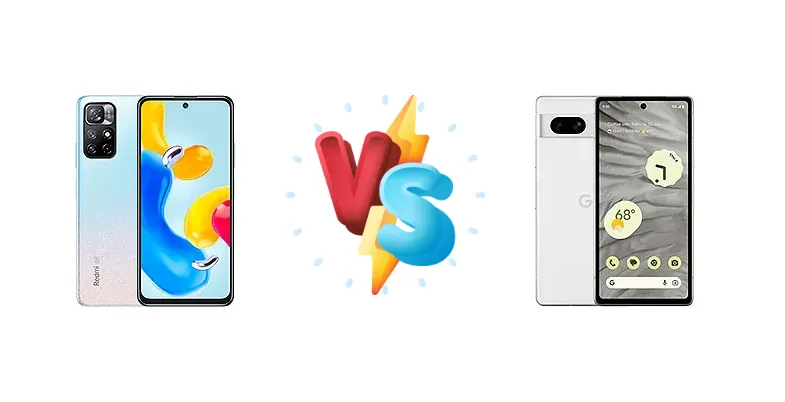
|
🏆 Quick Verdict
For most users, the Google Pixel 7a emerges as the stronger choice. Its superior image processing, powered by the Google Tensor G2, delivers significantly better photos and videos. While the Redmi Note 11S 5G boasts impressive battery life, the Pixel 7a’s overall refinement and performance justify the price difference.
| PHONES | ||
|---|---|---|
| Phone Names | Xiaomi Redmi Note 11S 5G | Google Pixel 7a |
| Network | ||
|---|---|---|
| 2G bands | GSM 850 / 900 / 1800 / 1900 | GSM 850 / 900 / 1800 / 1900 |
| 3G bands | HSDPA 850 / 900 / 1700(AWS) / 1900 / 2100 | HSDPA 800 / 850 / 900 / 1700(AWS) / 1900 / 2100 |
| 4G bands | 1, 2, 3, 4, 5, 7, 8, 12, 13, 17, 20, 26, 28, 32, 38, 40, 41, 66 | 1, 2, 3, 4, 5, 7, 8, 12, 13, 14, 17, 20, 25, 26, 28, 29, 30, 38, 40, 41, 48, 66, 71 - GWKK3, G0DZQ |
| 5G bands | 1, 3, 5, 7, 8, 20, 28, 38, 40, 41, 66, 77, 78 SA/NSA | 1, 2, 3, 5, 7, 8, 12, 14, 20, 25, 28, 30, 38, 41, 48, 66, 71, 77, 78 SA/NSA/Sub6 - GWKK3 |
| Speed | HSPA, LTE, 5G | HSPA, LTE, 5G |
| Technology | GSM / HSPA / LTE / 5G | GSM / HSPA / LTE / 5G |
| - | 1, 2, 3, 5, 7, 8, 12, 20, 25, 28, 38, 40, 41, 66, 75, 76, 77, 78, 79 SA/NSA/Sub6 - GHL1X, G82U8 | |
| Launch | ||
|---|---|---|
| Announced | 2022, March 29 | 2023, May 10 |
| Status | Available. Released 2022, April 23 | Available. Released 2023, May 10 |
| Body | ||
|---|---|---|
| Build | Glass front (Gorilla Glass 3), plastic back, plastic frame | Glass front (Gorilla Glass 3), aluminum frame, plastic back |
| Dimensions | 163.6 x 75.8 x 8.8 mm (6.44 x 2.98 x 0.35 in) | 152 x 72.9 x 9 mm (5.98 x 2.87 x 0.35 in) |
| SIM | Nano-SIM + Nano-SIM | Nano-SIM + eSIM |
| Weight | 195 g (6.88 oz) | 193.5 g (6.84 oz) |
| IP53, dust and splash resistant | IP67 dust/water resistant (up to 1m for 30 min) | |
| Display | ||
|---|---|---|
| Protection | Corning Gorilla Glass 3 | Corning Gorilla Glass 3 |
| Resolution | 1080 x 2400 pixels, 20:9 ratio (~399 ppi density) | 1080 x 2400 pixels, 20:9 ratio (~429 ppi density) |
| Size | 6.6 inches, 105.2 cm2 (~84.8% screen-to-body ratio) | 6.1 inches, 90.7 cm2 (~81.8% screen-to-body ratio) |
| Type | IPS LCD, 90Hz, 450 nits (typ) | OLED, HDR, 90Hz |
| - | Always-on display | |
| Platform | ||
|---|---|---|
| CPU | Octa-core (2x2.4 GHz Cortex-A76 & 6x2.0 GHz Cortex-A55) | Octa-core (2x2.85 GHz Cortex-X1 & 2x2.35 GHz Cortex-A78 & 4x1.80 GHz Cortex-A55) |
| Chipset | Mediatek Dimensity 810 (6 nm) | Google Tensor G2 (5 nm) |
| GPU | Mali-G57 MC2 | Mali-G710 MP7 |
| OS | Android 11, MIUI 13 | Android 13, upgradable to Android 15, up to 5 major Android upgrades |
| Memory | ||
|---|---|---|
| Card slot | microSDXC (uses shared SIM slot) | No |
| Internal | 64GB 4GB RAM, 128GB 4GB RAM, 128GB 6GB RAM, 128GB 8GB RAM | 128GB 8GB RAM |
| UFS 2.2 | UFS 3.1 | |
| Main Camera | ||
|---|---|---|
| Dual | - | 64 MP, f/1.9, 26mm (wide), 1/1.73", 0.8µm, dual pixel PDAF, OIS 13 MP, f/2.2, 120˚ (ultrawide), 1.12µm |
| Features | LED flash, HDR, panorama | Dual-LED flash, Pixel Shift, Auto-HDR, panorama |
| Single | 13 MP, f/2.4, (wide) | - |
| Triple | 50 MP, f/1.8, 26mm (wide), PDAF 8 MP, f/2.2, 119˚ (ultrawide) 2 MP (macro) | - |
| Video | 1080p@30/60fps | 4K@30/60fps, 1080p@30/60/120/240fps, OIS |
| Selfie camera | ||
|---|---|---|
| Features | - | HDR, panorama |
| Single | 13 MP, f/2.4, (wide) | 13 MP, f/2.2, 20mm (ultrawide), 1.12µm |
| Video | 1080p@30fps | 4K@30fps, 1080p@30fps |
| Sound | ||
|---|---|---|
| 3.5mm jack | Yes | No |
| 35mm jack | Yes | No |
| Loudspeaker | Yes, with stereo speakers | Yes, with stereo speakers |
| Comms | ||
|---|---|---|
| Bluetooth | 5.1, A2DP, LE | 5.3, A2DP, LE |
| Infrared port | Yes | - |
| NFC | Yes (market/region dependent) | Yes |
| Positioning | GPS, GLONASS, GALILEO | GPS, GLONASS, GALILEO, BDS, QZSS, NavIC |
| Radio | FM radio | No |
| USB | USB Type-C 2.0, OTG | USB Type-C 3.2 |
| WLAN | Wi-Fi 802.11 a/b/g/n/ac, dual-band, Wi-Fi Direct | Wi-Fi 802.11 a/b/g/n/ac/6e, tri-band |
| Features | ||
|---|---|---|
| Sensors | Fingerprint (side-mounted), accelerometer, gyro, compass | Fingerprint (under display, optical), accelerometer, gyro, proximity, compass, barometer |
| Virtual proximity sensing | - | |
| Battery | ||
|---|---|---|
| Charging | 33W wired, 100% in 59 min | 18W wired, PD3.0 7.5W wireless |
| Type | Li-Po 5000 mAh | Li-Po 4385 mAh |
| Misc | ||
|---|---|---|
| Colors | Midnight Black, Twilight Blue, Star Blue | Charcoal, Snow, Sea, Coral |
| Models | 22031116BG | GWKK3, GHL1X, G0DZQ, G82U8 |
| Price | About 140 EUR | € 179.90 / $ 150.00 / £ 170.00 / ₹ 25,980 |
| SAR | 1.09 W/kg (head) 1.00 W/kg (body) | - |
| SAR EU | 0.60 W/kg (head) 1.00 W/kg (body) | - |
| Tests | ||
|---|---|---|
| Battery life | Endurance rating 131h | - |
| Camera | Photo / Video | - |
| Display | Contrast ratio: 1314:1 (nominal) | - |
| Loudspeaker | -26.8 LUFS (Good) | - |
| Performance | AnTuTu: 360255 (v9) GeekBench: 1820 (v5.1) GFXBench: 13fps (ES 3.1 onscreen) | - |
Xiaomi Redmi Note 11S 5G
- Superior camera performance with Google’s image processing
- Faster and more efficient Google Tensor G2 chipset
- Brighter and more vibrant display
- Significantly shorter battery life
- Slower wireless charging
Google Pixel 7a
- Exceptional battery endurance
- Faster wired charging (33W)
- More affordable price point
- Less powerful processor
- Inferior camera quality
Display Comparison
The Pixel 7a’s display achieves a peak brightness of 1070 nits, significantly outshining the Redmi Note 11S 5G’s 509 nits. This translates to superior visibility in direct sunlight. While the Redmi Note 11S 5G offers a respectable 1314:1 contrast ratio, the Pixel 7a’s OLED panel inherently provides better blacks and a more vibrant picture. Both displays lack high refresh rates, a common omission in this price bracket, but the Pixel 7a’s color accuracy is likely superior due to Google’s display calibration.
Camera Comparison
The Pixel 7a’s camera system is its defining feature. While both phones offer photo and video capabilities, the Pixel 7a leverages Google’s computational photography expertise. The Tensor G2 chip enables features like Magic Eraser and Photo Unblur, enhancing image quality beyond what the hardware alone can achieve. Although sensor sizes aren't specified, Google’s image processing algorithms consistently deliver superior dynamic range, detail, and low-light performance. The Redmi Note 11S 5G’s camera is adequate for everyday snapshots, but it won’t match the Pixel 7a’s consistency and quality.
Performance
The Google Tensor G2 (5nm) in the Pixel 7a represents a substantial leap in processing power compared to the Mediatek Dimensity 810 (6nm) found in the Redmi Note 11S 5G. The Tensor G2’s Cortex-X1 prime core, clocked at 2.85 GHz, provides significantly faster single-core performance, crucial for app launch speeds and responsiveness. The 5nm fabrication process also contributes to better thermal efficiency, potentially reducing throttling during sustained workloads. While the Redmi Note 11S 5G’s octa-core CPU is capable, it will struggle with demanding tasks and graphically intensive games compared to the Pixel 7a.
Battery Life
The Redmi Note 11S 5G boasts an endurance rating of 131 hours, significantly exceeding the Pixel 7a’s 76 hours. This difference is primarily due to the Redmi’s larger battery capacity (not specified in the data, but typical for the model) and more efficient chipset. However, the Pixel 7a compensates with faster charging – 18W wired with PD3.0 and 7.5W wireless – while the Redmi Note 11S 5G is limited to 33W wired, taking 59 minutes to reach 100%. For users who prioritize minimizing charging frequency, the Redmi Note 11S 5G is the clear winner, but the Pixel 7a’s faster charging mitigates the battery life gap for many.
Buying Guide
Buy the Xiaomi Redmi Note 11S 5G if you prioritize all-day battery life and are a casual user who doesn't heavily rely on mobile photography. It’s ideal for streaming, browsing, and basic social media. Buy the Google Pixel 7a if you value camera quality above all else, appreciate a smoother software experience, and want a phone that will receive timely updates and feature drops. It’s the better choice for photography enthusiasts and those who demand responsive performance.