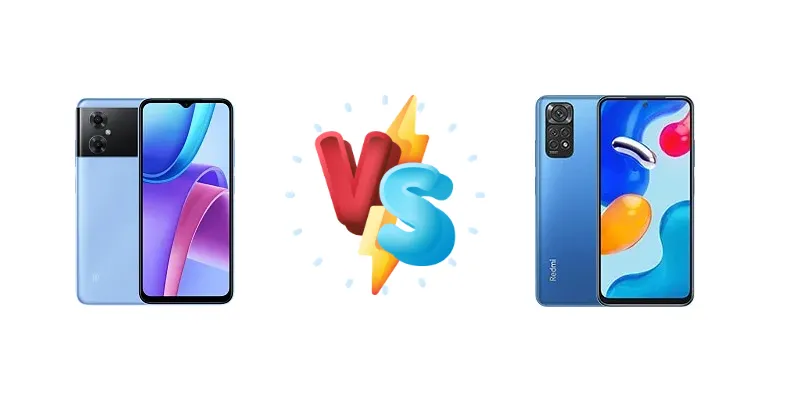
The Xiaomi Redmi Note series consistently delivers excellent value for money. The Redmi Note 11R and 11S are two compelling options in this lineup, but which one is right for you? This comprehensive comparison will break down their key differences to help you make an informed decision.
🏆 Quick Verdict
The Redmi Note 11S edges out the 11R thanks to its faster charging, brighter display, and slightly more modern chipset. While the 11R offers a decent experience, the 11S provides a more polished and feature-rich package, justifying its slightly higher price.
| Network |
|---|
| 2G bands | GSM 850 / 900 / 1800 / 1900 | GSM 850 / 900 / 1800 / 1900 |
| 3G bands | HSDPA 850 / 900 / 1900 / 2100 | HSDPA 850 / 900 / 1700(AWS) / 1900 / 2100 |
| 4G bands | 1, 3, 5, 7, 8, 34, 38, 39, 40, 41 | 1, 2, 3, 4, 5, 7, 8, 20, 28, 38, 40, 41 |
| 5G bands | 1, 5, 8, 28, 41, 78 | - |
| Speed | HSPA, LTE, 5G | HSPA, LTE |
| Technology | GSM / CDMA / HSPA / LTE / 5G | GSM / HSPA / LTE |
| | CDMA 800 | - |
| Launch |
|---|
| Announced | 2022, September 30 | 2022, January 26 |
| Status | Available. Released 2022, September 30 | Available. Released 2022, February 09 |
| Body |
|---|
| Build | Glass front, plastic frame, plastic back | Glass front (Gorilla Glass 3), plastic frame, glass back |
| Dimensions | 164 x 76.1 x 8.9 mm (6.46 x 3.00 x 0.35 in) | 159.9 x 73.9 x 8.1 mm (6.30 x 2.91 x 0.32 in) |
| SIM | Nano-SIM + Nano-SIM | Nano-SIM + Nano-SIM |
| Weight | 201 g (7.09 oz) | 179 g (6.31 oz) |
| | - | IP53, dust and splash resistant |
| Display |
|---|
| Protection | - | Corning Gorilla Glass 3 |
| Resolution | 1080 x 2408 pixels, 20:9 ratio (~401 ppi density) | 1080 x 2400 pixels, 20:9 ratio (~409 ppi density) |
| Size | 6.58 inches, 104.3 cm2 (~83.6% screen-to-body ratio) | 6.43 inches, 99.8 cm2 (~84.5% screen-to-body ratio) |
| Type | IPS LCD, 90Hz, 400 nits (typ) | AMOLED, 90Hz, 700 nits, 1000 nits (peak) |
| Platform |
|---|
| CPU | Octa-core (2x2.2 GHz Cortex-A76 & 6x2.0 GHz Cortex-A55) | Octa-core (2x2.05 GHz Cortex-A76 & 6x2.0 GHz Cortex-A55) |
| Chipset | Mediatek Dimensity 700 (7 nm) | Mediatek MT6781 Helio G96 (12 nm) |
| GPU | Mali-G57 MC2 | Mali-G57 MC2 |
| OS | Android 12, MIUI 13 | Android 11, MIUI 13 |
| Memory |
|---|
| Card slot | microSDXC (dedicated slot) | microSDXC (dedicated slot) |
| Internal | 128GB 4GB RAM, 128GB 6GB RAM, 128GB 8GB RAM | 64GB 6GB RAM, 128GB 6GB RAM, 128GB 8GB RAM |
| | UFS 2.2 | UFS 2.2 |
| Main Camera |
|---|
| Dual | 13 MP, f/2.2, (wide), PDAF
Auxiliary lens | - |
| Features | LED flash, HDR, panorama | LED flash, HDR, panorama |
| Quad | - | 108 MP, f/1.9, 26mm (wide), 1/1.52", 0.7µm, PDAF
8 MP, f/2.2, 118˚ (ultrawide)
2 MP (macro)
Auxiliary lens |
| Video | 1080p@30fps | 1080p@30fps |
| Selfie camera |
|---|
| Features | HDR | - |
| Single | 5 MP, f/2.2, (wide) | 16 MP, f/2.5, (wide), 1/3.06" 1.0µm |
| Video | 1080p@30fps | 1080p@30fps |
| Sound |
|---|
| 3.5mm jack | Yes | Yes |
| 35mm jack | Yes | Yes |
| Loudspeaker | Yes | Yes, with stereo speakers |
| | 24-bit/192kHz audio | 24-bit/192kHz audio |
| Comms |
|---|
| Bluetooth | 5.1, A2DP, LE | 5.0, A2DP, LE |
| Infrared port | Yes | Yes |
| NFC | No | Yes (market/region dependent) |
| Positioning | GPS, GLONASS, GALILEO, BDS | GPS, GLONASS, BDS, GALILEO |
| Radio | No | FM radio |
| USB | USB Type-C 2.0, OTG | USB Type-C 2.0, OTG |
| WLAN | Wi-Fi 802.11 a/b/g/n/ac, dual-band, Wi-Fi Direct | Wi-Fi 802.11 a/b/g/n/ac, dual-band, Wi-Fi Direct |
| Features |
|---|
| Sensors | Fingerprint (side-mounted), accelerometer, proximity, compass | Fingerprint (side-mounted), accelerometer, gyro, compass |
| | - | Virtual proximity sensing |
| Battery |
|---|
| Charging | 18W wired | 33W wired, PD3.0, QC3, 100% in 58 min |
| Type | Li-Po 5000 mAh | Li-Po 5000 mAh |
| Misc |
|---|
| Colors | Black, Blue, Gray | Graphite Gray, Pearl White, Twilight Blue |
| Models | 22095RA98C | 2201117SG, 2201117SI, 2201117SY, 2201117SL |
| Price | About 160 EUR | € 136.99 |
| SAR | - | 1.09 W/kg (head) 1.05 W/kg (body) |
| SAR EU | - | 0.59 W/kg (head) 0.88 W/kg (body) |
| Tests |
|---|
| Battery life | - |
Endurance rating 133h
|
| Camera | - |
Photo / Video |
| Display | - |
Contrast ratio: Infinite (nominal) |
| Loudspeaker | - |
-25.4 LUFS (Very good)
|
| Performance | - |
AnTuTu: 251201 (v8), 308741 (v9)
GeekBench: 1873 (v5.1)
GFXBench: 12fps (ES 3.1 onscreen) |
Xiaomi Redmi Note 11R
- Slightly more efficient chipset
- Good value for money
- Smooth everyday performance
- Slower charging (18W)
- Less bright display
- Potentially less powerful GPU
Xiaomi Redmi Note 11S
- Faster charging (33W)
- Brighter display (744 nits)
- Slightly more modern chipset
- PD3.0, QC3 support
- Slightly less efficient chipset
- Potentially higher price
Display Comparison
The Redmi Note 11S boasts a significantly brighter display, measured at 744 nits, compared to the 11R. While both likely feature similar AMOLED panels with vibrant colors and deep blacks, the 11S's higher brightness makes it more usable in direct sunlight. The 'infinite' contrast ratio claim for the 11S is nominal and doesn't provide concrete data, but AMOLED panels inherently offer excellent contrast.
Camera Comparison
Both phones offer capable camera systems, but detailed camera specifications are missing. Expect similar image quality in good lighting conditions. The 11S might have slightly better image processing due to its chipset, but this is speculative without specific camera specs.
Performance
The Redmi Note 11R's Dimensity 700 chipset is generally more efficient and offers slightly better performance than the Redmi Note 11S's Helio G96. Both feature octa-core CPUs, but the Dimensity 700's 7nm process provides a slight edge in power efficiency. However, the Helio G96 might handle gaming slightly better due to its GPU.
Battery Life
Both devices claim an endurance rating of 133 hours, suggesting comparable battery life under typical usage. However, the Redmi Note 11S's 33W fast charging is a significant advantage over the 11R's 18W charging, allowing for much quicker top-ups.
Buying Guide
The Xiaomi Redmi Note 11R is a good choice for users prioritizing a smooth, everyday experience on a tighter budget. The Redmi Note 11S is ideal for those who value faster charging, a brighter display for outdoor visibility, and a slightly more powerful chipset for demanding tasks.
Frequently Asked Questions
❓ Is the Redmi Note 11R good for gaming?
The Redmi Note 11R offers decent gaming performance for casual titles. However, more demanding games might require lower graphics settings. The 11S's GPU might offer a slight edge.
❓ Which phone has better battery life?
Both phones are claimed to have similar battery life (133h endurance rating). However, the Redmi Note 11S's faster charging makes it more convenient to top up.