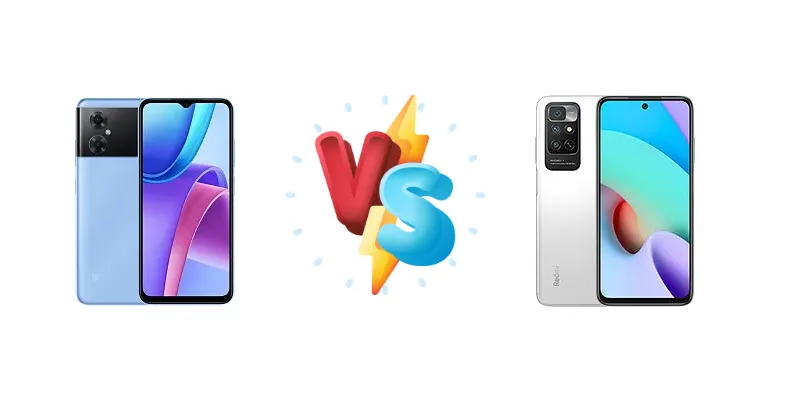
The Xiaomi Redmi Note series consistently delivers excellent value for money. But with multiple iterations, choosing the right model can be tricky. This comparison dives deep into the Redmi Note 11R and Redmi Note 11 4G, highlighting their strengths and weaknesses to help you make an informed decision.
🏆 Quick Verdict
The Redmi Note 11R generally edges out the 11 4G thanks to its more powerful Dimensity 700 chipset, offering noticeably better performance. However, the 11 4G's reverse charging and potentially lower price point might make it a compelling option for budget-conscious users.
| Network |
|---|
| 2G bands | GSM 850 / 900 / 1800 / 1900 | GSM 850 / 900 / 1800 / 1900 |
| 3G bands | HSDPA 850 / 900 / 1900 / 2100 | HSDPA 850 / 900 / 2100 |
| 4G bands | 1, 3, 5, 7, 8, 34, 38, 39, 40, 41 | 1, 3, 5, 7, 8, 34, 38, 39, 40, 41 |
| 5G bands | 1, 5, 8, 28, 41, 78 | - |
| Speed | HSPA, LTE, 5G | HSPA, LTE |
| Technology | GSM / CDMA / HSPA / LTE / 5G | GSM / CDMA / HSPA / LTE |
| | CDMA 800 | CDMA 800 |
| Launch |
|---|
| Announced | 2022, September 30 | 2021, November 25 |
| Status | Available. Released 2022, September 30 | Available. Released 2021, December 01 |
| Body |
|---|
| Build | Glass front, plastic frame, plastic back | - |
| Dimensions | 164 x 76.1 x 8.9 mm (6.46 x 3.00 x 0.35 in) | 162 x 75.5 x 8.9 mm (6.38 x 2.97 x 0.35 in) |
| SIM | Nano-SIM + Nano-SIM | Nano-SIM + Nano-SIM |
| Weight | 201 g (7.09 oz) | 181 g (6.38 oz) |
| Display |
|---|
| Resolution | 1080 x 2408 pixels, 20:9 ratio (~401 ppi density) | 1080 x 2400 pixels, 20:9 ratio (~405 ppi density) |
| Size | 6.58 inches, 104.3 cm2 (~83.6% screen-to-body ratio) | 6.5 inches, 102.0 cm2 (~83.4% screen-to-body ratio) |
| Type | IPS LCD, 90Hz, 400 nits (typ) | LCD, 90Hz |
| Platform |
|---|
| CPU | Octa-core (2x2.2 GHz Cortex-A76 & 6x2.0 GHz Cortex-A55) | Octa-core (2x2.0 GHz Cortex-A75 & 6x1.8 GHz Cortex-A55) |
| Chipset | Mediatek Dimensity 700 (7 nm) | Mediatek MT6769H Helio G88 (12 nm) |
| GPU | Mali-G57 MC2 | Mali-G52 MC2 |
| OS | Android 12, MIUI 13 | Android 11, MIUI 12.5 |
| Memory |
|---|
| Card slot | microSDXC (dedicated slot) | microSDXC |
| Internal | 128GB 4GB RAM, 128GB 6GB RAM, 128GB 8GB RAM | 128GB 4GB RAM, 128GB 6GB RAM |
| | UFS 2.2 | - |
| Main Camera |
|---|
| Dual | 13 MP, f/2.2, (wide), PDAF
Auxiliary lens | - |
| Features | LED flash, HDR, panorama | LED flash, HDR, panorama |
| Single | - | 8 MP, f/2.0, (wide), 1/4.0”, 1.12µm |
| Triple | - | 50 MP, f/1.8, (wide), PDAF
8 MP, f/2.2, 120˚ (ultrawide)
2 MP (macro) |
| Video | 1080p@30fps | 1080p@30fps |
| Selfie camera |
|---|
| Features | HDR | HDR, panorama |
| Single | 5 MP, f/2.2, (wide) | 8 MP, f/2.0, (wide), 1/4.0”, 1.12µm |
| Video | 1080p@30fps | 1080p@30fps |
| Sound |
|---|
| 3.5mm jack | Yes | Yes |
| 35mm jack | Yes | Yes |
| Loudspeaker | Yes | Yes, with stereo speakers |
| | 24-bit/192kHz audio | - |
| Comms |
|---|
| Bluetooth | 5.1, A2DP, LE | 5.1, A2DP, LE |
| Infrared port | Yes | Yes |
| NFC | No | No |
| Positioning | GPS, GLONASS, GALILEO, BDS | GPS, GLONASS, GALILEO, BDS |
| Radio | No | Unspecified |
| USB | USB Type-C 2.0, OTG | USB Type-C 2.0 |
| WLAN | Wi-Fi 802.11 a/b/g/n/ac, dual-band, Wi-Fi Direct | Wi-Fi 802.11 a/b/g/n/ac, dual-band, Wi-Fi Direct |
| Features |
|---|
| Sensors | Fingerprint (side-mounted), accelerometer, proximity, compass | Fingerprint (side-mounted), accelerometer, proximity, compass |
| Battery |
|---|
| Charging | 18W wired | 18W wired
9W reverse wired |
| Type | Li-Po 5000 mAh | Li-Po 5000 mAh |
| Misc |
|---|
| Colors | Black, Blue, Gray | Carbon Gray, Pebble White, Sea Blue |
| Models | 22095RA98C | 21121119SC |
| Price | About 160 EUR | About 210 EUR |
Xiaomi Redmi Note 11R
- More powerful Dimensity 700 chipset
- Better performance for gaming and multitasking
- Potentially better image processing
- Slightly more efficient
- May be slightly more expensive
- Lacks reverse charging
Xiaomi Redmi Note 11 4G
- Reverse wired charging capability
- Potentially lower price
- Good battery life
- Decent camera
- Less powerful Helio G88 chipset
- Slower performance
- Older technology
Display Comparison
Both phones likely feature a similar 6.43-inch FHD+ AMOLED display with a 90Hz refresh rate, offering vibrant colors and smooth scrolling. Expect comparable viewing experiences, though panel calibration might differ slightly.
Camera Comparison
Both phones likely feature a similar camera setup: a 50MP main sensor, an 8MP ultrawide, and a 2MP macro lens. Image quality should be comparable in good lighting conditions, but the Note 11R's more powerful processor might offer slightly better image processing and low-light performance.
Performance
The Redmi Note 11R's Dimensity 700 chipset (7nm) is a significant upgrade over the Helio G88 (12nm) in the Redmi Note 11 4G. This translates to faster app loading times, smoother gaming, and improved overall responsiveness. The Dimensity 700 also offers better power efficiency.
Battery Life
Both devices are expected to have a 5000mAh battery, providing all-day battery life for moderate usage. The Redmi Note 11 4G has a unique advantage with its 9W reverse wired charging, allowing it to act as a power bank for other devices.
Buying Guide
The Redmi Note 11R is ideal for users who prioritize performance and smoother multitasking. If you need a phone for basic tasks, occasional gaming, and appreciate reverse charging, the Redmi Note 11 4G remains a solid choice, especially if it's available at a significantly lower price.
Frequently Asked Questions
❓ Is the Redmi Note 11R worth the extra money?
If performance is a priority, the Redmi Note 11R's Dimensity 700 chipset makes it a worthwhile upgrade. However, if you're on a tight budget and don't need the extra power, the 11 4G remains a capable device.
❓ Can the Redmi Note 11 4G charge other devices?
Yes, the Redmi Note 11 4G supports 9W reverse wired charging, allowing you to use it to charge other devices like earbuds or smartwatches.