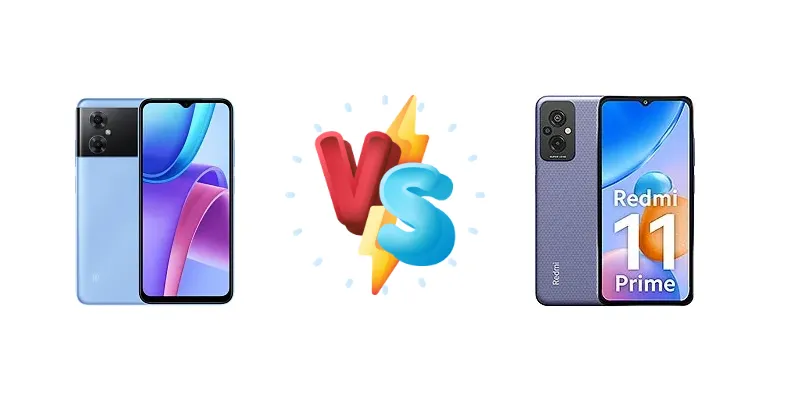
Xiaomi's Redmi series consistently delivers impressive value, but choosing between models can be tricky. The Redmi Note 11R and Redmi 11 Prime are both strong contenders in the budget smartphone market. Let's break down their differences to help you pick the perfect phone for your needs.
🏆 Quick Verdict
The Redmi 11 Prime edges out the 11R thanks to its slightly more efficient 6nm Helio G99 chipset and the added convenience of reverse wired charging. Both offer similar performance and features, but the Prime's efficiency and extra feature give it a slight advantage.
| Network |
|---|
| 2G bands | GSM 850 / 900 / 1800 / 1900 | GSM 850 / 900 / 1800 / 1900 |
| 3G bands | HSDPA 850 / 900 / 1900 / 2100 | HSDPA 850 / 900 / 2100 |
| 4G bands | 1, 3, 5, 7, 8, 34, 38, 39, 40, 41 | 40, 41 |
| 5G bands | 1, 5, 8, 28, 41, 78 | - |
| Speed | HSPA, LTE, 5G | HSPA, LTE |
| Technology | GSM / CDMA / HSPA / LTE / 5G | GSM / HSPA / LTE |
| | CDMA 800 | - |
| Launch |
|---|
| Announced | 2022, September 30 | 2022, September 06 |
| Status | Available. Released 2022, September 30 | Available. Released 2022, September 23 |
| Body |
|---|
| Build | Glass front, plastic frame, plastic back | Glass front (Gorilla Glass 3), plastic frame, plastic back |
| Dimensions | 164 x 76.1 x 8.9 mm (6.46 x 3.00 x 0.35 in) | 164 x 76.1 x 8.9 mm (6.46 x 3.00 x 0.35 in) |
| SIM | Nano-SIM + Nano-SIM | Nano-SIM + Nano-SIM |
| Weight | 201 g (7.09 oz) | 201 g (7.09 oz) |
| Display |
|---|
| Protection | - | Corning Gorilla Glass 3 |
| Resolution | 1080 x 2408 pixels, 20:9 ratio (~401 ppi density) | 1080 x 2408 pixels, 20:9 ratio (~401 ppi density) |
| Size | 6.58 inches, 104.3 cm2 (~83.6% screen-to-body ratio) | 6.58 inches, 104.3 cm2 (~83.6% screen-to-body ratio) |
| Type | IPS LCD, 90Hz, 400 nits (typ) | IPS LCD, 90Hz, 400 nits (typ) |
| Platform |
|---|
| CPU | Octa-core (2x2.2 GHz Cortex-A76 & 6x2.0 GHz Cortex-A55) | Octa-core (2x2.2 GHz Cortex-A76 & 6x2.0 GHz Cortex-A55) |
| Chipset | Mediatek Dimensity 700 (7 nm) | Mediatek Helio G99 (6 nm) |
| GPU | Mali-G57 MC2 | Mali-G57 MC2 |
| OS | Android 12, MIUI 13 | Android 12, MIUI 13 |
| Memory |
|---|
| Card slot | microSDXC (dedicated slot) | microSDXC (dedicated slot) |
| Internal | 128GB 4GB RAM, 128GB 6GB RAM, 128GB 8GB RAM | 64GB 4GB RAM, 128GB 6GB RAM |
| | UFS 2.2 | UFS 2.2 |
| Main Camera |
|---|
| Dual | 13 MP, f/2.2, (wide), PDAF
Auxiliary lens | 50 MP, f/1.8, (wide), PDAF
2 MP (macro)
Auxiliary lens |
| Features | LED flash, HDR, panorama | LED flash, HDR, panorama |
| Video | 1080p@30fps | 1080p@30fps |
| Selfie camera |
|---|
| Features | HDR | HDR |
| Single | 5 MP, f/2.2, (wide) | 8 MP |
| Video | 1080p@30fps | 1080p@30fps |
| Sound |
|---|
| 3.5mm jack | Yes | Yes |
| 35mm jack | Yes | Yes |
| Loudspeaker | Yes | Yes |
| | 24-bit/192kHz audio | 24-bit/192kHz audio |
| Comms |
|---|
| Bluetooth | 5.1, A2DP, LE | 5.1, A2DP, LE |
| Infrared port | Yes | Yes |
| NFC | No | Yes |
| Positioning | GPS, GLONASS, GALILEO, BDS | GPS, GLONASS, BDS, GALILEO |
| Radio | No | FM radio |
| USB | USB Type-C 2.0, OTG | USB Type-C 2.0, OTG |
| WLAN | Wi-Fi 802.11 a/b/g/n/ac, dual-band, Wi-Fi Direct | Wi-Fi 802.11 a/b/g/n/ac, dual-band |
| Features |
|---|
| Sensors | Fingerprint (side-mounted), accelerometer, proximity, compass | Fingerprint (side-mounted), accelerometer, proximity, compass |
| Battery |
|---|
| Charging | 18W wired | 18W wired
5W reverse wired |
| Type | Li-Po 5000 mAh | Li-Po 5000 mAh |
| Misc |
|---|
| Colors | Black, Blue, Gray | Playful Green, Flashy Black, Peppy Purple |
| Models | 22095RA98C | 22071219AI |
| Price | About 160 EUR | About 160 EUR |
Xiaomi Redmi Note 11R
- Smooth 120Hz display
- Decent performance for everyday tasks
- Large 5000mAh battery
- Less efficient chipset than the 11 Prime
- No reverse wired charging
- Potential for slightly lower gaming performance
Xiaomi Redmi 11 Prime
- More efficient 6nm chipset
- Reverse wired charging
- Slightly better gaming performance
- Likely improved image processing
- May have slightly higher price
- Camera performance still limited in low light
- Display panel type may be less premium
Display Comparison
Both phones likely feature a 6.67-inch FHD+ display with a 120Hz refresh rate, offering a smooth visual experience. While specific panel types (AMOLED vs IPS) may vary, the overall viewing experience should be comparable. Expect vibrant colors and decent brightness for indoor and outdoor use.
Camera Comparison
While both phones likely feature a 50MP main camera, the Redmi 11 Prime may have a slightly more advanced image processing pipeline. Expect decent image quality in good lighting conditions, but low-light performance might be a weak point for both. The Redmi 11 Prime may offer slightly better video recording capabilities.
Performance
The Redmi 11 Prime's Mediatek Helio G99 (6nm) offers a slight edge in performance and efficiency over the Redmi Note 11R's Dimensity 700 (7nm). This translates to smoother gaming and potentially better battery life under load. Both CPUs feature the same core configuration, but the manufacturing process difference is key.
Battery Life
Both phones are expected to have a 5000mAh battery, providing all-day battery life for moderate users. The Redmi 11 Prime's more efficient chipset could result in slightly better battery endurance. The 11R lacks reverse charging, while the 11 Prime offers 5W reverse wired charging for accessories.
Buying Guide
The Xiaomi Redmi Note 11R is ideal for users prioritizing a smooth, everyday experience and don't need reverse charging. The Redmi 11 Prime is a better choice for those who want slightly better performance, especially in gaming, and appreciate the ability to charge accessories from their phone.
Frequently Asked Questions
❓ Is the Redmi 11R good for gaming?
The Redmi 11R can handle casual games well, but the Redmi 11 Prime's more powerful chipset provides a smoother experience for more demanding titles.
❓ What does reverse wired charging do?
Reverse wired charging allows you to use your phone to charge other devices, like earbuds or smartwatches, using a USB cable.
❓ Which phone has better battery life?
The Redmi 11 Prime likely has slightly better battery life due to its more efficient chipset, although both offer all-day usage.