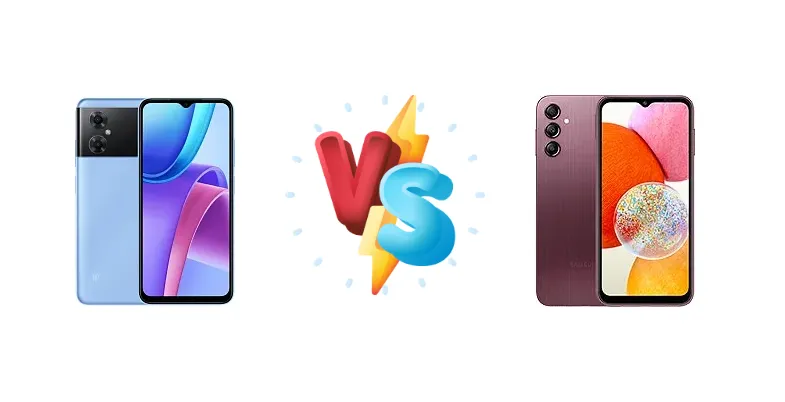
The budget smartphone market is fiercely competitive, and the Xiaomi Redmi Note 11R and Samsung Galaxy A14 are two strong contenders. Both offer compelling features at affordable prices, but which one reigns supreme? This comprehensive comparison will break down every aspect, from performance to camera, to help you make the right choice.
🏆 Quick Verdict
The Redmi Note 11R edges out the Galaxy A14 thanks to its more powerful Dimensity 700 chipset, offering noticeably better performance. However, the Galaxy A14 benefits from Samsung's brand recognition and potentially better software support. Ultimately, the choice depends on your priorities: performance or brand trust.
| Network |
|---|
| 2G bands | GSM 850 / 900 / 1800 / 1900 | GSM 850 / 900 / 1800 / 1900 |
| 3G bands | HSDPA 850 / 900 / 1900 / 2100 | HSDPA 850 / 900 / 2100 |
| 4G bands | 1, 3, 5, 7, 8, 34, 38, 39, 40, 41 | 1, 3, 5, 7, 8, 20, 28, 38, 40, 41 |
| 5G bands | 1, 5, 8, 28, 41, 78 | - |
| Speed | HSPA, LTE, 5G | HSPA, LTE |
| Technology | GSM / CDMA / HSPA / LTE / 5G | GSM / HSPA / LTE |
| | CDMA 800 | - |
| Launch |
|---|
| Announced | 2022, September 30 | 2023, February 28 |
| Status | Available. Released 2022, September 30 | Available. Released 2023, March 27 |
| Body |
|---|
| Build | Glass front, plastic frame, plastic back | Glass front, plastic back, plastic frame |
| Dimensions | 164 x 76.1 x 8.9 mm (6.46 x 3.00 x 0.35 in) | 167.7 x 78 x 9.1 mm (6.60 x 3.07 x 0.36 in) |
| SIM | Nano-SIM + Nano-SIM | · Nano-SIM· Nano-SIM + Nano-SIM |
| Weight | 201 g (7.09 oz) | 201 g (7.09 oz) |
| Display |
|---|
| Resolution | 1080 x 2408 pixels, 20:9 ratio (~401 ppi density) | 1080 x 2408 pixels, 20:9 ratio (~400 ppi density) |
| Size | 6.58 inches, 104.3 cm2 (~83.6% screen-to-body ratio) | 6.6 inches, 104.9 cm2 (~80.2% screen-to-body ratio) |
| Type | IPS LCD, 90Hz, 400 nits (typ) | PLS LCD |
| Platform |
|---|
| CPU | Octa-core (2x2.2 GHz Cortex-A76 & 6x2.0 GHz Cortex-A55) | Octa-core (2x2.0 GHz Cortex-A75 & 6x1.8 GHz Cortex-A55) - Version AOcta-core (4x2.0 GHz Cortex-A55 & 4x2.0 GHz Cortex-A55) - Version B |
| Chipset | Mediatek Dimensity 700 (7 nm) | Mediatek MT6769 Helio G80 (12 nm) - Version AExynos 850 (8 nm) - Version B |
| GPU | Mali-G57 MC2 | Mali-G52 MC2 |
| OS | Android 12, MIUI 13 | Android 13, upgradable to Android 15, One UI 7 |
| Memory |
|---|
| Card slot | microSDXC (dedicated slot) | microSDXC (dedicated slot) |
| Internal | 128GB 4GB RAM, 128GB 6GB RAM, 128GB 8GB RAM | 64GB 4GB RAM, 128GB 4GB RAM, 128GB 6GB RAM |
| | UFS 2.2 | - |
| Main Camera |
|---|
| Dual | 13 MP, f/2.2, (wide), PDAF
Auxiliary lens | - |
| Features | LED flash, HDR, panorama | LED flash, panorama, HDR |
| Single | - | 13 MP, f/2.0, (wide) |
| Triple | - | 50 MP, f/1.8, 26mm (wide), 1/2.75", 0.64µm, PDAF
5 MP, f/2.2, 17mm (ultrawide), 1/5.0", 1.12µm
2 MP (macro) |
| Video | 1080p@30fps | 1080p@30fps |
| Selfie camera |
|---|
| Features | HDR | - |
| Single | 5 MP, f/2.2, (wide) | 13 MP, f/2.0, 26mm (wide), 1/3.1", 1.12µm |
| Video | 1080p@30fps | 1080p@30fps |
| Sound |
|---|
| 3.5mm jack | Yes | Yes |
| 35mm jack | Yes | Yes |
| Loudspeaker | Yes | Yes |
| | 24-bit/192kHz audio | - |
| Comms |
|---|
| Bluetooth | 5.1, A2DP, LE | 5.1 or 5.3, A2DP, LE |
| Infrared port | Yes | - |
| NFC | No | Yes (market/region dependent) |
| Positioning | GPS, GLONASS, GALILEO, BDS | GPS, GALILEO, GLONASS, BDS, QZSS |
| Radio | No | Unspecified |
| USB | USB Type-C 2.0, OTG | USB Type-C 2.0 |
| WLAN | Wi-Fi 802.11 a/b/g/n/ac, dual-band, Wi-Fi Direct | Wi-Fi 802.11 a/b/g/n/ac, dual-band, Wi-Fi Direct |
| Features |
|---|
| Sensors | Fingerprint (side-mounted), accelerometer, proximity, compass | Fingerprint (side-mounted), accelerometer, proximity, compass |
| Battery |
|---|
| Charging | 18W wired | 15W wired |
| Type | Li-Po 5000 mAh | Li-Po 5000 mAh |
| Misc |
|---|
| Colors | Black, Blue, Gray | Black, Dark Red, Silver, Green |
| Models | 22095RA98C | SM-A145F, SM-A145F/DSN, SM-A145M, SM-A145M/DS, SM-A145P, SM-A145R |
| Price | About 160 EUR | € 85.76 / $ 147.60 / £ 79.95 |
| SAR EU | - | 0.46 W/kg (head) 1.37 W/kg (body) |
Xiaomi Redmi Note 11R
- More powerful chipset (Dimensity 700)
- Potentially higher refresh rate display
- Generally better gaming performance
- Competitive price
- Less established brand reputation
- Potentially shorter software update support
- Charging speed is slow
Samsung Galaxy A14
- Strong brand recognition
- Potentially longer software update support
- Versatile camera system
- Familiar Samsung UI
- Less powerful chipset (Helio G80/Exynos 850)
- Lower refresh rate display
- Slower charging speed
Display Comparison
Both phones feature large displays, typically around 6.6 inches, with a resolution of 1080 x 2408 pixels (FHD+). The Redmi Note 11R often boasts a slightly higher refresh rate (90Hz or 120Hz) compared to the A14 (typically 60Hz), resulting in smoother scrolling and animations. Panel technology is likely LCD for both, though specific variants may differ. Color accuracy and brightness are generally adequate for the price range.
Camera Comparison
The Galaxy A14 typically features a more versatile camera system, often including a higher-resolution main sensor (50MP or higher) and potentially an ultrawide lens. The Redmi Note 11R's camera setup is generally simpler, though image quality is still respectable. Samsung's image processing tends to be more consistent and pleasing to a wider range of users. Low-light performance is a key area where the A14 might have an edge.
Performance
The Redmi Note 11R's Mediatek Dimensity 700 chipset provides a significant performance advantage over the Galaxy A14's Helio G80 (or Exynos 850). The Dimensity 700's Cortex-A76 cores offer better single-core performance, leading to snappier app launches and smoother multitasking. Gaming performance is also noticeably improved on the Redmi Note 11R. The A14's performance is adequate for everyday tasks but may struggle with demanding games.
Battery Life
Both phones offer large batteries, typically around 5000mAh, providing all-day battery life for moderate usage. However, the Redmi Note 11R's more efficient chipset can lead to slightly better battery endurance. Charging speeds are a drawback for both, with both capped at 18W or 15W wired charging.
Buying Guide
The Xiaomi Redmi Note 11R is ideal for users prioritizing performance and smooth multitasking, especially those who enjoy gaming. The Samsung Galaxy A14 is a better fit for those who value a reliable brand, a potentially longer software update lifespan, and a more familiar user interface.
Frequently Asked Questions
❓ Which phone has better software support?
The Samsung Galaxy A14 is generally expected to receive longer software update support than the Xiaomi Redmi Note 11R, thanks to Samsung's commitment to updates for its A-series devices.
❓ Is the Redmi Note 11R good for gaming?
Yes, the Redmi Note 11R's Dimensity 700 chipset makes it a better choice for gaming compared to the Galaxy A14, offering smoother frame rates and better overall performance in most games.