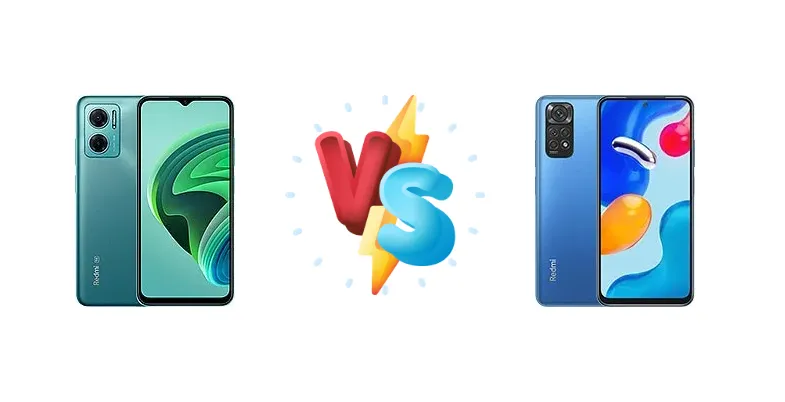
The Xiaomi Redmi Note series consistently delivers excellent value, but choosing between models can be tricky. Today, we're pitting the Redmi Note 11E against the Redmi Note 11S to see which phone offers the best bang for your buck. We'll break down everything from display quality to performance and battery life.
🏆 Quick Verdict
The Redmi Note 11S emerges as the clear winner thanks to its faster charging, brighter display, and generally more refined features. While the 11E offers a decent experience, the 11S provides a more premium feel and better overall performance for a slight price increase.
| Network |
|---|
| 2G bands | GSM 850 / 900 / 1800 / 1900 | GSM 850 / 900 / 1800 / 1900 |
| 3G bands | HSDPA 850 / 900 / 1900 / 2100 | HSDPA 850 / 900 / 1700(AWS) / 1900 / 2100 |
| 4G bands | 1, 3, 5, 7, 8, 34, 38, 39, 40, 41 | 1, 2, 3, 4, 5, 7, 8, 20, 28, 38, 40, 41 |
| 5G bands | 1, 5, 8, 28, 41, 78 SA/NSA | - |
| Speed | HSPA, LTE, 5G | HSPA, LTE |
| Technology | GSM / CDMA / HSPA / EVDO / LTE / 5G | GSM / HSPA / LTE |
| | CDMA2000 1xEV-DO | - |
| Launch |
|---|
| Announced | 2022, March 02 | 2022, January 26 |
| Status | Available. Released 2022, March 18 | Available. Released 2022, February 09 |
| Body |
|---|
| Build | - | Glass front (Gorilla Glass 3), plastic frame, glass back |
| Dimensions | 164 x 76.1 x 8.9 mm (6.46 x 3.00 x 0.35 in) | 159.9 x 73.9 x 8.1 mm (6.30 x 2.91 x 0.32 in) |
| SIM | Nano-SIM + Nano-SIM | Nano-SIM + Nano-SIM |
| Weight | 200 g (7.05 oz) | 179 g (6.31 oz) |
| | - | IP53, dust and splash resistant |
| Display |
|---|
| Protection | - | Corning Gorilla Glass 3 |
| Resolution | 1080 x 2408 pixels, 20:9 ratio (~401 ppi density) | 1080 x 2400 pixels, 20:9 ratio (~409 ppi density) |
| Size | 6.58 inches, 104.3 cm2 (~83.6% screen-to-body ratio) | 6.43 inches, 99.8 cm2 (~84.5% screen-to-body ratio) |
| Type | IPS LCD, 90Hz | AMOLED, 90Hz, 700 nits, 1000 nits (peak) |
| Platform |
|---|
| CPU | Octa-core (2x2.2 GHz Cortex-A76 & 6x2.0 GHz Cortex-A55) | Octa-core (2x2.05 GHz Cortex-A76 & 6x2.0 GHz Cortex-A55) |
| Chipset | Mediatek Dimensity 700 (7 nm) | Mediatek MT6781 Helio G96 (12 nm) |
| GPU | Mali-G57 MC2 | Mali-G57 MC2 |
| OS | Android 11, MIUI 13 | Android 11, MIUI 13 |
| Memory |
|---|
| Card slot | No | microSDXC (dedicated slot) |
| Internal | 128GB 4GB RAM, 128GB 6GB RAM | 64GB 6GB RAM, 128GB 6GB RAM, 128GB 8GB RAM |
| | UFS 2.2 | UFS 2.2 |
| Main Camera |
|---|
| Dual | 50 MP, f/1.8, (wide), PDAF
Auxiliary lens | - |
| Features | LED flash, HDR, panorama | LED flash, HDR, panorama |
| Quad | - | 108 MP, f/1.9, 26mm (wide), 1/1.52", 0.7µm, PDAF
8 MP, f/2.2, 118˚ (ultrawide)
2 MP (macro)
Auxiliary lens |
| Single | 5 MP | - |
| Video | 1080p@30fps | 1080p@30fps |
| Selfie camera |
|---|
| Features | HDR | - |
| Single | 5 MP | 16 MP, f/2.5, (wide), 1/3.06" 1.0µm |
| Video | 1080p@30fps | 1080p@30fps |
| Sound |
|---|
| 3.5mm jack | Yes | Yes |
| 35mm jack | Yes | Yes |
| Loudspeaker | Yes | Yes, with stereo speakers |
| | 24-bit/192kHz audio | 24-bit/192kHz audio |
| Comms |
|---|
| Bluetooth | 5.1, A2DP, LE | 5.0, A2DP, LE |
| Infrared port | Yes | Yes |
| NFC | No | Yes (market/region dependent) |
| Positioning | GPS, GLONASS, BDS, GALILEO | GPS, GLONASS, BDS, GALILEO |
| Radio | No | FM radio |
| USB | USB Type-C 2.0, OTG | USB Type-C 2.0, OTG |
| WLAN | Wi-Fi 802.11 a/b/g/n/ac, dual-band, Wi-Fi Direct | Wi-Fi 802.11 a/b/g/n/ac, dual-band, Wi-Fi Direct |
| Features |
|---|
| Sensors | Fingerprint (side-mounted), accelerometer, proximity, compass | Fingerprint (side-mounted), accelerometer, gyro, compass |
| | - | Virtual proximity sensing |
| Battery |
|---|
| Charging | 18W wired | 33W wired, PD3.0, QC3, 100% in 58 min |
| Type | Li-Po 5000 mAh | Li-Po 5000 mAh |
| Misc |
|---|
| Colors | Gray, Silver, Atlantic Blue | Graphite Gray, Pearl White, Twilight Blue |
| Models | 22041219C | 2201117SG, 2201117SI, 2201117SY, 2201117SL |
| Price | About 170 EUR | € 136.99 |
| SAR | - | 1.09 W/kg (head) 1.05 W/kg (body) |
| SAR EU | - | 0.59 W/kg (head) 0.88 W/kg (body) |
| Tests |
|---|
| Battery life | - |
Endurance rating 133h
|
| Camera | - |
Photo / Video |
| Display | - |
Contrast ratio: Infinite (nominal) |
| Loudspeaker | - |
-25.4 LUFS (Very good)
|
| Performance | - |
AnTuTu: 251201 (v8), 308741 (v9)
GeekBench: 1873 (v5.1)
GFXBench: 12fps (ES 3.1 onscreen) |
Xiaomi Redmi Note 11E
- More affordable
- Decent performance for basic tasks
- Good battery life (133h endurance)
- Slower charging (18W)
- Less bright display
- Potentially less capable camera
Xiaomi Redmi Note 11S
- Faster charging (33W)
- Brighter and more vibrant display
- Better performance (Helio G96)
- Likely better camera system
- Slightly more expensive
- 12nm process (less efficient than 7nm)
Display Comparison
The Redmi Note 11S boasts a significantly brighter display, measured at 744 nits, compared to the 11E. While both offer a similar resolution and panel type (likely AMOLED for both), the 11S's higher brightness makes it more visible in direct sunlight and offers a more vibrant viewing experience. The 'infinite' contrast ratio mentioned for the 11S is a nominal value, but generally indicates good contrast.
Camera Comparison
While both phones are listed as having 'Photo / Video' capabilities, the Redmi Note 11S is generally expected to have a more versatile and higher-quality camera system. The 11S often includes a higher resolution main sensor and potentially additional lenses (like a macro or depth sensor) not found on the 11E. Image processing and low-light performance are also likely to be better on the 11S.
Performance
The Redmi Note 11E's Dimensity 700 chipset is a capable performer for everyday tasks, but the Redmi Note 11S's Helio G96 offers a noticeable performance boost. The G96 generally handles gaming and multitasking slightly better. Both phones feature octa-core CPUs with similar core configurations, but the G96's architecture and slightly higher clock speeds give it an edge.
Battery Life
Both phones share an endurance rating of 133h, suggesting comparable battery life under typical usage. However, the Redmi Note 11S's 33W fast charging is a significant advantage over the 11E's 18W charging. This means the 11S can be fully charged in approximately 58 minutes, while the 11E will take considerably longer.
Buying Guide
Who should buy the Xiaomi Redmi Note 11E? It's a good option for users on a very tight budget who prioritize basic functionality and don't need the extra features of the 11S. Who should buy the Xiaomi Redmi Note 11S? It's ideal for those seeking a better display, faster charging, and a slightly more powerful chipset without breaking the bank.
Frequently Asked Questions
❓ Is the Redmi Note 11E good for gaming?
The Redmi Note 11E can handle casual games, but demanding titles may experience lag or reduced frame rates. The Redmi Note 11S is a better choice for more intensive gaming.
❓ What is the difference in camera quality between the two phones?
The Redmi Note 11S generally offers better camera quality with a higher resolution main sensor and potentially additional lenses. Expect improved image processing and low-light performance on the 11S.