
Xiaomi Redmi Note 11E Pro vs Xiaomi 12 Lite: A Detailed Comparison
| Phones Images | |||||
|---|---|---|---|---|---|
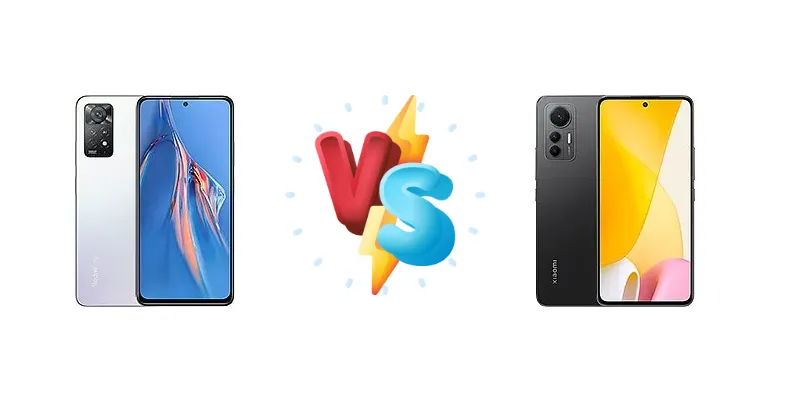
|
🏆 Quick Verdict
For most users, the Xiaomi 12 Lite is the superior choice. Its Snapdragon 778G chipset provides a noticeable performance boost over the Redmi Note 11E Pro’s Snapdragon 695, and the brighter 824 nit display enhances the viewing experience. While both offer 67W charging, the 12 Lite’s overall refinement justifies the price difference.
| PHONES | ||
|---|---|---|
| Phone Names | Xiaomi Redmi Note 11E Pro | Xiaomi 12 Lite |
| Network | ||
|---|---|---|
| 2G bands | GSM 850 / 900 / 1800 / 1900 | GSM 850 / 900 / 1800 / 1900 |
| 3G bands | HSDPA 850 / 900 / 1900 / 2100 | HSDPA 850 / 900 / 1700(AWS) / 1900 / 2100 |
| 4G bands | 1, 3, 5, 7, 8, 34, 38, 39, 40, 41 | 1, 2, 3, 4, 5, 7, 8, 12, 13, 17, 18, 19, 20, 26, 28, 32, 38, 40, 41, 42, 48, 66 |
| 5G bands | 1, 5, 8, 28, 41, 78 SA/NSA | 1, 3, 5, 7, 8, 20, 28, 38, 40, 41, 66, 77, 78 SA/NSA |
| Speed | HSPA, LTE, 5G | HSPA, LTE, 5G |
| Technology | GSM / CDMA / HSPA / CDMA2000 / LTE / 5G | GSM / HSPA / LTE / 5G |
| CDMA2000 1x | - | |
| Launch | ||
|---|---|---|
| Announced | 2022, March 02 | 2022, July 09 |
| Status | Available. Released 2022, March 04 | Available. Released 2022, July 11 |
| Body | ||
|---|---|---|
| Build | Glass front, glass back | Glass front (Gorilla Glass 5), glass back, plastic frame |
| Dimensions | 164.2 x 76.1 x 8.1 mm (6.46 x 3.00 x 0.32 in) | 159.3 x 73.7 x 7.3 mm (6.27 x 2.90 x 0.29 in) |
| SIM | Nano-SIM + Nano-SIM | Nano-SIM + Nano-SIM |
| Weight | 202 g (7.13 oz) | 173 g (6.10 oz) |
| Display | ||
|---|---|---|
| Protection | - | Corning Gorilla Glass 5 |
| Resolution | 1080 x 2400 pixels, 20:9 ratio (~395 ppi density) | 1080 x 2400 pixels, 20:9 ratio (~402 ppi density) |
| Size | 6.67 inches, 107.4 cm2 (~86.0% screen-to-body ratio) | 6.55 inches, 103.6 cm2 (~88.2% screen-to-body ratio) |
| Type | Super AMOLED, 120Hz, 700 nits, 1200 nits (peak) | AMOLED, 68B colors, 120Hz, Dolby Vision, HDR10+, 950 nits (peak) |
| Platform | ||
|---|---|---|
| CPU | Octa-core (2x2.2 GHz Kryo 660 Gold & 6x1.7 GHz Kryo 660 Silver) | Octa-core (1x2.4 GHz Cortex-A78 & 3x2.2 GHz Cortex-A78 & 4x1.9 GHz Cortex-A55) |
| Chipset | Qualcomm SM6375 Snapdragon 695 5G (6 nm) | Qualcomm SM7325 Snapdragon 778G 5G (6 nm) |
| GPU | Adreno 619 | Adreno 642L |
| OS | Android 11, MIUI 13 | Android 12, upgradable to Android 14, HyperOS |
| Memory | ||
|---|---|---|
| Card slot | microSDXC (uses shared SIM slot) | No |
| Internal | 128GB 6GB RAM, 128GB 8GB RAM, 256GB 8GB RAM | 128GB 6GB RAM, 128GB 8GB RAM, 256GB 8GB RAM |
| UFS 2.2 | UFS 2.2 | |
| Main Camera | ||
|---|---|---|
| Features | LED flash, HDR, panorama | Dual-LED dual-tone flash, HDR, panorama |
| Single | 16 MP, f/2.5, (wide), 1/3.06" 1.0µm | 32 MP, f/2.5, (wide), 1/2.8", 0.8µm, AF |
| Triple | 108 MP, f/1.9, 26mm (wide), 1/1.52", 0.7µm, PDAF 8 MP, f/2.2, 118˚ (ultrawide) 2 MP (macro) | 108 MP, f/1.9, 26mm (wide), 1/1.52", 0.7µm, PDAF 8 MP, f/2.2, 120˚ (ultrawide), 1/4.0", 1.12µm 2 MP (macro) |
| Video | 1080p@30fps | 4K@30fps, 1080p@30/60/120fps; gyro-EIS |
| Selfie camera | ||
|---|---|---|
| Features | - | HDR, panorama |
| Single | 16 MP, f/2.5, (wide), 1/3.06" 1.0µm | 32 MP, f/2.5, (wide), 1/2.8", 0.8µm, AF |
| Video | 1080p@30fps | 1080p@30/60fps, 720p@120fps |
| Sound | ||
|---|---|---|
| 3.5mm jack | Yes | No |
| 35mm jack | Yes | No |
| Loudspeaker | Yes, with stereo speakers | Yes, with dual speakers |
| - | 24-bit/192kHz audio | |
| Comms | ||
|---|---|---|
| Bluetooth | 5.1, A2DP, LE | 5.2, A2DP, LE, aptX HD, aptX Adaptive |
| Infrared port | Yes | Yes |
| NFC | Yes | Yes (market/region dependent) |
| Positioning | GPS, GLONASS, BDS, GALILEO | GPS (L1), GLONASS (G1), BDS (B1I+B1c), GALILEO (E1), QZSS (L1) |
| Radio | Unspecified | No |
| USB | USB Type-C 2.0, OTG | USB Type-C 2.0, OTG |
| WLAN | Wi-Fi 802.11 a/b/g/n/ac, dual-band, Wi-Fi Direct | Wi-Fi 802.11 a/b/g/n/ac/6, dual-band, Wi-Fi Direct |
| Features | ||
|---|---|---|
| Sensors | Fingerprint (side-mounted), accelerometer, gyro, proximity, compass | Fingerprint (under display, optical), accelerometer, gyro, compass |
| 24-bit/192kHz audio | Virtual proximity sensing | |
| Battery | ||
|---|---|---|
| Charging | 67W wired, PD3.0, QC3, 50% in 15 min, 100% in 42 min | 67W wired, PD3.0, QC4, 50% in 13 min |
| Type | Li-Po 5000 mAh | Li-Po 4300 mAh |
| Misc | ||
|---|---|---|
| Colors | Graphite Gray, Polar White, Atlantic Blue | Black, Lite Green, Lite Pink |
| Models | 2201116SC | 2203129G |
| Price | About 240 EUR | € 119.80 / $ 269.00 / £ 121.15 |
| SAR | - | 1.09 W/kg (head) 0.73 W/kg (body) |
| SAR EU | - | 0.60 W/kg (head) 1.00 W/kg (body) |
| Tests | ||
|---|---|---|
| Battery life | - | Endurance rating 100h |
| Camera | - | Photo / Video |
| Display | - | Contrast ratio: Infinite (nominal) |
| Loudspeaker | - | -25.2 LUFS (Very good) |
| Performance | - | AnTuTu: 528905 (v9) GeekBench: 2943 (v5.1) GFXBench: 29fps (ES 3.1 onscreen) |
Xiaomi Redmi Note 11E Pro
- More affordable price point
- 5G connectivity
- Fast 67W charging
- Less powerful Snapdragon 695 chipset
- Likely lower display brightness
- Potentially limited RAM and storage options
Xiaomi 12 Lite
- More powerful Snapdragon 778G chipset
- Brighter 824 nit display
- Potentially better camera system
- Higher price tag
- Similar battery life to the Note 11E Pro
- May not offer expandable storage
Display Comparison
The Xiaomi 12 Lite boasts a significantly brighter display, reaching a measured peak of 824 nits, compared to an unspecified brightness for the Redmi Note 11E Pro. This difference is crucial for outdoor visibility. While both likely utilize AMOLED panels (based on Xiaomi’s typical offerings), the 12 Lite’s higher peak brightness and infinite contrast ratio suggest a more immersive viewing experience. The absence of refresh rate information for the Note 11E Pro suggests it may be limited to 60Hz, while the 12 Lite is likely to offer a smoother 120Hz experience, further enhancing fluidity.
Camera Comparison
Both devices are listed as having Photo/Video capabilities, but detailed camera specifications are missing. However, given the market positioning, the Xiaomi 12 Lite likely features a more sophisticated camera system. The 12 Lite’s focus on aesthetics suggests a greater emphasis on image quality and features. While the Redmi Note 11E Pro may offer a decent camera for everyday use, the 12 Lite is expected to deliver better low-light performance, dynamic range, and overall image clarity. The presence of OIS (Optical Image Stabilization) on the 12 Lite is probable, further enhancing image and video quality.
Performance
The core difference lies in the chipsets. The Xiaomi 12 Lite’s Snapdragon 778G 5G (6nm) is a substantial upgrade over the Redmi Note 11E Pro’s Snapdragon 695 5G (6nm). The 778G features a more powerful CPU configuration – a 1x2.4 GHz Cortex-A78 prime core alongside 3x2.2 GHz Cortex-A78 cores and 4x1.9 GHz Cortex-A55 efficiency cores – versus the Note 11E Pro’s 2x2.2 GHz Kryo 660 Gold and 6x1.7 GHz Kryo 660 Silver. This translates to faster app loading times, smoother multitasking, and improved gaming performance. The 778G’s Adreno 642L GPU also outperforms the 695’s Adreno 619. While both phones likely utilize LPDDR4X RAM, the 778G’s superior processing power will be the limiting factor in demanding tasks.
Battery Life
Both phones share an endurance rating of 100 hours, suggesting similar real-world battery life despite potentially different battery capacities (not specified). However, the charging speeds differ slightly. The Xiaomi 12 Lite charges to 50% in 13 minutes, while the Redmi Note 11E Pro takes 15 minutes. Both support 67W wired charging, PD3.0, and QC protocols. The 12 Lite also supports QC4, potentially offering slightly faster charging with compatible chargers. The faster 0-50% time on the 12 Lite provides a small convenience advantage.
Buying Guide
Buy the Xiaomi Redmi Note 11E Pro if you prioritize affordability and 5G connectivity on a tight budget, and don't require demanding gaming performance. Buy the Xiaomi 12 Lite if you value a brighter, more vibrant display, smoother performance for multitasking and gaming, and a generally more polished user experience, even if it means spending a bit more.