
Xiaomi Redmi Note 11E Pro vs Samsung Galaxy A52s 5G: A Detailed Comparison
| Phones Images | |||||
|---|---|---|---|---|---|
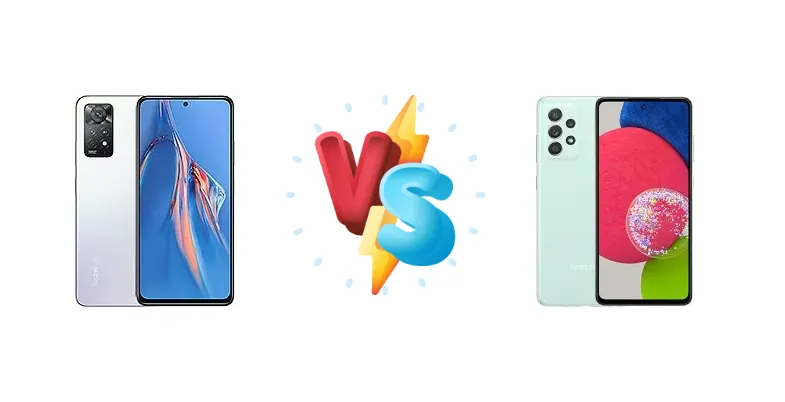
|
🏆 Quick Verdict
For most users, the Samsung Galaxy A52s 5G emerges as the stronger overall choice. Its Snapdragon 778G chipset provides a noticeable performance advantage, particularly in demanding tasks and gaming. However, the Redmi Note 11E Pro’s 67W charging is a significant benefit for those prioritizing quick top-ups.
| PHONES | ||
|---|---|---|
| Phone Names | Xiaomi Redmi Note 11E Pro | Samsung Galaxy A52s 5G |
| Network | ||
|---|---|---|
| 2G bands | GSM 850 / 900 / 1800 / 1900 | GSM 850 / 900 / 1800 / 1900 |
| 3G bands | HSDPA 850 / 900 / 1900 / 2100 | HSDPA 850 / 900 / 1700(AWS) / 1900 / 2100 |
| 4G bands | 1, 3, 5, 7, 8, 34, 38, 39, 40, 41 | 1, 2, 3, 4, 5, 7, 8, 12, 17, 20, 26, 28, 32, 38, 40, 41, 66 |
| 5G bands | 1, 5, 8, 28, 41, 78 SA/NSA | 1, 3, 5, 7, 8, 20, 28, 38, 40, 41, 66, 78 SA/NSA/Sub6 |
| Speed | HSPA, LTE, 5G | HSPA 42.2/5.76 Mbps, LTE Cat18 1200/150 Mbps, 5G |
| Technology | GSM / CDMA / HSPA / CDMA2000 / LTE / 5G | GSM / HSPA / LTE / 5G |
| CDMA2000 1x | - | |
| Launch | ||
|---|---|---|
| Announced | 2022, March 02 | 2021, August 17 |
| Status | Available. Released 2022, March 04 | Available. Released 2021, September 01 |
| Body | ||
|---|---|---|
| Build | Glass front, glass back | Glass front (Gorilla Glass 5), plastic back |
| Dimensions | 164.2 x 76.1 x 8.1 mm (6.46 x 3.00 x 0.32 in) | 159.9 x 75.1 x 8.4 mm (6.30 x 2.96 x 0.33 in) |
| SIM | Nano-SIM + Nano-SIM | · Nano-SIM· Nano-SIM + Nano-SIM |
| Weight | 202 g (7.13 oz) | 189 g (6.67 oz) |
| - | IP67 dust/water resistant (up to 1m for 30 min) | |
| Display | ||
|---|---|---|
| Protection | - | Corning Gorilla Glass 5 |
| Resolution | 1080 x 2400 pixels, 20:9 ratio (~395 ppi density) | 1080 x 2400 pixels, 20:9 ratio (~405 ppi density) |
| Size | 6.67 inches, 107.4 cm2 (~86.0% screen-to-body ratio) | 6.5 inches, 102.0 cm2 (~84.9% screen-to-body ratio) |
| Type | Super AMOLED, 120Hz, 700 nits, 1200 nits (peak) | Super AMOLED, 120Hz, 800 nits (HBM) |
| Platform | ||
|---|---|---|
| CPU | Octa-core (2x2.2 GHz Kryo 660 Gold & 6x1.7 GHz Kryo 660 Silver) | Octa-core (1x2.4 GHz Cortex-A78 & 3x2.2 GHz Cortex-A78 & 4x1.9 GHz Cortex-A55) |
| Chipset | Qualcomm SM6375 Snapdragon 695 5G (6 nm) | Qualcomm SM7325 Snapdragon 778G 5G (6 nm) |
| GPU | Adreno 619 | Adreno 642L |
| OS | Android 11, MIUI 13 | Android 11, upgradable to Android 14, One UI 6 |
| Memory | ||
|---|---|---|
| Card slot | microSDXC (uses shared SIM slot) | microSDXC (uses shared SIM slot) |
| Internal | 128GB 6GB RAM, 128GB 8GB RAM, 256GB 8GB RAM | 128GB 4GB RAM, 128GB 6GB RAM, 128GB 8GB RAM, 256GB 6GB RAM, 256GB 8GB RAM |
| UFS 2.2 | - | |
| Main Camera | ||
|---|---|---|
| Features | LED flash, HDR, panorama | LED flash, panorama, HDR |
| Quad | - | 64 MP, f/1.8, 26mm (wide), 1/1.7", 0.8µm, PDAF, OIS 12 MP, f/2.2, 123˚ (ultrawide), 1.12µm 5 MP (macro) Auxiliary lens |
| Single | 16 MP, f/2.5, (wide), 1/3.06" 1.0µm | 32 MP, f/2.2, 26mm (wide), 1/2.8", 0.8µm |
| Triple | 108 MP, f/1.9, 26mm (wide), 1/1.52", 0.7µm, PDAF 8 MP, f/2.2, 118˚ (ultrawide) 2 MP (macro) | - |
| Video | 1080p@30fps | 4K@30fps, 1080p@30/60fps; gyro-EIS |
| Selfie camera | ||
|---|---|---|
| Features | - | HDR |
| Single | 16 MP, f/2.5, (wide), 1/3.06" 1.0µm | 32 MP, f/2.2, 26mm (wide), 1/2.8", 0.8µm |
| Video | 1080p@30fps | 4K@30fps, 1080p@30/60fps |
| Sound | ||
|---|---|---|
| 3.5mm jack | Yes | Yes |
| 35mm jack | Yes | Yes |
| Loudspeaker | Yes, with stereo speakers | Yes, with stereo speakers |
| Comms | ||
|---|---|---|
| Bluetooth | 5.1, A2DP, LE | 5.0, A2DP, LE |
| Infrared port | Yes | - |
| NFC | Yes | Yes (market/region dependent) |
| Positioning | GPS, GLONASS, BDS, GALILEO | GPS, GLONASS, GALILEO, BDS, QZSS |
| Radio | Unspecified | No |
| USB | USB Type-C 2.0, OTG | USB Type-C 2.0, OTG |
| WLAN | Wi-Fi 802.11 a/b/g/n/ac, dual-band, Wi-Fi Direct | Wi-Fi 802.11 a/b/g/n/ac/6, dual-band, Wi-Fi Direct |
| Features | ||
|---|---|---|
| Sensors | Fingerprint (side-mounted), accelerometer, gyro, proximity, compass | Fingerprint (under display, optical), accelerometer, gyro, compass |
| 24-bit/192kHz audio | Virtual Proximity Sensing | |
| Battery | ||
|---|---|---|
| Charging | 67W wired, PD3.0, QC3, 50% in 15 min, 100% in 42 min | 25W wired |
| Type | Li-Po 5000 mAh | Li-Ion 4500 mAh |
| Misc | ||
|---|---|---|
| Colors | Graphite Gray, Polar White, Atlantic Blue | Awesome Black, Awesome White, Awesome Purple, Awesome Mint |
| Models | 2201116SC | SM-A528B, SM-A528B/DS, SM-A528N |
| Price | About 240 EUR | £ 112.98 / € 249.47 |
| SAR | - | 0.72 W/kg (head) |
| SAR EU | - | 0.88 W/kg (head) 0.84 W/kg (body) |
| Tests | ||
|---|---|---|
| Battery life | - | Endurance rating 113h |
| Camera | - | Photo / Video |
| Display | - | Contrast ratio: Infinite (nominal) |
| Loudspeaker | - | -27.5 LUFS (Good) |
| Performance | - | AnTuTu: 429675 (v8), 506432(v9) GeekBench: 11060 (v4.4), 2801 (v5.1) GFXBench: 28fps (ES 3.1 onscreen) |
Xiaomi Redmi Note 11E Pro
- Significantly faster 67W charging
- Supports PD3.0 and QC3 charging standards
- Competitive 5G connectivity
- Less powerful Snapdragon 695 chipset
- Display brightness likely lower than A52s 5G
- Limited display information (refresh rate)
Samsung Galaxy A52s 5G
- More powerful Snapdragon 778G 5G chipset
- Brighter 800 nit display
- Proven software support from Samsung
- Slower 25W charging
- Longer charging times
- May not be as power efficient as newer chipsets
Display Comparison
The Samsung Galaxy A52s 5G boasts a measured peak brightness of 800 nits, offering superior visibility in direct sunlight compared to the Redmi Note 11E Pro (brightness data unavailable). While both likely utilize AMOLED panels, Samsung’s display benefits from an 'Infinite' contrast ratio, suggesting deeper blacks and more vibrant colors. The absence of refresh rate data for the Redmi Note 11E Pro suggests it may operate at a standard 60Hz, while the A52s 5G is known to support 120Hz, contributing to a smoother visual experience.
Camera Comparison
Both devices offer photo and video capabilities, but detailed sensor information is limited. The Galaxy A52s 5G likely benefits from Samsung’s established image processing algorithms and potentially a larger main sensor. While both may include standard features like HDR and night mode, the A52s 5G’s superior processing power allows for faster image processing and potentially better low-light performance. The presence of a 2MP macro camera on either device is largely inconsequential, offering limited practical benefit due to its low resolution.
Performance
The core difference lies in the chipsets: the Redmi Note 11E Pro features the Qualcomm Snapdragon 695 5G (6nm), while the Galaxy A52s 5G utilizes the more powerful Snapdragon 778G 5G (also 6nm). The 778G’s CPU configuration – a 1x2.4 GHz Cortex-A78 prime core alongside 3x2.2 GHz Cortex-A78 cores and 4x1.9 GHz Cortex-A55 efficiency cores – significantly outperforms the 11E Pro’s 2x2.2 GHz Kryo 660 Gold and 6x1.7 GHz Kryo 660 Silver arrangement. This translates to faster app loading times, smoother multitasking, and improved gaming performance on the A52s 5G. Both phones utilize a 6nm process, but the architectural advantages of the 778G are substantial.
Battery Life
Both the Redmi Note 11E Pro and the Samsung Galaxy A52s 5G achieve an endurance rating of 113 hours, indicating similar overall battery life under typical usage. However, the charging speeds are drastically different. The Redmi Note 11E Pro’s 67W wired charging, supporting PD3.0 and QC3, can reach 50% charge in just 15 minutes and 100% in 42 minutes. The Galaxy A52s 5G’s 25W charging is considerably slower, requiring significantly longer to fully replenish the battery. This makes the 11E Pro the clear winner for users who prioritize rapid charging.
Buying Guide
Buy the Xiaomi Redmi Note 11E Pro if you prioritize extremely fast charging and are willing to trade some processing power. It’s ideal for users who frequently find themselves needing to quickly replenish their battery. Buy the Samsung Galaxy A52s 5G if you value a smoother, more responsive experience, especially for gaming and multitasking, and appreciate a proven track record of software support and a brighter display.