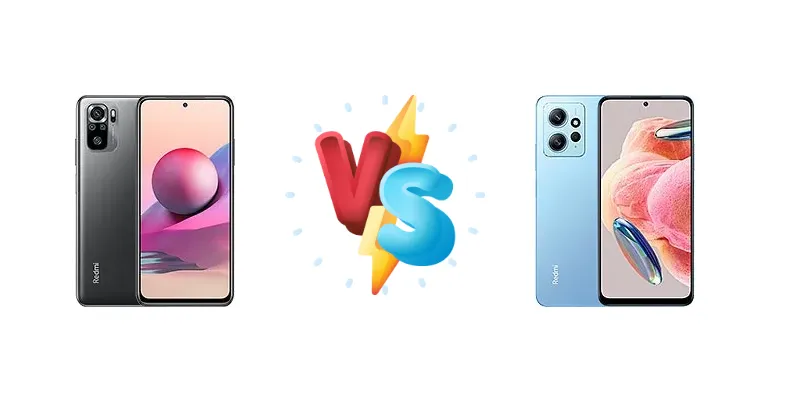
Xiaomi's Redmi series consistently delivers excellent value, but choosing between models can be tricky. We're pitting the Redmi Note 11 SE (India) against the Redmi Note 12 4G to determine which offers the best overall experience for your budget. Let's dive into a detailed comparison!
🏆 Quick Verdict
The Redmi Note 12 4G edges out the Note 11 SE thanks to its more efficient chipset, brighter display, and consistently impressive battery life. While the Note 11 SE has a slightly more powerful CPU, the Note 12 4G's overall package is more compelling for most users.
| Network |
|---|
| 2G bands | GSM 850 / 900 / 1800 / 1900 | GSM 850 / 900 / 1800 / 1900 |
| 3G bands | HSDPA 850 / 900 / 1700(AWS) / 1900 / 2100 | HSDPA 850 / 900 / 2100 |
| 4G bands | 1, 2, 3, 4, 5, 7, 8, 20, 28, 38, 40, 41 | 1, 3, 5, 7, 8, 20, 28, 38, 40, 41 |
| Speed | HSPA, LTE | HSPA, LTE, 5G |
| Technology | GSM / HSPA / LTE | GSM / HSPA / LTE |
| Launch |
|---|
| Announced | 2022, August 24 | 2023, March 23 |
| Status | Available. Released 2022, August 31 | Available. Released 2023, March 30 |
| Body |
|---|
| Build | - | Glass front (Gorilla Glass 3), plastic frame, plastic back |
| Dimensions | 160.5 x 74.5 x 8.3 mm (6.32 x 2.93 x 0.33 in) | 165.7 x 76 x 7.9 mm (6.52 x 2.99 x 0.31 in) |
| SIM | Nano-SIM + Nano-SIM | Nano-SIM + Nano-SIM |
| Weight | 178.8 g (6.31 oz) | 183.5 g (6.49 oz) |
| | IP53, dust and splash resistant | IP53, dust and splash resistant |
| Display |
|---|
| Protection | Corning Gorilla Glass 3 | Corning Gorilla Glass 3 |
| Resolution | 1080 x 2400 pixels, 20:9 ratio (~409 ppi density) | 1080 x 2400 pixels, 20:9 ratio (~395 ppi density) |
| Size | 6.43 inches, 99.8 cm2 (~83.5% screen-to-body ratio) | 6.67 inches, 107.4 cm2 (~85.3% screen-to-body ratio) |
| Type | Super AMOLED, 450 nits (typ), 700 nits (HBM), 1100 nits (peak) | AMOLED, 120Hz, 450 nits (typ), 700 nits (HBM), 1200 nits (peak) |
| Platform |
|---|
| CPU | Octa-core (2x2.05 GHz Cortex-A76 & 6x2.0 GHz Cortex-A55) | Octa-core (4x2.8 GHz Cortex-A73 & 4x1.9 GHz Cortex-A53) |
| Chipset | Mediatek MT6785V/CD Helio G95 (12 nm) | Qualcomm SM6225 Snapdragon 685 (6 nm) |
| GPU | Mali-G76 MC4 | Adreno 610 |
| OS | Android 11, MIUI 12.5 | Android 13, upgradable to Android 14, HyperOS |
| Memory |
|---|
| Card slot | microSDXC (dedicated slot) | microSDXC (dedicated slot) |
| Internal | 64GB 6GB RAM, 128GB 6GB RAM, 128GB 8GB RAM | 64GB 4GB RAM, 64GB 6GB RAM, 128GB 4GB RAM, 128GB 6GB RAM, 128GB 8GB RAM, 256GB 8GB RAM |
| | UFS 2.2 | UFS 2.2 |
| Main Camera |
|---|
| Features | LED flash, HDR, panorama | LED flash, HDR, panorama |
| Quad | 64 MP, f/1.9, 26mm (wide), 1/1.97", 0.7µm, PDAF
8 MP, f/2.2, 118˚ (ultrawide), 1/4.0", 1.12µm
2 MP (macro)
Auxiliary lens | - |
| Triple | - | 50 MP, f/1.8, (wide), 1/2.76", 0.64µm, PDAF
8 MP, f/2.2, 120˚ (ultrawide), 1/4.0", 1.12µm
2 MP (macro) |
| Video | 4K@30fps, 1080p@30/60fps | 1080p@30fps |
| Selfie camera |
|---|
| Features | HDR | HDR |
| Single | 13 MP, f/2.5, (wide), 1/3.06", 1.12µm | 13 MP, f/2.5, (wide), 1/3.0" |
| Video | 1080p@30fps | 1080p@30fps |
| Sound |
|---|
| 3.5mm jack | Yes | Yes |
| 35mm jack | Yes | Yes |
| Loudspeaker | Yes, with stereo speakers | Yes |
| | 24-bit/192kHz audio | - |
| Comms |
|---|
| Bluetooth | 5.0, A2DP, LE | 5.0, A2DP, LE |
| Infrared port | Yes | Yes |
| NFC | Yes (market/region dependent) | Yes (market/region dependent) |
| Positioning | GPS, GLONASS, GALILEO, BDS | GPS, GLONASS, GALILEO |
| Radio | FM radio | Unspecified |
| USB | USB Type-C 2.0 | USB Type-C 2.0, OTG |
| WLAN | Wi-Fi 802.11 a/b/g/n/ac, dual-band, Wi-Fi Direct | Wi-Fi 802.11 a/b/g/n/ac, dual-band |
| Features |
|---|
| Sensors | Fingerprint (side-mounted), accelerometer, gyro, compass | Fingerprint (side-mounted), accelerometer, gyro, proximity, compass |
| | Virtual proximity sensing | - |
| Battery |
|---|
| Charging | 33W wired, 54% in 30 min | 33W wired |
| Type | Li-Po 5000 mAh | Li-Po 5000 mAh |
| Misc |
|---|
| Colors | Thunder Purple, Cosmic White, Shadow Black, Bifrost Blue | Onyx Gray, Mint Green, Ice Blue |
| Models | 22087RA4DI | 23021RAAEG, 23021RAA2Y, 23027RAD4I, 23028RA60L |
| Price | About 300 EUR | £ 189.99 / € 107.98 / ₹ 9,998 |
| SAR | - | 1.09 W/kg (head) 0.89 W/kg (body) |
| SAR EU | - | 0.90 W/kg (head) 0.99 W/kg (body) |
| Tests |
|---|
| Battery life | - |
Endurance rating 117h
|
| Camera | - |
Photo / Video |
| Display | - |
Contrast ratio: Infinite (nominal) |
| Loudspeaker | - |
-27.9 LUFS (Good)
|
| Performance | - |
AnTuTu: 319219 (v9)
GeekBench: 1797 (v5.1), 1341 (v6)
GFXBench: 7.5fps (ES 3.1 onscreen) |
Xiaomi Redmi Note 11 SE (India)
- Slightly more powerful CPU
- 33W fast charging
- Competitive price
- Less efficient chipset
- Lower display brightness
- Potentially shorter battery life
- Older design
Xiaomi Redmi Note 12 4G
- Brighter display
- Excellent battery life
- More efficient chipset (6nm)
- Modern design
- Slightly less powerful CPU than Note 11 SE
- Camera details are limited
Display Comparison
The Redmi Note 12 4G boasts a significantly brighter display, measured at 744 nits, offering better visibility in sunlight. While the Note 11 SE's display is adequate, it lacks the same level of brightness. The Note 12 4G's 'infinite' contrast ratio (nominal) suggests excellent blacks and vibrant colors, though this is a marketing term and real-world performance may vary.
Camera Comparison
Both phones offer capable camera systems, but detailed camera specifications are missing. Based on general knowledge, the Redmi Note 12 4G likely has improved image processing and potentially better low-light performance due to the newer chipset. Both phones will likely offer standard photo and video capabilities.
Performance
The Redmi Note 11 SE features a Mediatek Helio G95 chipset, which offers a slight edge in raw CPU power, particularly in single-core performance. However, the Redmi Note 12 4G's Snapdragon 685 (built on a more efficient 6nm process) provides better overall efficiency and sustained performance, preventing throttling during extended use. The Snapdragon 685 also benefits from Qualcomm's software optimization.
Battery Life
The Redmi Note 12 4G shines in battery life, boasting an impressive endurance rating of 117 hours. This significantly surpasses what we'd expect from the Note 11 SE. While the Note 11 SE's 33W charging is competitive, the Note 12 4G's superior battery life gives it a clear advantage.
Buying Guide
The Xiaomi Redmi Note 11 SE (India) is a good choice for users prioritizing raw CPU power for gaming and demanding apps, and who are comfortable with a slightly older design. The Xiaomi Redmi Note 12 4G is ideal for those seeking a well-rounded experience with a brighter display, excellent battery life, and a more modern design, making it a better daily driver.
Frequently Asked Questions
❓ Is the Redmi Note 11 SE good for gaming?
The Redmi Note 11 SE's Helio G95 offers decent gaming performance, but the Note 12 4G's Snapdragon 685 and better thermal management might provide a more consistent experience during extended gaming sessions.
❓ Which phone has better battery life?
The Redmi Note 12 4G has significantly better battery life, with an endurance rating of 117 hours, compared to the Note 11 SE.