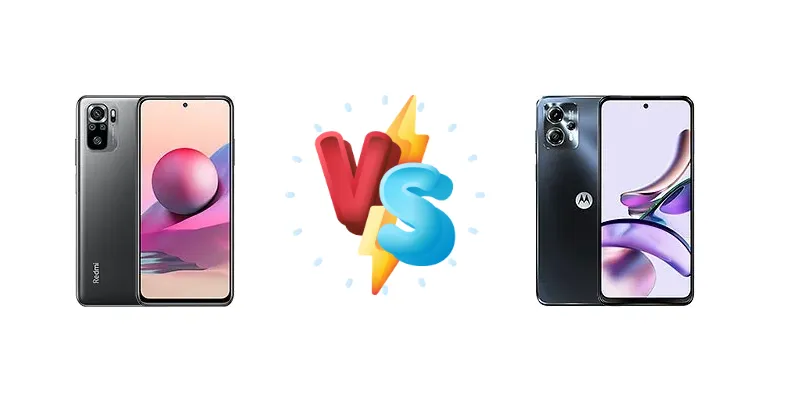
The budget smartphone market is fiercely competitive, and the Xiaomi Redmi Note 11 SE (India) and Motorola Moto G13 are two strong contenders. Both offer compelling features at affordable prices, but which one reigns supreme? This comprehensive comparison will break down their strengths and weaknesses to help you make an informed decision.
🏆 Quick Verdict
The Redmi Note 11 SE takes the lead thanks to its significantly faster Helio G95 chipset and faster charging. While the Moto G13 offers a clean software experience and potentially better software support, the Note 11 SE delivers a more powerful overall performance for the price.
| Network |
|---|
| 2G bands | GSM 850 / 900 / 1800 / 1900 | GSM 850 / 900 / 1800 / 1900 |
| 3G bands | HSDPA 850 / 900 / 1700(AWS) / 1900 / 2100 | HSDPA 850 / 900 / 1900 / 2100 |
| 4G bands | 1, 2, 3, 4, 5, 7, 8, 20, 28, 38, 40, 41 | 1, 2, 3, 5, 7, 8, 20, 38, 40, 41 |
| Speed | HSPA, LTE | HSPA, LTE |
| Technology | GSM / HSPA / LTE | GSM / HSPA / LTE |
| Launch |
|---|
| Announced | 2022, August 24 | 2023, January 24 |
| Status | Available. Released 2022, August 31 | Available. Released 2023, January 24 |
| Body |
|---|
| Build | - | Glass front, plastic frame, plastic back |
| Dimensions | 160.5 x 74.5 x 8.3 mm (6.32 x 2.93 x 0.33 in) | 162.7 x 74.7 x 8.2 mm (6.41 x 2.94 x 0.32 in) |
| SIM | Nano-SIM + Nano-SIM | · Nano-SIM· Nano-SIM + Nano-SIM |
| Weight | 178.8 g (6.31 oz) | 183.5 g (6.49 oz) |
| | IP53, dust and splash resistant | Water-resistant design |
| Display |
|---|
| Protection | Corning Gorilla Glass 3 | Panda glass |
| Resolution | 1080 x 2400 pixels, 20:9 ratio (~409 ppi density) | 720 x 1600 pixels, 20:9 ratio (~270 ppi density) |
| Size | 6.43 inches, 99.8 cm2 (~83.5% screen-to-body ratio) | 6.5 inches, 102.0 cm2 (~83.9% screen-to-body ratio) |
| Type | Super AMOLED, 450 nits (typ), 700 nits (HBM), 1100 nits (peak) | IPS LCD, 90Hz, 400 nits (peak) |
| Platform |
|---|
| CPU | Octa-core (2x2.05 GHz Cortex-A76 & 6x2.0 GHz Cortex-A55) | Octa-core (2x2.0 GHz Cortex-A75 & 6x1.8 GHz Cortex-A55) |
| Chipset | Mediatek MT6785V/CD Helio G95 (12 nm) | Mediatek MT6769Z Helio G85 (12 nm) |
| GPU | Mali-G76 MC4 | Mali-G52 MC2 |
| OS | Android 11, MIUI 12.5 | Android 13 |
| Memory |
|---|
| Card slot | microSDXC (dedicated slot) | microSDXC (dedicated slot) |
| Internal | 64GB 6GB RAM, 128GB 6GB RAM, 128GB 8GB RAM | 64GB 4GB RAM, 128GB 4GB RAM |
| | UFS 2.2 | - |
| Main Camera |
|---|
| Features | LED flash, HDR, panorama | LED flash, HDR, panorama |
| Quad | 64 MP, f/1.9, 26mm (wide), 1/1.97", 0.7µm, PDAF
8 MP, f/2.2, 118˚ (ultrawide), 1/4.0", 1.12µm
2 MP (macro)
Auxiliary lens | - |
| Triple | - | 50 MP, f/1.8, (wide), 0.64µm, PDAF
2 MP (macro)
Auxiliary lens |
| Video | 4K@30fps, 1080p@30/60fps | 1080p@30fps |
| Selfie camera |
|---|
| Features | HDR | - |
| Single | 13 MP, f/2.5, (wide), 1/3.06", 1.12µm | 8 MP, f/2.0, (wide), 1/4.0", 1.12µm |
| Video | 1080p@30fps | 1080p@30fps |
| Sound |
|---|
| 3.5mm jack | Yes | Yes |
| 35mm jack | Yes | Yes |
| Loudspeaker | Yes, with stereo speakers | Yes, with stereo speakers |
| | 24-bit/192kHz audio | - |
| Comms |
|---|
| Bluetooth | 5.0, A2DP, LE | 5.1, A2DP, LE |
| Infrared port | Yes | - |
| NFC | Yes (market/region dependent) | Yes (market/region dependent) |
| Positioning | GPS, GLONASS, GALILEO, BDS | GPS, GLONASS, GALILEO |
| Radio | FM radio | Unspecified |
| USB | USB Type-C 2.0 | USB Type-C 2.0 |
| WLAN | Wi-Fi 802.11 a/b/g/n/ac, dual-band, Wi-Fi Direct | Wi-Fi 802.11 a/b/g/n/ac, dual-band |
| Features |
|---|
| Sensors | Fingerprint (side-mounted), accelerometer, gyro, compass | Fingerprint (side-mounted), accelerometer, gyro, proximity |
| | Virtual proximity sensing | - |
| Battery |
|---|
| Charging | 33W wired, 54% in 30 min | 20W or 10W wired |
| Type | Li-Po 5000 mAh | Li-Po 5000 mAh |
| Misc |
|---|
| Colors | Thunder Purple, Cosmic White, Shadow Black, Bifrost Blue | Matte Charcoal, Blue Lavender, Rose Gold |
| Models | 22087RA4DI | - |
| Price | About 300 EUR | About 160 EUR |
Xiaomi Redmi Note 11 SE (India)
- Faster Processor (Helio G95)
- Faster Charging (33W)
- Potentially better camera ISP
- Likely 120Hz Refresh Rate
- MIUI software can be bloated
- Design may be less appealing to some
Motorola Moto G13
- Clean Android Experience
- Potentially better software updates
- More understated design
- Reliable brand reputation
- Slower Processor (Helio G85)
- Slower Charging (20W/10W)
- Potentially lower gaming performance
Display Comparison
Both phones feature a 6.67-inch FHD+ display, likely with similar color accuracy and brightness. The Redmi Note 11 SE might have a slightly higher refresh rate (likely 120Hz vs. 120Hz on the G13), offering smoother scrolling and animations. However, panel technology (AMOLED vs. IPS) is not specified for either, which significantly impacts viewing experience.
Camera Comparison
The Redmi Note 11 SE likely features a triple camera setup (potentially 64MP main, 8MP ultrawide, 2MP macro), while the Moto G13 has a 50MP main camera, 8MP ultrawide, and 2MP macro. Image quality will depend on software processing, but the G95's more powerful image signal processor (ISP) could give the Note 11 SE an edge in low-light conditions. Video recording capabilities are likely similar.
Performance
The Redmi Note 11 SE's Helio G95 chipset is noticeably more powerful than the Moto G13's Helio G85. The G95 boasts faster CPU and GPU cores, resulting in better gaming performance and smoother multitasking. Expect the Note 11 SE to handle demanding apps and games with greater ease.
Battery Life
Both phones have a 5000mAh battery, offering all-day battery life. However, the Redmi Note 11 SE's 33W fast charging is a significant advantage over the Moto G13's 20W or 10W charging. Expect the Note 11 SE to charge much faster.
Buying Guide
The Xiaomi Redmi Note 11 SE is ideal for users prioritizing performance and fast charging, especially gamers or those who frequently multitask. The Motorola Moto G13 is a good choice for users who value a clean Android experience, reliable software updates, and a more understated design.
Frequently Asked Questions
❓ Which phone has better gaming performance?
The Xiaomi Redmi Note 11 SE's Helio G95 chipset provides significantly better gaming performance compared to the Moto G13's Helio G85.
❓ Does the Moto G13 get faster software updates?
Motorola is generally known for providing quicker and more consistent software updates than Xiaomi, so the Moto G13 may have an advantage in this area.